3 Machine-Level ISA, Version 1.13
This chapter describes the machine-level operations available in machine-mode (M-mode), which is the highest privilege mode in a RISC-V hart. M-mode is used for low-level access to a hardware platform and is the first mode entered at reset. M-mode can also be used to implement features that are too difficult or expensive to implement in hardware directly. The RISC-V machine-level ISA contains a common core that is extended depending on which other privilege levels are supported and other details of the hardware implementation.
3.1 Machine-Level CSRs
In addition to the machine-level CSRs described in this section, M-mode code can access all CSRs at lower privilege levels.
3.1.1 Machine ISA (misa) Register
The misa CSR is a WARL read-write register reporting the ISA supported by the hart.
This register must be readable in any implementation,
but a value of zero can be returned to indicate this feature has not been implemented, requiring that CPU capabilities be determined through a separate non-standard mechanism.

The MXL (Machine XLEN) field encodes the native base integer ISA width as
shown in Table 11.
The MXL field is read-only.
If misa is nonzero, the
MXL field indicates the effective XLEN in M-mode, a constant termed MXLEN.
XLEN is never greater than MXLEN, but XLEN might be smaller than MXLEN in
less-privileged modes.
Table 11. Encoding of MXL field in misa
| MXL | XLEN |
|---|---|
| 1 | 32 |
| 2 | 64 |
| 3 | Reserved |
The misa CSR is MXLEN bits wide.
The base width can be quickly ascertained using branches on the sign of
the returned misa value, and possibly a shift left by one and a second
branch on the sign. These checks can be written in assembly code without
knowing the register width (MXLEN) of the hart. The base width is
given by MXLEN=2MXL+4.
The base width can also be found if misa is zero, by placing the
immediate 2 in a register, then shifting the register left by 31 bits.
If zero, the hart is RV32, else it is RV64.
The Extensions field encodes the presence of the standard extensions,
with a single bit per letter of the alphabet (bit 0 encodes presence of
extension A , bit 1 encodes presence of extension B, through to
bit 25 which encodes Z).
The I bit will be set for the RV32I and RV64I base ISAs,
and the E bit will be set for RV32E and RV64E.
The Extensions field is a WARL field that can contain writable bits where the
implementation allows the supported ISA to be modified.
At reset, the Extensions field shall contain the maximal set of supported extensions,
and I shall be selected over E if both are available.
When a standard extension is disabled by clearing its bit in misa, the
instructions and CSRs defined or modified by the extension revert to
their defined or reserved behaviors as if the extension is not
implemented.
For a given RISC-V execution environment, an instruction, extension, or
other feature of the RISC-V ISA is ordinarily judged to be implemented
or not by the observable execution behavior in that environment. For
example, the F extension is said to be implemented for an execution
environment if and only if the instructions that the RISC-V Unprivileged
ISA defines for F execute as specified.
With this definition of implemented, disabling an extension by
clearing its bit in misa results in the extension being considered
not implemented in M-mode. For example, setting misa.F=0 results in
the F extension being not implemented for M-mode, because the
F extension’s instructions will not act as the Unprivileged ISA requires
but may instead raise an illegal-instruction exception.
Defining the term implemented based strictly on the observable behavior might conflict with other common understandings of the same word. In particular, although common usage may allow for the combination implemented but disabled, in this document it is considered a contradiction of terms, because disabled implies execution will not behave as required for the feature to be considered implemented. In the same vein, implemented and enabled is redundant here; implemented suffices.
All bits that are reserved for future use must return zero when read.
Table 12. Encoding of Extensions field in misa
| Bit | Character | Description |
|---|---|---|
| 0 | A | Atomic extension |
| 1 | B | B extension |
| 2 | C | Compressed extension |
| 3 | D | Double-precision floating-point extension |
| 4 | E | RV32E/64E base ISA |
| 5 | F | Single-precision floating-point extension |
| 6 | G | Reserved |
| 7 | H | Hypervisor extension |
| 8 | I | RV32I/64I base ISA |
| 9 | J | Reserved |
| 10 | K | Reserved |
| 11 | L | Reserved |
| 12 | M | Integer Multiply/Divide extension |
| 13 | N | Tentatively reserved for User-Level Interrupts extension |
| 14 | O | Reserved |
| 15 | P | Tentatively reserved for Packed-SIMD extension |
| 16 | Q | Quad-precision floating-point extension |
| 17 | R | Reserved |
| 18 | S | Supervisor mode implemented |
| 19 | T | Reserved |
| 20 | U | User mode implemented |
| 21 | V | Vector extension |
| 22 | W | Reserved |
| 23 | X | Non-standard extensions implemented |
| 24 | Y | Reserved |
| 25 | Z | Reserved |
The X bit will be set if there are any non-standard extensions.
When the B bit is 1, the implementation supports the instructions provided by the
Zba, Zbb, and Zbs extensions. When the B bit is 0, it indicates that the
implementation might not support one or more of the Zba, Zbb, or Zbs extensions.
When the M bit is 1, the implementation supports all multiply and
division instructions defined by the M extension. When the M bit
is 0, it indicates that the implementation might not support those
instructions. However if the Zmmul extension is supported then
the multiply instructions it specifies are supported irrespective
of the value of the M bit.
When the S bit is 1, the implementation supports supervisor mode.
When the S bit is 0, the implementation might not support supervisor mode.
When the U bit is 1, the implementation supports user mode.
When the U bit is 0, the implementation might not support user mode.
The misa CSR exposes a rudimentary catalog of CPU features to
machine-mode code. More extensive information can be obtained in machine
mode by probing other machine registers, and examining other ROM storage
in the system as part of the boot process.
We require that lower privilege levels execute environment calls instead of reading CPU registers to determine features available at each privilege level. This enables virtualization layers to alter the ISA observed at any level, and supports a much richer command interface without burdening hardware designs.
The E bit is read-only.
Unless misa is all read-only zero, the
E bit always reads as the complement of the I bit.
If an execution environment supports both RV32E and RV32I, software can select
RV32E by clearing the I bit.
If an ISA feature x depends on an ISA feature y, then attempting to
enable feature x but disable feature y results in both features
being disabled.
For example, setting F=0 and D=1 results in both F and D being cleared.
Similarly, setting U=0 and S=1 results in both U and S being cleared.
An implementation may impose additional constraints on the collective
setting of two or more misa fields, in which case they function
collectively as a single WARL field. An attempt to write an unsupported combination causes those bits to be set to some supported combination.
Writing misa may increase IALIGN, e.g., by disabling the
C extension. If an instruction that would write misa increases IALIGN,
and the subsequent instruction’s address is not IALIGN-bit aligned, the
write to misa is suppressed, leaving misa unchanged.
misa.C must be clear if any of the following holds:
Zcais not implemented- MXLEN=32,
Fis implemented, andZcfis not implemented Dis implemented, andZcdis not implemented
When software enables an extension that was previously disabled, then all state uniquely associated with that extension is UNSPECIFIED, unless otherwise specified by that extension.
Although one of the bits 25–0 in misa being set to 1 implies that
the corresponding feature is implemented, the inverse is not necessarily
true: one of these bits being clear does not necessarily imply that the
corresponding feature is not implemented. This follows from the fact that,
when a feature is not implemented, the corresponding opcodes and CSRs become
reserved, not necessarily illegal.
3.1.2 Machine Vendor ID (mvendorid) Register
The mvendorid CSR is a 32-bit read-only register providing the JEDEC
manufacturer ID of the provider of the core.
This register must be readable in any implementation, but a value of 0 can be returned to
indicate the field is not implemented or that this is a non-commercial implementation.

JEDEC manufacturer IDs are ordinarily encoded as a sequence of one-byte
continuation codes 0x7f, terminated by a one-byte ID not equal to
0x7f, with an odd parity bit in the most-significant bit of each byte.
mvendorid encodes the number of one-byte continuation codes in the
Bank field, and encodes the final byte in the Offset field, discarding
the parity bit. For example, the JEDEC manufacturer ID
0x7f 0x7f 0x7f 0x7f 0x7f 0x7f 0x7f 0x7f 0x7f 0x7f 0x7f 0x7f 0x8a
(twelve continuation codes followed by 0x8a) would be encoded in the
mvendorid CSR as 0x60a.
In JEDEC’s parlance, the bank number is one greater than the number of
continuation codes; hence, the mvendorid Bank field encodes a value
that is one less than the JEDEC bank number.
Previously the vendor ID was to be a number allocated by RISC-V International, but this duplicates the work of JEDEC in maintaining a manufacturer ID standard. At time of writing, registering a manufacturer ID with JEDEC has a one-time cost of $500.
3.1.3 Machine Architecture ID (marchid) Register
The marchid CSR is an MXLEN-bit read-only register encoding the base
microarchitecture of the hart.
This register must be readable in any
implementation, but a value of 0 can be returned to indicate the field is not implemented.
The combination of mvendorid and marchid should uniquely identify the type of hart microarchitecture that is implemented.

Open-source project architecture IDs are allocated globally by RISC-V International, and have non-zero architecture IDs with a zero most-significant-bit (MSB). Commercial architecture IDs are allocated by each commercial vendor independently, but must have the MSB set and cannot contain zero in the remaining MXLEN-1 bits.
The intent is for the architecture ID to represent the microarchitecture associated with the project around which development occurs rather than a particular organization. Commercial fabrications of open-source designs should (and might be required by the license to) retain the original architecture ID. This will aid in reducing fragmentation and tool support costs, as well as provide attribution. Open-source architecture IDs are administered by RISC-V International and should only be allocated to released, functioning open-source projects. Commercial architecture IDs can be managed independently by any registered vendor but are required to have IDs disjoint from the open-source architecture IDs (MSB set) to prevent collisions if a vendor wishes to use both closed-source and open-source microarchitectures.
The convention adopted within the following Implementation field can be
used to segregate branches of the same architecture design, including by
organization. The misa register also helps distinguish different
variants of a design.
3.1.4 Machine Implementation ID (mimpid) Register
The mimpid CSR provides a unique encoding of the version of the
processor implementation.
This register must be readable in any
implementation, but a value of 0 can be returned to indicate that the field is not implemented.
The Implementation value should reflect the design of the RISC-V processor itself and not any surrounding system.

The format of this field is left to the provider of the architecture source code, but will often be printed by standard tools as a hexadecimal string without any leading or trailing zeros, so the Implementation value can be left-justified (i.e., filled in from most-significant nibble down) with subfields aligned on nibble boundaries to ease human readability.
3.1.5 Hart ID (mhartid) Register
The mhartid CSR is an MXLEN-bit read-only register containing the
integer ID of the hardware thread running the code.
This register must be readable in any implementation.
Hart IDs might not necessarily be numbered contiguously in a multiprocessor system, but
one hart must have a hart ID of zero.
Hart IDs must be unique within the execution environment.

In certain cases, we must ensure exactly one hart runs some code (e.g., at reset), and so require one hart to have a known hart ID of zero.
For efficiency, system implementers should aim to reduce the magnitude of the largest hart ID used in a system.
3.1.6 Machine Status (mstatus and mstatush) Registers
The mstatus register is an MXLEN-bit read/write register formatted as
shown in Machine-mode status (mstatus) register for RV32 for RV32 and Machine-mode status (mstatus) register for RV64 for RV64. mstatus must be implemented.
The mstatus register keeps track of and controls the hart’s current operating state. A
restricted view of mstatus appears as the sstatus register in the S-level ISA.

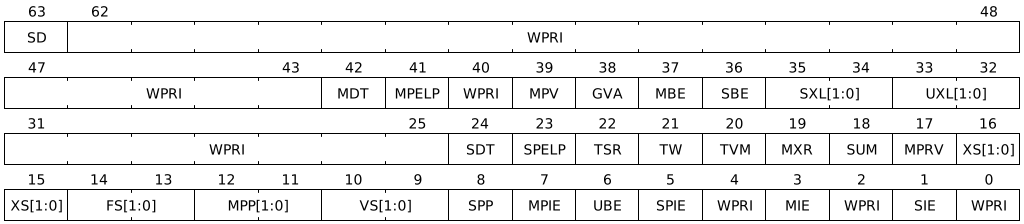
For RV32 only, mstatush is a 32-bit read/write register formatted as shown in Additional machine-mode status (mstatush) register for RV32.
Bits 30:4 of mstatush generally contain the same fields found in bits 62:36 of mstatus for RV64. Fields SD, SXL, and UXL do not exist in mstatush.

3.1.6.1 Privilege and Global Interrupt-Enable Stack in mstatus register
Global interrupt-enable bits, MIE and SIE, are provided for M-mode and
S-mode respectively. These bits are primarily used to guarantee
atomicity with respect to interrupt handlers in the current privilege mode.
The global _x_IE bits are located in the low-order bits of mstatus,
allowing them to be atomically set or cleared with a single CSR
instruction.
When a hart is executing in privilege mode x, interrupts are globally
enabled when _x_IE=1 and globally disabled when _x_IE=0.
Interrupts for lower-privilege modes, w<x,
are always globally disabled regardless of the setting of any global _w_IE bit for the
lower-privilege mode. Interrupts for higher-privilege modes, y>x,
are always globally enabled regardless of the
setting of the global _y_IE bit for the higher-privilege mode.
Higher-privilege-level code can use separate per-interrupt enable bits
to disable selected higher-privilege-mode interrupts before ceding
control to a lower-privilege mode.
MIE and MPIE must be writable.
If supervisor mode is not implemented, then SIE and SPIE are read-only 0;
otherwise, they must be writable.
A higher-privilege mode y could disable all of its interrupts before ceding control to a lower-privilege mode but this would be unusual as it would leave only a synchronous trap, non-maskable interrupt, or reset as means to regain control of the hart.
To support nested traps, each privilege mode x that can respond to
interrupts has a two-level stack of interrupt-enable bits and privilege modes.
_x_PIE holds the value of the interrupt-enable bit active prior
to the trap, and _x_PP holds the previous privilege mode.
The _x_PP fields can only hold privilege modes up to x, so
MPP is two bits wide and SPP is one bit wide.
When a trap is taken from privilege mode y
into privilege mode x, _x_PIE is set to the value of _x_IE; _x_IE is
set to 0; and _x_PP is set to y.
For lower privilege modes, any trap (synchronous or asynchronous) is usually taken at a higher privilege mode with interrupts disabled upon entry. The higher-level trap handler will either service the trap and return using the stacked information, or, if not returning immediately to the interrupted context, will save the privilege stack before re-enabling interrupts, so only one entry per stack is required.
An MRET or SRET instruction is used to return from a trap in M-mode or S-mode respectively.
When executing an _x_RET instruction, supposing
_x_PP holds the value y, _x_IE is set to _x_PIE; the privilege mode is
changed to y; _x_PIE is set to 1; and _x_PP is set to the
least-privileged supported mode (U if U-mode is implemented, else M). If
y≠M, _x_RET also sets MPRV=0.
Setting _x_PP to the least-privileged supported mode on an _x_RET helps identify software bugs in the management of the two-level privilege-mode stack.
Trap handlers must be designed to neither enable interrupts nor cause exceptions during the phase of handling where the trap handler preserves the critical state information required to handle and resume from the trap. An exception or interrupt in this critical phase of trap handling may lead to a trap that can overwrite such critical state. This could result in the loss of data needed to recover from the initial trap. Further, if an exception occurs in the code path needed to handle traps, then such a situation may lead to an infinite loop of traps. To prevent this, trap handlers must be meticulously designed to identify and safely manage exceptions within their operational flow.
_x_PP fields are WARL fields that can hold only privilege mode x and any implemented privilege mode lower than x. If privilege mode x is not implemented, then _x_PP must be read-only 0.
M-mode software can determine whether a privilege mode is implemented by
writing that mode to MPP then reading it back.
If the machine provides only U and M modes, then only a single hardware
storage bit is required to represent either 00 or 11 in MPP.
3.1.6.2 Double Trap Control in mstatus Register
A double trap typically arises during a sensitive phase in trap handling operations — when an exception or interrupt occurs while the trap handler (the component responsible for managing these events) is in a non-reentrant state. This non-reentrancy usually occurs in the early phase of trap handling, wherein the trap handler has not yet preserved the necessary state to handle and resume from the trap. The occurrence of a trap during this phase can lead to an overwrite of critical state information, resulting in the loss of data needed to recover from the initial trap. The trap that caused this critical error condition is henceforth called the unexpected trap. Trap handlers are designed to neither enable interrupts nor cause exceptions during this phase of handling. However, managing Hardware-Error exceptions, which may occur unpredictably, presents significant challenges in trap handler implementation due to the potential risk of a double trap.
The M-mode-disable-trap (MDT) bit is a WARL field introduced by the Smdbltrp extension.
Upon reset, the MDT field is set to 1.
When the MDT bit is set to 1 by an explicit CSR write,
the MIE (Machine Interrupt Enable) bit is cleared to 0.
For RV64, this clearing occurs regardless of the value written, if any, to the MIE bit by the same write.
The MIE bit can only be set to 1 by an
explicit CSR write if the MDT bit is already 0
or, for RV64, is being set to 0 by the same write
(For RV32, the MDT bit is in mstatush and the MIE bit in mstatus register).
When a trap is to be taken into M-mode, if the MDT bit is currently 0, it is then set to 1, and the trap is delivered as expected.
However, if MDT is already set to 1, then this is an unexpected trap.
When the Smrnmi extension
is implemented, a trap caused by an RNMI is not considered an unexpected trap
irrespective of the state of the MDT bit.
A trap caused by an RNMI does not set the MDT bit. However,
a trap that occurs when executing in M-mode with
mnstatus.NMIE set to 0 is an unexpected trap.
In the event of a unexpected trap, the handling is as follows:
- When the Smrnmi extension is implemented and
mnstatus.NMIEis 1, the hart traps to the RNMI handler. To deliver this trap, themnepcandmncauseregisters are written with the values that the unexpected trap would have written to themepcandmcauseregisters respectively. The privilege mode information fields in themnstatusregister are written to indicate M-mode and itsNMIEfield is set to 0.
The consequence of this specification is that on occurrence of double trap the
RNMI handler is not provided with information that a trap reports in the
mtval and the mtval2 registers. This information, if needed, can be obtained
by the RNMI handler by decoding the instruction at the address in mnepc and
examining its source register contents.
- When the
Smrnmiextension is not implemented, or if theSmrnmiextension is implemented andmnstatus.NMIEis 0, the hart enters a critical-error state without updating any architectural state, including thepc. This state involves ceasing execution, disabling all interrupts (including NMIs), and asserting a critical-error signal to the platform. Whether performance counters and timers are updated in the critical-error state is UNSPECIFIED.
The actions performed by the platform when a hart asserts a critical-error signal are platform-specific. The range of possible actions include restarting the affected hart or restarting the entire platform, among others.
When the Smdbltrp extension is implemented, executing an MRET instruction, or executing
an SRET instruction while the current privilege mode is M, has the following additional
effects.
The MDT bit is set to 0.
If the Ssdbltrp extension is also implemented, and the new privilege mode is U, VS, or VU, then sstatus.SDT is also set to 0.
Additionally, if it is VU, then vsstatus.SDT is also set to 0.
When the Smdbltrp extension is implemented, the MNRET instruction, provided by the Smrnmi extension, sets the MDT bit to 0 if the new privilege mode is not M.
If the Ssdbltrp extension is also implemented, and the new privilege mode is U, VS, or VU, then sstatus.SDT is also set to 0.
Additionally, if it is VU, then vsstatus.SDT is also set to 0.
3.1.6.3 Base ISA Control in mstatus Register
For RV64 harts, the SXL and UXL fields are WARL fields that control the
value of XLEN for S-mode and U-mode, respectively.
The encoding of these fields is the same as the MXL field of misa, shown in Table 11.
The effective XLEN in S-mode and U-mode are termed SXLEN and UXLEN, respectively.
When MXLEN=32, the SXL and UXL fields do not exist, and SXLEN=32 and UXLEN=32.
When MXLEN=64, if S-mode is not supported, then SXL is read-only zero.
Otherwise, it is a WARL field that encodes the current value of SXLEN.
In particular, an implementation may make SXL be a read-only field whose
value always ensures that SXLEN=MXLEN.
When MXLEN=64, if U-mode is not supported, then UXL is read-only zero.
Otherwise, it is a WARL field that encodes the current value of UXLEN.
In particular, an implementation may make UXL be a read-only field whose
value always ensures that UXLEN=MXLEN or UXLEN=SXLEN.
If S-mode is implemented, the set of legal values that the UXL field may
assume excludes those that would cause UXLEN to be greater than SXLEN.
Whenever XLEN in any mode is set to a value less than the widest
supported XLEN, all operations must ignore source operand register bits
above the configured XLEN, and must sign-extend results to fill the
entire widest supported XLEN in the destination register.
Similarly, pc bits above XLEN are ignored, and when the pc is written, it is
sign-extended to fill the widest supported XLEN.
We require that operations always fill the entire underlying hardware registers with defined values to avoid implementation-defined behavior.
To reduce hardware complexity, the architecture imposes no checks that lower-privilege modes have XLEN settings less than or equal to the next-higher privilege mode. In practice, such settings would almost always be a software bug, but machine operation is well-defined even in this case.
Some HINT instructions are encoded as integer computational instructions that overwrite their destination register with its current value, e.g., C.ADDI x8, 0. When such a HINT is executed with XLEN < MXLEN and bits MXLEN..XLEN of the destination register not all equal to bit XLEN-1, it is implementation-defined whether bits MXLEN..XLEN of the destination register are unchanged or are overwritten with copies of bit XLEN-1.
This definition allows implementations to elide register write-back for some HINTs, while allowing them to execute other HINTs in the same manner as other integer computational instructions. The implementation choice is observable only by privilege modes with an XLEN setting greater than the current XLEN; it is invisible to the current privilege mode.
3.1.6.4 Memory Privilege in mstatus Register
The MPRV (Modify PRiVilege) bit modifies the effective privilege mode,
i.e., the privilege level at which explicit memory accesses execute.
When MPRV=0, explicit memory accesses
behave as normal, using the translation and
protection mechanisms of the current privilege mode. When MPRV=1, load
and store memory addresses are translated and protected, and endianness
is applied, as though the current privilege mode were set to MPP.
Instruction address-translation and protection are unaffected by the
setting of MPRV.
MPRV is read-only 0 if U-mode is not supported; otherwise, it must be writable.
An MRET or SRET instruction that changes the privilege mode to a mode
less privileged than M also sets MPRV=0.
The MXR (Make eXecutable Readable) bit modifies the privilege with which loads access virtual memory.
When MXR=0, only loads from pages marked readable (R=1 in Sv32 page table entry.) will succeed.
When MXR=1, loads from pages marked either readable or executable (R=1 or
X=1) will succeed. MXR has no effect when page-based virtual memory is not in effect.
MXR is read-only 0 if S-mode is not supported or if satp.MODE is read-only 0; otherwise, it must be writable.
The MPRV and MXR mechanisms were conceived to improve the efficiency of
M-mode routines that emulate missing hardware features, e.g., misaligned
loads and stores. MPRV obviates the need to perform address translation
in software. MXR allows instruction words to be loaded from pages marked
execute-only.
The current privilege mode and the privilege mode specified by MPP might
have different XLEN settings. When MPRV=1, load and store memory
addresses are treated as though the current XLEN were set to MPP’s XLEN,
following the rules in Section 3.1.6.3.
The SUM (permit Supervisor User Memory access) bit modifies the
privilege with which S-mode loads and stores access virtual memory.
When SUM=0, S-mode memory accesses to pages that are accessible by U-mode
(U=1 in Sv32 page table entry.) will fault. When SUM=1, these accesses are permitted.
SUM has no effect when page-based virtual memory is not in effect.
Note that, while SUM is ordinarily ignored when not
executing in S-mode, it is in effect when MPRV=1 and MPP=S.
SUM is read-only 0 if S-mode is not supported or if satp.MODE is read-only 0; otherwise, it must be writable.
The MXR and SUM mechanisms only affect the interpretation of permissions
encoded in page-table entries. In particular, they have no impact on
whether access-fault exceptions are raised due to PMAs or PMP.
3.1.6.5 Endianness Control in mstatus and mstatush Registers
The MBE, SBE, and UBE bits in mstatus and mstatush are WARL fields that
control the endianness of memory accesses other than instruction fetches.
Each may be read/write or read-only.
Instruction fetches are always little-endian.
MBE controls whether non-instruction-fetch memory accesses made from
M-mode (assuming mstatus.MPRV=0) are little-endian (MBE=0) or
big-endian (MBE=1).
If S-mode is not supported, SBE is read-only 0. Otherwise, SBE controls
whether explicit load and store memory accesses made from S-mode are
little-endian (SBE=0) or big-endian (SBE=1).
If U-mode is not supported, UBE is read-only 0. Otherwise, UBE controls
whether explicit load and store memory accesses made from U-mode are
little-endian (UBE=0) or big-endian (UBE=1).
For implicit accesses to supervisor-level memory management data
structures, such as page tables, endianness is always controlled by SBE.
Since changing SBE alters the implementation’s interpretation of these
data structures, if any such data structures remain in use across a
change to SBE, M-mode software must follow such a change to SBE by
executing an SFENCE.VMA instruction with rs1=x0 and rs2=x0.
Only in contrived scenarios will a given memory-management data
structure be interpreted as both little-endian and big-endian. In
practice, SBE will only be changed at runtime on world switches, in
which case neither the old nor new memory-management data structure will
be reinterpreted in a different endianness. In this case, no additional
SFENCE.VMA is necessary, beyond what would ordinarily be required for a
world switch.
If S-mode is supported, an implementation may make SBE be a read-only
copy of MBE.
If U-mode is supported, an implementation may make UBE be a
read-only copy of either MBE or SBE.
An implementation supports only little-endian memory accesses if fields
MBE, SBE, and UBE are all read-only 0. An implementation supports only
big-endian memory accesses (aside from instruction fetches) if MBE is
read-only 1 and SBE and UBE are each read-only 1 when S-mode and U-mode
are supported.
sec:intro-memory defines a hart’s address space as a circular sequence of 2XLEN bytes at consecutive addresses. The correspondence between addresses and byte locations is fixed and not affected by any endianness mode. Rather, the applicable endianness mode determines the order of mapping between memory bytes and a multibyte quantity (halfword, word, etc.).
Standard RISC-V ABIs are expected to be purely little-endian-only or big-endian-only, with no accommodation for mixing endianness. Nevertheless, endianness control has been defined so as to permit, for instance, an OS of one endianness to execute user-mode programs of the opposite endianness. Consideration has been given also to the possibility of non-standard usages whereby software flips the endianness of memory accesses as needed.
RISC-V instructions are uniformly little-endian to decouple instruction encoding from the current endianness settings, for the benefit of both hardware and software. Otherwise, for instance, a RISC-V assembler or disassembler would always need to know the intended active endianness, despite that the endianness mode might change dynamically during execution. In contrast, by giving instructions a fixed endianness, it is sometimes possible for carefully written software to be endianness-agnostic even in binary form, much like position-independent code.
The choice to have instructions be only little-endian does have consequences, however, for RISC-V software that encodes or decodes machine instructions. In big-endian mode, such software must account for the fact that explicit loads and stores have endianness opposite that of instructions, for example by swapping byte order after loads and before stores.
3.1.6.6 Virtualization Support in mstatus Register
The TVM (Trap Virtual Memory) bit is a WARL field that supports intercepting
supervisor virtual-memory management operations. When TVM=1, attempts to
read or write the satp CSR or execute an SFENCE.VMA or SINVAL.VMA
instruction while executing in S-mode will raise an illegal-instruction
exception. When TVM=0, these operations are permitted in S-mode. TVM is
read-only 0 when S-mode is not supported or if satp.MODE is read-only 0;
otherwise, it must be writable.
The TVM mechanism improves virtualization efficiency by permitting guest
operating systems to execute in S-mode, rather than classically
virtualizing them in U-mode. This approach obviates the need to trap
accesses to most S-mode CSRs.
Trapping satp accesses and the SFENCE.VMA and SINVAL.VMA instructions
provides the hooks necessary to lazily populate shadow page tables.
The TW (Timeout Wait) bit is a WARL field that supports intercepting the
WFI instruction (see Section 3.3.3).
When TW=0, the WFI instruction may execute in modes less privileged than M when not prevented for
some other reason. When TW=1, then if WFI is executed in any
less-privileged mode, and it does not complete within an
implementation-specific, bounded time limit, the WFI instruction causes
an illegal-instruction exception.
An implementation may have WFI always
raise an illegal-instruction exception in modes less privileged than M when
TW=1, even if there are pending globally-disabled interrupts when the
instruction is executed.
TW is read-only 0 when there are no modes less privileged than M;
otherwise, it must be writable.
Trapping the WFI instruction can trigger a world switch to another guest OS, rather than wastefully idling in the current guest.
When S-mode is implemented, then executing WFI in U-mode causes an
illegal-instruction exception, regardless of the value of the TW bit, unless the
instruction completes within an implementation-specific, bounded time limit.
The TSR (Trap SRET) bit is a WARL field that supports intercepting the
supervisor exception return instruction, SRET.
When TSR=1, attempts to
execute SRET while executing in S-mode will raise an illegal-instruction
exception. When TSR=0, this operation is permitted in S-mode.
TSR is read-only 0 when S-mode is not supported;
otherwise, it must be writable.
Trapping SRET is necessary to emulate the hypervisor extension (see Section 5) on implementations that do not provide it.
3.1.6.7 Extension Context Status in mstatus Register
Supporting substantial extensions is one of the primary goals of RISC-V, and hence we define a standard interface to allow unchanged privileged-mode code, particularly a supervisor-level OS, to support arbitrary user-mode state extensions.
To date, the V extension is the only standard extension that defines
additional state beyond the floating-point CSR and data registers.
The FS[1:0] and VS[1:0] WARL fields
and the XS[1:0] read-only field are used
to reduce the cost of context save and restore by setting and tracking
the current state of the floating-point unit and any other user-mode
extensions respectively.
The FS field encodes the status of the
floating-point unit state, including the floating-point registers
f0–f31 and the CSRs fcsr, frm, and fflags.
The VS field encodes the status of the
vector extension state, including the vector
registers v0–v31 and the CSRs vcsr, vxrm, vxsat, vstart,
vl, vtype, and vlenb.
The XS field encodes the status of
additional user-mode extensions and associated state.
These fields can be checked by a context switch routine to quickly determine whether a
state save or restore is required. If a save or restore is required,
additional instructions and CSRs are typically required to effect and
optimize the process.
The design anticipates that most context switches will not need to save/restore state in either or both of the floating-point unit or other extensions, so provides a fast check via the SD bit.
The FS, VS, and XS fields use the same status encoding as shown in
Table 13, with the four possible status
values being Off, Initial, Clean, and Dirty.
Table 13. Encoding of FS[1:0], VS[1:0], and XS[1:0] status fields
| Status | FS and VS Meaning | XS Meaning |
|---|---|---|
| 0 | Off | All off |
| 1 | Initial | None dirty or clean, some on |
| 2 | Clean | None dirty, some clean |
| 3 | Dirty | Some dirty |
If the F extension is implemented, the FS field shall not be read-only zero.
If neither the F extension nor S-mode is implemented, then FS is read-only zero.
If S-mode is implemented but the F extension is not,
FS may optionally be read-only zero.
Implementations with S-mode but without the F extension are permitted,
but not required, to make the FS field be read-only zero. Some such
implementations will choose not to have the FS field be read-only
zero, so as to enable emulation of the F extension for both S-mode and
U-mode via invisible traps into M-mode.
If the v registers are implemented, the VS field shall not be read-only zero.
If neither the v registers nor S-mode is implemented, then VS is
read-only zero.
If S-mode is implemented but the v registers are not,
VS may optionally be read-only zero.
In harts without additional user extensions requiring new state, the
XS field is read-only zero.
Every additional extension with state
provides a CSR field that encodes the equivalent of the XS states.
The XS field represents a summary of all extensions' status as shown in
Table 13.
The XS field effectively reports the maximum status value across all
user-extension status fields, though individual extensions can use a
different encoding than XS.
The SD bit is a read-only bit that
summarizes whether either the FS, VS,
or XS fields signal the presence of some dirty state that will require
saving extended user context to memory.
If FS, VS, and XS are all read-only zero, then SD is also always zero.
When an extension’s status is set to Off, any instruction that attempts to read or write the corresponding state will cause an illegal-instruction exception. When the status is Initial, the corresponding state should have an initial constant value. When the status is Clean, the corresponding state is potentially different from the initial value, but matches the last value stored on a context swap. When the status is Dirty, the corresponding state has potentially been modified since the last context save.
During a context save, the responsible privileged code need only write out the corresponding state if its status is Dirty, and can then reset the extension’s status to Clean. During a context restore, the context need only be loaded from memory if the status is Clean (it should never be Dirty at restore). If the status is Initial, the context must be set to an initial constant value on context restore to avoid a security hole, but this can be done without accessing memory. For example, the floating-point registers can all be initialized to the immediate value 0.
The FS, VS, and XS fields are read by the privileged code
before saving the context.
The FS and VS fields are set directly by privileged code when
resuming a user context, while the XS field is set indirectly by
writing to the status register of the individual extensions.
The status fields are
also updated during execution of instructions, regardless of privilege mode.
Extensions to the user-mode ISA often include additional user-mode state, and this state can be considerably larger than the base integer registers. The extensions might only be used for some applications, or might only be needed for short phases within a single application. To improve performance, the user-mode extension can define additional instructions to allow user-mode software to return the unit to an initial state or even to turn off the unit.
For example, a coprocessor might require to be configured before use and can be unconfigured after use. The unconfigured state would be represented as the Initial state for context save. If the same application remains running between the unconfigure and the next configure (which would set status to Dirty), there is no need to actually reinitialize the state at the unconfigure instruction, as all state is local to the user process, i.e., the Initial state may only cause the coprocessor state to be initialized to a constant value at context restore, not at every unconfigure.
Executing a user-mode instruction to disable a unit and place it into the Off state will cause an illegal-instruction exception to be raised if any subsequent instruction tries to use the unit before it is turned back on. A user-mode instruction to turn a unit on must also ensure the unit’s state is properly initialized, as the unit might have been used by another context meantime.
Changing the setting of FS has no effect on the contents of the
floating-point register state. In particular, setting FS=Off does not
destroy the state, nor does setting FS=Initial clear the contents. Similarly,
the setting of VS has no effect on the contents of the vector
register state.
Other extensions, however, might not preserve state when set to Off.
Implementations may choose to track the dirtiness of the floating-point
register state imprecisely by reporting the state to be dirty even when
it has not been modified.
On some implementations, some instructions
that do not mutate the floating-point state may cause the state to
transition from Initial or Clean to Dirty.
On other implementations,
dirtiness might not be tracked at all, in which case the valid FS states
are Off and Dirty, and an attempt to set FS to Initial or Clean causes
it to be set to Dirty.
This definition of FS does not disallow setting FS to Dirty as a result
of errant speculation. Some platforms may choose to disallow
speculatively writing FS to close a potential side channel.
If an instruction explicitly or implicitly writes a floating-point
register or the fcsr but does not alter its contents, and FS=Initial
or FS=Clean, it is implementation-defined whether FS transitions to
Dirty.
Implementations may choose to track the dirtiness of the vector register
state in an analogous imprecise fashion, including possibly setting
VS to Dirty when software attempts to set VS=Initial or VS=Clean.
When VS=Initial or VS=Clean, it is implementation-defined whether an
instruction that writes a vector register or vector CSR but does not
alter its contents causes VS to transition to Dirty.
Table 14 shows all the possible state
transitions for the FS, VS, or XS status bits. Note that the standard
floating-point and vector extensions do not support user-mode
unconfigure or disable/enable instructions.
Table 14. FS, VS, and XS state transitions
| Action | Off | Initial | Clean | Dirty |
| At context save in privileged code | ||||
|---|---|---|---|---|
| Next state | Off | Initial | Clean | Clean |
| At context restore in privileged code | ||||
|---|---|---|---|---|
| Next state | Off | Initial | Clean | N/A |
| Execute instruction to read state | ||||
|---|---|---|---|---|
| Next state | Off | Initial | Clean | Dirty |
| Execute instruction that possibly modifies state, including configuration | ||||
|---|---|---|---|---|
| Next state | Off | Dirty | Dirty | Dirty |
| Execute instruction to unconfigure unit | ||||
|---|---|---|---|---|
| Next state | Off | Initial | Initial | Initial |
| Execute instruction to disable unit | ||||
|---|---|---|---|---|
| Next state | Off | Off | Off | Off |
| Execute instruction to enable unit | ||||
|---|---|---|---|---|
| Next state | Initial | Initial | Initial | Initial |
Standard privileged instructions to initialize, save, and restore extension state are provided to insulate privileged code from details of the added extension state by treating the state as an opaque object.
Many coprocessor extensions are only used in limited contexts that allows software to safely unconfigure or even disable units when done. This reduces the context-switch overhead of large stateful coprocessors.
We separate out floating-point state from other extension state, as when a floating-point unit is present the floating-point registers are part of the standard calling convention, and so user-mode software cannot know when it is safe to disable the floating-point unit.
The XS field provides a summary of all added extension state, but
additional microarchitectural bits might be maintained in the extension
to further reduce context save and restore overhead.
The SD bit is read-only and is set when either the FS, VS, or XS bits
encode a Dirty state (i.e., SD=(FS==0b11 OR XS==0b11 OR VS==0b11)). This
allows privileged code to quickly determine when no additional context
save is required beyond the integer register set and pc.
The floating-point unit state is always initialized, saved, and restored
using standard instructions (F, D, and/or Q), and privileged code must
be aware of FLEN to determine the appropriate space to reserve for each
f register.
Machine and Supervisor modes share a single copy of the FS, VS, and XS
bits. Supervisor-level software normally uses the FS, VS, and XS bits
directly to record the status with respect to the supervisor-level saved
context. Machine-level software must be more conservative in saving and
restoring the extension state in their corresponding version of the
context.
In any reasonable use case, the number of context switches between user and supervisor level should far outweigh the number of context switches to other privilege levels. Note that coprocessors should not require their context to be saved and restored to service asynchronous interrupts, unless the interrupt results in a user-level context swap.
3.1.6.8 Previous Expected Landing Pad (ELP) State in mstatus Register
The Zicfilp extension adds the SPELP and MPELP fields that hold the previous
ELP, and are updated as specified in Section 6.9.1.2.
The xPELP fields are encoded as follows:
- 0 -
NO_LP_EXPECTED- no landing pad instruction expected. - 1 -
LP_EXPECTED- a landing pad instruction is expected.
3.1.7 Machine Trap-Vector Base-Address (mtvec) Register
The mtvec register is an MXLEN-bit WARL read/write register that holds
trap vector configuration, consisting of a vector base address (BASE)
and a vector mode (MODE).

The mtvec register must always be implemented, but
can contain a read-only value.
If mtvec is writable, the set of values the register
may hold can vary by implementation.
The value in the BASE field must
always be aligned on a 4-byte boundary, and
the MODE setting may impose
additional alignment constraints on the value in the BASE field.
Note that the CSR contains only bits XLEN-1 through 2 of the address BASE.
When used as an address, the lower two bits are filled with zeroes to obtain
an XLEN-bit address that is always aligned on a 4-byte boundary.
We allow for considerable flexibility in implementation of the trap vector base address. On the one hand, we do not wish to burden low-end implementations with a large number of state bits, but on the other hand, we wish to allow flexibility for larger systems.
Table 15. Encoding of mtvec.MODE field
| Value | Name | Description |
|---|---|---|
| 0 | Direct | All traps set pc to BASE. |
| 1 | Vectored | Asynchronous interrupts set pc to BASE+4×cause. |
| ≥2 | — | Reserved |
The encoding of the MODE field is shown in Table 15.
When MODE=Direct, all traps into
machine mode cause the pc to be set to the address in the BASE field.
When MODE=Vectored, all synchronous exceptions into machine mode cause
the pc to be set to the address in the BASE field, whereas interrupts
cause the pc to be set to the address in the BASE field plus four
times the interrupt cause number.
For example, a machine-mode timer interrupt (see Table 16) causes the pc to be set to BASE+0x1c.
An implementation may have different alignment constraints for different
modes. In particular, MODE=Vectored may have stricter alignment
constraints than MODE=Direct.
Allowing coarser alignments in Vectored mode enables vectoring to be implemented without a hardware adder circuit.
Reset and NMI vector locations are given in a platform specification.
3.1.8 Machine Trap Delegation (medeleg and mideleg) Registers
By default, all traps at any privilege level are handled in machine
mode, though a machine-mode handler can redirect traps back to the
appropriate level with the MRET instruction (Section 3.3.2). To increase performance,
implementations can provide individual read/write bits within
medeleg and mideleg to indicate that certain exceptions and interrupts should
be processed directly by a lower privilege level.
The machine exception delegation register (medeleg) is a 64-bit read/write register.
The machine interrupt delegation (mideleg) register is an MXLEN-bit
read/write register.
In harts with S-mode, the medeleg and mideleg registers must
exist, and setting a bit in medeleg or mideleg will delegate the
corresponding trap, when occurring in S-mode or U-mode, to the S-mode
trap handler.
In harts without S-mode, the medeleg and mideleg registers should not exist.
In versions 1.9.1 and earlier, these registers existed but were
hardwired to zero in M-mode only, or M/U without N harts. There is no
reason to require they return zero in those cases, as the misa
register indicates whether they exist.
When a trap is delegated to S-mode,
the scause register is written
with the trap cause; the sepc register is written with the virtual
address of the instruction that took the trap; the stval register is
written with an exception-specific datum; the SPP field of mstatus is
written with the active privilege mode at the time of the trap; the
SPIE field of mstatus is written with the value of the SIE field at the
time of the trap; and the SIE field of mstatus is cleared.
The mcause, mepc, and mtval registers and the MPP and MPIE fields of
mstatus are not written.
An implementation can choose to subset the delegatable traps, with the
supported delegatable bits found by writing one to every bit location,
then reading back the value in medeleg or mideleg to see which bit
positions hold a one.
An implementation shall not have any bits of medeleg be read-only one,
i.e., any synchronous trap that can be delegated must support not being delegated.
Similarly,
an implementation shall not fix as read-only one
any bits of mideleg corresponding to machine-level interrupts
(but may do so for lower-level interrupts).
Version 1.11 and earlier prohibited having any bits of mideleg be
read-only one. Platform standards may always add such restrictions.
Traps never transition from a more-privileged mode to a less-privileged mode. For example, if M-mode has delegated illegal-instruction exceptions to S-mode, and M-mode software later executes an illegal instruction, the trap is taken in M-mode, rather than being delegated to S-mode. By contrast, traps may be taken horizontally. Using the same example, if M-mode has delegated illegal-instruction exceptions to S-mode, and S-mode software later executes an illegal instruction, the trap is taken in S-mode.
Delegated interrupts result in the interrupt being masked at the
delegator privilege level. For example, if the supervisor timer
interrupt (STI) is delegated to S-mode by setting mideleg[5], STIs
will not be taken when executing in M-mode. By contrast, if mideleg[5]
is clear, STIs can be taken in any mode and regardless of current mode
will transfer control to M-mode.

medeleg has a bit position allocated for every synchronous exception
shown in Table 16, with the index of the
bit position equal to the value returned in the mcause register
(i.e., setting bit 8 allows user-mode environment calls to be delegated to a
lower-privilege trap handler).
When XLEN=32, medelegh is a 32-bit read/write register
that aliases bits 63:32 of medeleg.
The medelegh register does not exist when XLEN=64.

mideleg holds trap delegation bits for individual interrupts, with the
layout of bits matching those in the mip register (i.e., STIP
interrupt delegation control is located in bit 5).
For exceptions that cannot occur in less privileged modes, the
corresponding medeleg bits should be read-only zero. In particular,
medeleg[11] is read-only zero.
The medeleg[16] is read-only zero as double trap is not delegatable.
3.1.9 Machine Interrupt (mip and mie) Registers
The mip register is an MXLEN-bit read/write register containing
information on pending interrupts, while mie is the corresponding
MXLEN-bit read/write register containing interrupt enable bits.
Interrupt cause number i (as reported in CSR mcause,
Section 3.1.15) corresponds with bit i in both mip and mie.
Bits 15:0 are allocated to standard interrupt causes only, while
bits 16 and above are designated for platform use.
Interrupts designated for platform use may be designated for custom use at the platform’s discretion.
An interrupt i will trap to M-mode (causing the privilege mode to
change to M-mode) if all of the following are true: (a) either the
current privilege mode is M and the MIE bit in the mstatus register is
set, or the current privilege mode has less privilege than M-mode;
(b) bit i is set in both mip and mie; and (c) if register
mideleg exists, bit i is not set in mideleg.
These conditions for an interrupt trap to occur must be evaluated in a
bounded amount of time from when an interrupt becomes, or ceases to be,
pending in mip, and must also be evaluated immediately following the
execution of an _x_RET instruction or an explicit write to a CSR on
which these interrupt trap conditions expressly depend (including mip,
mie, mstatus, and mideleg).
Interrupts to M-mode take priority over any interrupts to lower privilege modes.
The mip register must always be implemented,
but can contain read-only zeros in any position, indicating that interrupt
can never become pending.
Each individual bit in register mip may be writable or may be read-only.
When bit i in mip is writable, a pending interrupt i
can be cleared by writing 0 to this bit.
If interrupt i can become pending but bit i in mip is read-only, the implementation must
provide some other mechanism for clearing the pending interrupt.
The mie register must always be implemented.
A bit in mie must be writable if the corresponding interrupt can ever become pending.
Bits of mie that are not writable must be read-only zero.
The standard portions (bits 15:0) of the mip and mie registers are
formatted as shown in Standard portion (bits 15:0) of mip and Standard portion (bits 15:0) of mie respectively.


The machine-level interrupt registers handle a few root interrupt sources which are assigned a fixed service priority for simplicity, while separate external interrupt controllers can implement a more complex prioritization scheme over a much larger set of interrupts that are then multiplexed into the machine-level interrupt sources.
The non-maskable interrupt is not made visible via the mip register as
its presence is implicitly known when executing the NMI trap handler.
Bits mip.MEIP and mie.MEIE are the interrupt-pending and
interrupt-enable bits for machine-level external interrupts.
MEIP is read-only in mip, and is set and cleared by a platform-specific
interrupt controller.
Bits mip.MTIP and mie.MTIE are the interrupt-pending and
interrupt-enable bits for machine timer interrupts.
MTIP is read-only in the mip register, and is cleared by writing to
the memory-mapped machine-mode timer compare register.
Bits mip.MSIP and mie.MSIE are the interrupt-pending and
interrupt-enable bits for machine-level software interrupts.
MSIP is read-only in mip, and is written by accesses to memory-mapped control
registers, which are used to provide machine-level interprocessor interrupts.
A hart’s memory-mapped msip register is a 32-bit read/write register,
where bits 31–1 read as zero and bit 0 contains the MSIP bit.
When the memory-mapped msip register changes, it is guaranteed to be
reflected in mip.MSIP eventually, but not necessarily immediately.
If a system has only one hart, or
if a platform standard supports the delivery of machine-level
interprocessor interrupts through external interrupts (MEI) instead,
then mip.MSIP and mie.MSIE may both be read-only zeros.
If supervisor mode is not implemented, bits SEIP, STIP, and SSIP of
mip and SEIE, STIE, and SSIE of mie are read-only zeros.
If supervisor mode is implemented, bits mip.SEIP and mie.SEIE are
the interrupt-pending and interrupt-enable bits for supervisor-level external interrupts.
SEIP is writable in mip, and may be written by
M-mode software to indicate to S-mode that an external interrupt is
pending. Additionally, the platform-level interrupt controller may
generate supervisor-level external interrupts.
Supervisor-level external interrupts are made pending based on the logical-OR of the
software-writable SEIP bit and the signal from the external interrupt controller.
When mip is read with a CSR instruction, the value of the
SEIP bit returned in the rd destination register is the logical-OR of
the software-writable bit and the interrupt signal from the interrupt
controller, but the signal from the interrupt controller is not used to
calculate the value written to SEIP. Only the software-writable SEIP bit
participates in the read-modify-write sequence of a CSRRS or CSRRC instruction.
For example, if we name the software-writable SEIP bit B and the
signal from the external interrupt controller E, then if
CSRRS t0, mip, t1 is executed, t0[9] is written with B || E, then
B is written with B || t1[9]. If CSRRW t0, mip, t1 is executed,
then t0[9] is written with B || E, and B is simply written with
t1[9]. In neither case does B depend upon E.
The SEIP field behavior is designed to allow a higher privilege layer to
mimic external interrupts cleanly, without losing any real external
interrupts. The behavior of the CSR instructions is slightly modified
from regular CSR accesses as a result.
If supervisor mode is implemented, its mip.STIP and mie.STIE are
the interrupt-pending and interrupt-enable bits for supervisor-level timer interrupts.
If the stimecmp register is not implemented, STIP is writable in
mip, and may be written by M-mode software to deliver timer interrupts to
S-mode. If the stimecmp (supervisor-mode timer compare) register is
implemented, STIP is read-only in mip and reflects the supervisor-level timer
interrupt signal resulting from stimecmp. This timer interrupt signal is
cleared by writing stimecmp with a value greater than the current time value.
If supervisor mode is implemented, bits mip.SSIP and mie.SSIE are
the interrupt-pending and interrupt-enable bits for supervisor-level software interrupts.
SSIP is writable in mip and may also be set to 1
by a platform-specific interrupt controller.
If the Sscofpmf extension is implemented, bits mip.LCOFIP and
mie.LCOFIE are the interrupt-pending and interrupt-enable bits for local-counter-overflow interrupts.
LCOFIP is read-write in mip and reflects the occurrence of a local
counter-overflow overflow interrupt request resulting from any of the mhpmevent_n_.OF bits being set.
If the Sscofpmf extension is not implemented, mip.LCOFIP and mie.LCOFIE are
read-only zeros.
Multiple simultaneous interrupts destined for M-mode are handled in the following decreasing priority order: MEI, MSI, MTI, SEI, SSI, STI, LCOFI.
The machine-level interrupt fixed-priority ordering rules were developed with the following rationale.
Interrupts for higher privilege modes must be serviced before interrupts for lower privilege modes to support preemption.
The platform-specific machine-level interrupt sources in bits 16 and above have platform-specific priority, but are typically chosen to have the highest service priority to support very fast local vectored interrupts.
External interrupts are handled before internal (timer/software) interrupts as external interrupts are usually generated by devices that might require low interrupt service times.
Software interrupts are handled before internal timer interrupts,
because internal timer interrupts are usually intended for time slicing,
where time precision is less important, whereas software interrupts are
used for inter-processor messaging. Software interrupts can be avoided
when high-precision timing is required, or high-precision timer
interrupts can be routed via a different interrupt path. Software
interrupts are located in the lowest four bits of mip as these are
often written by software, and this position allows the use of a single
CSR instruction with a five-bit immediate.
Restricted views of the mip and mie registers appear as the sip
and sie registers for supervisor level. If an interrupt is delegated
to S-mode by setting a bit in the mideleg register, it becomes visible
in the sip register and is maskable using the sie register.
Otherwise, the corresponding bits in sip and sie are read-only zero.
3.1.10 Hardware Performance Monitor
M-mode includes a basic hardware performance-monitoring facility.
The mcycle CSR counts the number of clock cycles executed by the processor
core on which the hart is running.
The minstret CSR counts the number of instructions the hart has retired.
The mcycle and minstret registers have 64-bit precision on all RV32 and RV64 harts.
The counter registers have an arbitrary value after the hart is reset,
and can be written with a given value.
Any CSR write takes effect after the writing instruction has otherwise completed.
The mcycle CSR may be
shared between harts on the same core, in which case writes to
mcycle will be visible to those harts. The platform should provide a mechanism
to indicate which harts share an mcycle CSR.
The hardware performance monitor includes 29 additional 64-bit event
counters, mhpmcounter3–mhpmcounter31.
The event selector CSRs,
mhpmevent3–mhpmevent31, are 64-bit WARL registers that control which
event causes the corresponding counter to increment.
The meaning of these events is defined by the platform,
but event 0 is defined to mean no event.
All counters should be implemented, but
a legal implementation is to make both the counter and its corresponding event selector be read-only 0.
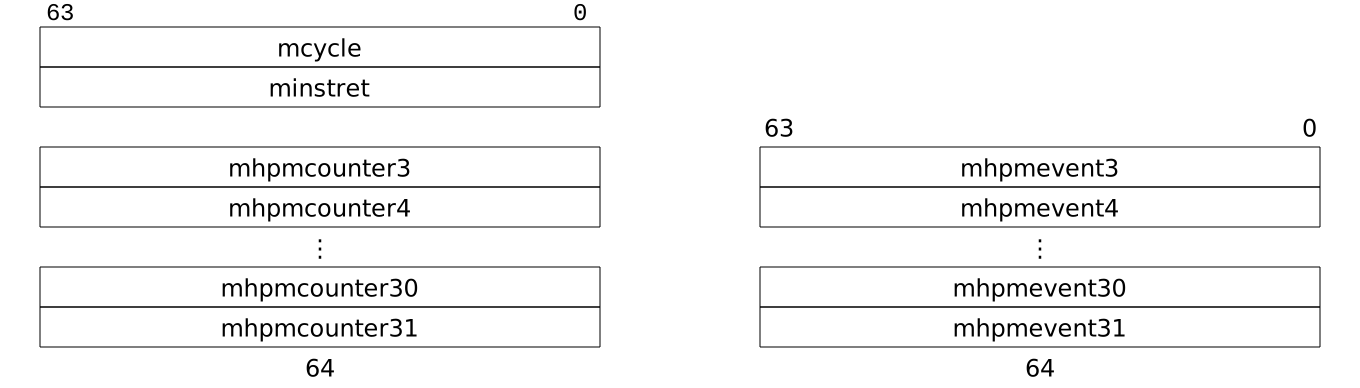
The mhpmcounters are WARL registers that
support up to 64 bits of precision on RV32 and RV64.
When XLEN=32, reads of the mcycle, minstret, mhpmcounter_n_, and mhpmevent_n_
CSRs return bits 31-0 of the corresponding register, and writes change only bits 31-0;
reads of the mcycleh, minstreth, mhpmcounter_n_h, and mhpmevent_n_h
CSRs return bits 63-32 of the corresponding register, and writes change only bits 63-32.
The mhpmevent_n_h CSRs are provided only if the Sscofpmf extension is implemented.
3.1.11 Machine Counter-Enable (mcounteren) Register
The counter-enable mcounteren register is a 32-bit register that
controls the availability of the hardware performance-monitoring
counters to the next-lower privileged mode.

The settings in this register only control accessibility. The act of reading or writing this register does not affect the underlying counters, which continue to increment even when not accessible.
When the CY, TM, IR, or HPM_n_ bit in the mcounteren register is
clear, attempts to read the cycle, time, instret, or
hpmcounter_n_ register while executing in S-mode or U-mode will cause an
illegal-instruction exception.
When one of these bits is set, access to
the corresponding register is permitted in the next implemented
privilege mode (S-mode if implemented, otherwise U-mode).
The counter-enable bits support two common use cases with minimal hardware. For harts that do not need high-performance timers and counters, machine-mode software can trap accesses and implement all features in software. For harts that need high-performance timers and counters but are not concerned with obfuscating the underlying hardware counters, the counters can be directly exposed to lower privilege modes.
In addition, when the csr:[tm] bit in the mcounteren register is clear, attempts to
access the stimecmp or vstimecmp register while executing in a mode less
privileged than M will cause an illegal-instruction exception.
When this bit is set, access to the stimecmp or vstimecmp register is permitted in S-mode
if implemented, and access to the vstimecmp register (via stimecmp) is
permitted in VS-mode if implemented and not otherwise prevented by the TM bit in
hcounteren.
The cycle, instret, and hpmcounter_n_ CSRs are read-only shadows of mcycle, minstret, and mhpmcounter_n_, respectively.
The time CSR is a read-only shadow of the memory-mapped mtime register.
Analogously, when XLEN=32, the cycleh, instreth and hpmcounter_n_h CSRs
are read-only shadows of mcycleh, minstreth and mhpmcounter_n_h, respectively.
When XLEN=32, the timeh CSR is a read-only shadow of the
upper 32 bits of the memory-mapped mtime register, while time
shadows only the lower 32 bits of mtime.
Implementations can convert reads of the time and timeh CSRs into
loads to the memory-mapped mtime register, or emulate this
functionality on behalf of less-privileged modes in M-mode software.
In harts with U-mode, the mcounteren must be
implemented, but all fields are WARL and
may be read-only zero, indicating reads to the
corresponding counter will cause an illegal-instruction exception when
executing in a less-privileged mode.
In harts without U-mode, the mcounteren register should not exist.
3.1.12 Machine Counter-Inhibit (mcountinhibit) Register

The counter-inhibit register mcountinhibit is a 32-bit
WARL register that controls which of the hardware performance-monitoring counters increment.
The settings in this register only control whether the
counters increment; their accessibility is not affected by the setting
of this register.
When the CY, IR, or HPM_n_ bit in the mcountinhibit register is clear,
the mcycle, minstret, or mhpmcounter_n_ register increments as usual.
When the CY, IR, or HPM_n_ bit is set, the corresponding counter does
not increment.
The mcycle CSR may be shared between harts on the same core,
in which case the mcountinhibit.CY field is also shared between those harts,
and so writes to mcountinhibit.CY will be visible to those harts.
If the mcountinhibit register is not implemented, the implementation
behaves as though the register were set to zero.
When the mcycle and minstret counters are not needed, it is desirable
to conditionally inhibit them to reduce energy consumption. Providing a
single CSR to inhibit all counters also allows the counters to be
atomically sampled.
Because the mtime counter can be shared between multiple cores, it
cannot be inhibited with the mcountinhibit mechanism.
3.1.13 Machine Scratch (mscratch) Register
The mscratch register is an MXLEN-bit read/write register dedicated
for use by machine mode. The mscratch register must be implemented.
Typically, it is used to hold a pointer to a
machine-mode hart-local context space and swapped with a user register
upon entry to an M-mode trap handler.

The MIPS ISA allocated two user registers (k0/k1) for use by the
operating system. Although the MIPS scheme provides a fast and simple
implementation, it also reduces available user registers, and does not
scale to further privilege levels, or nested traps. It can also require
both registers are cleared before returning to user level to avoid a
potential security hole and to provide deterministic debugging behavior.
The RISC-V user ISA was designed to support many possible privileged
system environments and so we did not want to infect the user-level ISA
with any OS-dependent features. The RISC-V CSR swap instructions can
quickly save/restore values to the mscratch register. Unlike the MIPS
design, the OS can rely on holding a value in the mscratch register
while the user context is running.
3.1.14 Machine Exception Program Counter (mepc) Register
mepc is an MXLEN-bit read/write register formatted as shown in Machine exception program counter register..
The low bit of mepc (mepc[0]) is always zero. On implementations that support only IALIGN=32, the two low bits (mepc[1:0]) are always zero.
If an implementation allows IALIGN to be either 16 or 32 (by changing
CSR misa, for example), then, whenever IALIGN=32, bit mepc[1] is
masked on reads so that it appears to be 0. This masking occurs also for
the implicit read by the MRET instruction. Though masked, mepc[1]
remains writable when IALIGN=32.
mepc is a WARL register that must be implemented and
must be able to hold all valid virtual
addresses. It need not be capable of holding all possible invalid addresses.
Prior to writing mepc, implementations may convert an
invalid address into some other invalid address that mepc is capable of holding.
When address translation is not in effect, virtual addresses and
physical addresses are equal. Hence, the set of addresses mepc must be
able to represent includes the set of physical addresses that can be
used as a valid pc or effective address.
When a trap is taken into M-mode, mepc is written with the virtual
address of the instruction that was interrupted or that encountered the
exception. Otherwise, mepc is never written by the implementation,
though it may be explicitly written by software.

3.1.15 Machine Cause (mcause) Register
The mcause register is an MXLEN-bit read-write register formatted as
shown in Machine Cause (mcause) register.. The mcause register must be implemented.
When a trap is taken into
M-mode, mcause is written with a code indicating the event that
caused the trap. Otherwise, mcause is never written by the
implementation, though it may be explicitly written by software.
The Interrupt bit in the mcause register is set if the trap was
caused by an interrupt.
The Exception Code field contains a code identifying
the last exception or interrupt.
Table 16 lists the possible machine-level exception codes.
The Exception Code is a WLRL field, so is only guaranteed to hold supported exception codes.

Note that load and load-reserved instructions generate load exceptions, whereas store, store-conditional, and AMO instructions generate store/AMO exceptions.
Interrupts can be separated from other traps with a single branch on the
sign of the mcause register value. A shift left can remove the
interrupt bit and scale the exception codes to index into a trap vector
table.
We do not distinguish privileged instruction exceptions from illegal-instruction exceptions. This simplifies the architecture and also hides details of which higher-privilege instructions are supported by an implementation. The privilege level servicing the trap can implement a policy on whether these need to be distinguished, and if so, whether a given opcode should be treated as illegal or privileged.
If an instruction may raise multiple synchronous exceptions, the
decreasing priority order of Table 17 indicates which
exception is taken and reported in mcause.
The priority of any custom synchronous exceptions is implementation-defined.
Table 16. Machine cause (mcause) register values after trap.
| Interrupt | Exception Code | Description |
|---|---|---|
| 1 | 3 | Machine software interrupt |
| 1 | 7 | Machine timer interrupt |
| 1 | 11 | Machine external interrupt |
| 1 | ≥16 | Designated for platform use |
| 0 | ≥64 | Reserved |
Table 17. Synchronous exception priority in decreasing priority order.
| Priority | Exc.Code | Description |
|---|---|---|
| Highest | 3 | Instruction address breakpoint |
| 12, 1 | First encountered page fault or access fault | |
| 1 | Instruction access fault | |
| 3 | Load/store/AMO address breakpoint | |
| 4,6 | Load/store/AMO address misaligned | |
| 13, 15, 5, 7 | First encountered page fault or access fault | |
| 5,7 | Load/store/AMO access fault | |
| Lowest | 4,6 | Load/store/AMO address misaligned |
When a virtual address is translated into a physical address, the address translation algorithm determines what specific exception may be raised.
Load/store/AMO address-misaligned exceptions may have either higher or lower priority than load/store/AMO page-fault and access-fault exceptions.
The relative priority of load/store/AMO address-misaligned and page-fault exceptions is implementation-defined to flexibly cater to two design points. Implementations that never support misaligned accesses can unconditionally raise the misaligned-address exception without performing address translation or protection checks. Implementations that support misaligned accesses only to some physical addresses must translate and check the address before determining whether the misaligned access may proceed, in which case raising the page-fault exception or access is more appropriate.
Instruction address breakpoints have the same cause value as, but different priority than, data address breakpoints (a.k.a. watchpoints) and environment break exceptions (which are raised by the EBREAK instruction).
Instruction address-misaligned exceptions are raised by control-flow instructions with misaligned targets, rather than by the act of fetching an instruction. Therefore, these exceptions have lower priority than other instruction address exceptions.
A software-check exception is a synchronous exception that is triggered when
there are violations of checks and assertions defined by ISA extensions that
aim to safeguard the integrity of software assets, including e.g. control-flow
and memory-access constraints. When this exception is raised, the _x_tval
register is set either to 0 or to an informative value defined by the extension
that stipulated the exception be raised. The priority of this exception,
relative to other synchronous exceptions, depends on the cause of this exception
and is defined by the extension that stipulated the exception be raised.
A hardware-error exception is a synchronous exception triggered when corrupted or
uncorrectable data is accessed explicitly or implicitly by an instruction. In
this context, data encompasses all types of information used within a RISC-V
hart. Upon a hardware-error exception, the _x_epc register is set to the
address of the instruction that attempted to access corrupted data, while the
_x_tval register is set either to 0 or to the virtual address of an
instruction fetch, load, or store that attempted to access corrupted data. The
priority of hardware-error exception is implementation-defined, but any given
occurrence is generally expected to be recognized at the point in the overall
priority order at which the hardware error is discovered.
3.1.16 Machine Trap Value (mtval) Register
The mtval register is an MXLEN-bit read-write register formatted as
shown in Machine Trap Value (mtval) register..
When a trap is taken into M-mode,
mtval is either set to zero or written with exception-specific
information to assist software in handling the trap. Otherwise, mtval
is never written by the implementation, though it may be explicitly
written by software.
The hardware platform will specify which exceptions
must set mtval informatively, which may unconditionally set it to
zero, and which may exhibit either behavior, depending on the underlying event
that caused the exception.
The mtval register must always be implemented. If the
hardware platform specifies that no exceptions set mtval
to a nonzero value, then mtval is read-only zero.
If mtval is written with a nonzero value when a breakpoint,
address-misaligned, access-fault, page-fault, or hardware-error exception
occurs on an instruction fetch, load, or store, then mtval will contain the
faulting virtual address.
On a breakpoint exception raised by an EBREAK or C.EBREAK instruction, mtval
is written with either zero or the virtual address of the instruction.
For breakpoint exceptions raised by [C.]EBREAK, the virtual address of
the instruction is already recorded in mepc.
Recording the same address in mtval is redundant; the option is provided for
backwards compatibility.
When page-based virtual memory is enabled, mtval is written with the
faulting virtual address, even for physical-memory access-fault exceptions.
This design reduces datapath cost for most implementations,
particularly those with hardware page-table walkers.

If mtval is written with a nonzero value when a misaligned load or
store causes an access-fault, page-fault, or hardware-error exception, then mtval will
contain the virtual address of the portion of the access that caused the fault.
If mtval is written with a nonzero value when an instruction
access-fault, page-fault, or hardware-error exception occurs on a hart with
variable-length instructions, then mtval will contain the virtual
address of the portion of the instruction that caused the fault, while
mepc will point to the beginning of the instruction.
The mtval register can optionally also be used to return the faulting
instruction bits on an illegal-instruction exception (mepc points to
the faulting instruction in memory). If mtval is written with a
nonzero value when an illegal-instruction exception occurs, then mtval
will contain the shortest of:
- the actual faulting instruction
- the first ILEN bits of the faulting instruction
- the first MXLEN bits of the faulting instruction
The value loaded into mtval on an illegal-instruction exception is
right-justified and all unused upper bits are cleared to zero.
Capturing the faulting instruction in mtval reduces the overhead of
instruction emulation, potentially avoiding several partial instruction
loads if the instruction is misaligned, and likely data cache misses or
slow uncached accesses when loads are used to fetch the instruction into
a data register. There is also a problem of atomicity if another agent
is manipulating the instruction memory, as might occur in a dynamic
translation system.
A requirement is that the entire instruction (or at least the first
MXLEN bits) are fetched into mtval before taking the trap. This should
not constrain implementations, which would typically fetch the entire
instruction before attempting to decode the instruction, and avoids
complicating software handlers.
A value of zero in mtval signifies either that the feature is not
supported, or an illegal zero instruction was fetched. A load from the
instruction memory pointed to by mepc can be used to distinguish these
two cases (or alternatively, the system configuration information can be
interrogated to install the appropriate trap handling before runtime).
On a trap caused by a software-check exception, the mtval register holds
the cause for the exception. The following encodings are defined:
- 0 - No information provided.
- 2 - Landing Pad Fault. Defined by the Zicfilp extension (Section 6.9.1).
- 3 - Shadow Stack Fault. Defined by the Zicfiss extension (Section 6.9.2).
For other traps, mtval is set to zero, but a future standard may
redefine mtval’s setting for other traps.
If mtval is not read-only zero, it is a WARL register that
must be able to hold all valid virtual addresses and the value zero.
It need not be capable of holding all possible invalid addresses.
Prior to writing mtval, implementations may convert an invalid address
into some other invalid address that mtval is capable of holding.
If the feature to return the faulting instruction bits is implemented,
mtval must also be able to hold all values less than 2N, where
N is the smaller of MXLEN and ILEN.
3.1.17 Machine Configuration Pointer (mconfigptr) Register
The mconfigptr register is an MXLEN-bit read-only CSR formatted as shown in Machine Configuration Pointer (mconfigptr) register., that
holds the physical address of a configuration data structure.
Software can traverse this data structure to discover information about the harts, the platform,
and their configuration.

The pointer alignment in bits must be no smaller than MXLEN: i.e., if MXLEN is
8×n, then mconfigptr[log2n-1:0] must be zero.
The mconfigptr register must be implemented, but
it may be zero to indicate the
configuration data structure does not exist or that an alternative
mechanism must be used to locate it.
The format and schema of the configuration data structure have yet to be standardized.
While the mconfigptr register will simply be hardwired in some implementations,
other implementations may provide a means to configure the value
returned on CSR reads. For example, mconfigptr might present the value
of a memory-mapped register that is programmed by the platform or by
M-mode software towards the beginning of the boot process.
3.1.18 Machine Environment Configuration (menvcfg) Register
The menvcfg CSR is a 64-bit read/write register, formatted
as shown in Machine environment configuration (menvcfg) register., that
controls certain characteristics of the execution environment
for modes less privileged than M.
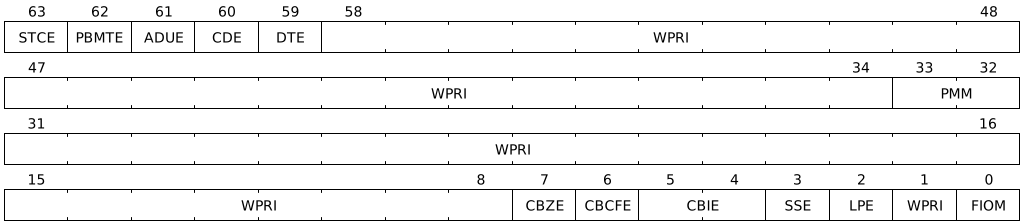
If bit FIOM (Fence of I/O implies Memory) is set to one in menvcfg,
FENCE instructions executed in modes less privileged than M are modified
so the requirement to order accesses to device I/O implies also the
requirement to order main memory accesses. Table 18
details the modified interpretation of FENCE instruction bits PI, PO,
SI, and SO for modes less privileged than M when FIOM=1.
Similarly, for modes less privileged than M when FIOM=1, if an atomic instruction that accesses a region ordered as device I/O has its aq and/or rl bit set, then that instruction is ordered as though it accesses both device I/O and memory.
If S-mode is not supported, or if satp.MODE is read-only zero (always
Bare), the implementation may make FIOM read-only zero.
Table 18. Modified interpretation of FENCE predecessor and successor sets for modes less privileged than M when FIOM=1.
| Instruction bit | Meaning when set |
|---|---|
| PO | Predecessor device output and memory writes (PW implied) |
| SO | Successor device output and memory writes (SW implied) |
Bit FIOM is needed in menvcfg so M-mode can emulate the hypervisor
extension of Section 5, which has an
equivalent FIOM bit in the hypervisor CSR henvcfg.
The PBMTE bit controls whether the Svpbmt extension is available for use
in S-mode and G-stage address translation (i.e., for page tables pointed
to by satp or hgatp). When PBMTE=1, Svpbmt is available for S-mode
and G-stage address translation. When PBMTE=0, the implementation
behaves as though Svpbmt were not implemented.
If Svpbmt is not implemented, PBMTE is read-only zero.
Furthermore,
for implementations with the hypervisor extension,
henvcfg.PBMTE is read-only zero if menvcfg.PBMTE is zero.
After changing menvcfg.PBMTE, executing an SFENCE.VMA instruction with
rs1=x0 and rs2=x0 suffices to synchronize address-translation caches
with respect to the altered interpretation of page-table entries' PBMT fields.
See Section 5.5.3 for additional synchronization requirements when the
hypervisor extension is implemented.
If the Svadu extension is implemented, the ADUE bit controls whether hardware
updating of PTE A/D bits is enabled for S-mode and G-stage address translations.
When ADUE=1, hardware updating of PTE A/D bits is enabled during S-mode
address translation, and the implementation behaves as though the Svade
extension were not implemented for S-mode address translation.
When the hypervisor extension is implemented, if ADUE=1, hardware updating of
PTE A/D bits is enabled during G-stage address translation, and the
implementation behaves as though the Svade extension were not implemented for
G-stage address translation.
When ADUE=0, the implementation behaves as though Svade were implemented for
S-mode and G-stage address translation.
If Svadu is not implemented, ADUE is read-only zero.
Furthermore, for implementations with the hypervisor extension,
henvcfg.ADUE is read-only zero if menvcfg.ADUE is zero.
After changing menvcfg.ADUE, executing an SFENCE.VMA instruction with
rs1=x0 and rs2=x0 suffices to synchronize address-translation caches
with respect to the altered interpretation of page-table entries' A/D bits.
See Section 5.5.3 for additional synchronization requirements when the
hypervisor extension is implemented.
The Svade extension requires page-fault exceptions be raised when PTE A/D bits need be set, hence Svade is implemented when ADUE=0.
If the Smcdeleg extension is implemented, the CDE (Counter Delegation Enable) bit controls whether Zicntr and Zihpm counters can be delegated to S-mode. When CDE=1, the Smcdeleg extension is enabled, see Section 6.6. When CDE=0, the Smcdeleg and Ssccfg extensions appear to be not implemented. If Smcdeleg is not implemented, CDE is read-only zero.
The Sstc extension adds the STCE (STimecmp Enable) bit to menvcfg CSR.
When the Sstc extension is not implemented, STCE is read-only zero.
The STCE bit enables stimecmp for S-mode when set to one.
When this extension is implemented and STCE in menvcfg is zero, an attempt to access stimecmp
in a mode other than M-mode raises an illegal-instruction exception, STCE in
henvcfg is read-only zero, and STIP in mip and sip reverts to its
defined behavior as if this extension is not implemented. Further, if the H
extension is implemented, then hip.VSTIP also reverts its defined behavior as
if this extension is not implemented.
The Zicboz extension adds the CBZE (Cache Block Zero instruction enable) field
to menvcfg. When the CBZE field is set to 1, it enables execution of the
cache block zero instruction, CBO.ZERO, in modes less privileged than M.
Otherwise, the instruction raises an illegal-instruction exception in modes less
privileged than M.
When the Zicboz extension is not implemented, CBZE is read-only zero.
The Zicbom extension adds the CBCFE (Cache Block Clean and Flush instruction
Enable) field to menvcfg. When the CBCFE field is set to 1, it enables
execution of the cache block clean instruction (CBO.CLEAN) and the cache block
flush instruction (CBO.FLUSH) in modes less privileged than M. Otherwise, these
instructions raise an illegal-instruction exception in modes less privileged than M.
When the Zicbom extension is not implemented, CBCFE is read-only zero.
The Zicbom extension adds the CBIE (Cache Block Invalidate instruction Enable)
WARL field to menvcfg to control execution of the cache block invalidate
instruction (CBO.INVAL) in modes less privileged than M. When CBIE is set to
0b00, the instruction raises an illegal-instruction exception in modes less
privileged than M.
When the Zicbom extension is not implemented, CBIE is read-only zero.
The encoding 0b10 is reserved.
When CBIE is set to 0b01
or 0b11, and when enabled for execution in modes less privileged than M, it
behaves as follows:
0b01— The instruction is executed and performs a flush operation, even if configured by a mode less privileged than M to perform an invalidate operation.0b11— The instruction is executed and performs an invalidate operation, unless configured by a mode less privileged than M to perform a flush operation.
If the Smnpm extension is implemented, the PMM field enables or disables
pointer masking (see Section 6.10) for the next-lower privilege mode (S-/HS-mode if
S-mode is implemented, or U-mode otherwise), according to the values in
Table 19.
If Smnpm is not implemented, PMM is read-only zero.
The PMM field is read-only zero for RV32.
Table 19. Legal values of PMM WARL field
| Value | Description |
|---|---|
| 00 | Pointer masking is disabled (PMLEN = 0) |
| 01 | Reserved |
| 10 | Pointer masking is enabled with PMLEN = XLEN - 57 (PMLEN = 7 on RV64) |
| 11 | Pointer masking is enabled with PMLEN = XLEN - 48 (PMLEN = 16 on RV64) |
The Zicfilp extension adds the LPE field in menvcfg. When the LPE field is
set to 1 and S-mode is implemented, the Zicfilp extension is enabled in S-mode.
If LPE field is set to 1 and S-mode is not implemented, the Zicfilp extension
is enabled in U-mode. When the LPE field is 0, the Zicfilp extension is not
enabled in S-mode, and the following rules apply to S-mode. If the LPE field
is 0 and S-mode is not implemented, then the same rules apply to U-mode.
- The hart does not update the
ELPstate; it remains asNO_LP_EXPECTED. - The
LPADinstruction operates as a no-op.
The Zicfiss extension adds the SSE field to menvcfg.
When the SSE field is set to 1 the Zicfiss extension is activated in S-mode. When SSE field is 0,
the following rules apply to privilege modes that are less than M:
- 32-bit Zicfiss instructions will revert to their behavior as defined by Zimop.
- 16-bit Zicfiss instructions will revert to their behavior as defined by Zcmop.
- The
pte.xwr=0b010encoding in VS/S-stage page tables becomes reserved. SSAMOSWAP.W/Draises an illegal-instruction exception.
When menvcfg.SSE is 0, the henvcfg.SSE and senvcfg.SSE fields are
read-only zero.
The Ssdbltrp extension adds the double-trap-enable (DTE) field in menvcfg.
When menvcfg.DTE is zero, the implementation behaves as though Ssdbltrp is not
implemented. When Ssdbltrp is not implemented sstatus.SDT, vsstatus.SDT, and
henvcfg.DTE bits are read-only zero.
When XLEN=32, menvcfgh is a 32-bit read/write register
that aliases bits 63:32 of menvcfg.
The menvcfgh register does not exist when XLEN=64.
In harts with U-mode, menvcfg must be
implemented, but all WARL fields may be read-only zero.
For harts with S-mode and XLEN=32, menvcfgh must be similarly implemented.
If U-mode is not supported, then registers menvcfg and menvcfgh do
not exist.
3.1.19 Machine Security Configuration (mseccfg) Register
mseccfg is a 64-bit read/write register, formatted as shown in Machine security configuration (mseccfg) register.,
that controls security features.
It exists if any extension that adds a field to mseccfg is implemented. Otherwise, it is reserved.
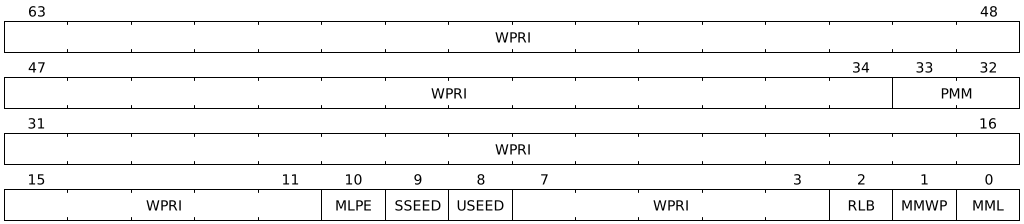
The Zkr extension adds the SSEED and USEED fields to the mseccfg CSR to
control access to the seed CSR from modes less privileged than M.
When USEED is 0, access to the seed CSR in U-mode raises an
illegal-instruction exception. When USEED is 1, read-write access to the
seed CSR from U-mode is allowed; all other types of accesses raise an
illegal-instruction exception.
If Zkr or U-mode is not implemented, USEED is read-only zero.
When SSEED is 0, access to the seed CSR from S-/HS-mode raises an
illegal-instruction exception. When SSEED is 1, read-write access to the
seed CSR from S-/HS-mode is allowed; all other types of accesses raise an
illegal-instruction exception.
If Zkr or S-mode is not implemented, SSEED is read-only zero.
When the H extension is also implemented,
access to the seed CSR from an
HS-qualified instruction leads to a virtual-instruction exception in VS and
VU modes; all other types of accesses raise an illegal-instruction exception.
Table 20. Entropy Source Access Control.
| Mode | SSEED | USEED | Description |
|---|---|---|---|
| M | - | - | The seed CSR is always available in machine mode as normal (with a CSR read-write instruction.) Attempted read without a write raises an illegal-instruction exception regardless of mode and access control bits. |
| U | - | 0 | Any seed CSR access raises an illegal-instruction exception. |
| U | - | 1 | The seed CSR is accessible as normal. No exception is raised for read-write. |
| S/HS | 0 | - | Any seed CSR access raises an illegal-instruction exception. |
| S/HS | 1 | - | The seed CSR is accessible as normal. No exception is raised for read-write. |
| VS/VU | 0 | - | Any seed CSR access raises an illegal-instruction exception. |
| VS/VU | 1 | - | A read-write seed access raises a virtual-instruction exception, while other access conditions raise an illegal-instruction exception. |
The Smepmp extension adds the RLB, MMWP, and the MML fields in
mseccfg.
mseccfg.RLB (Rule Locking Bypass) is a WARL field that provides a mechanism
to temporarily modify Locked PMP rules. When mseccfg.RLB is 1, locked PMP
rules may be removed or modified. When
mseccfg.RLB is 0 and pmpcfg.L is 1 in any rule or entry (including disabled
entries), then mseccfg.RLB remains 0 and any further modifications to
mseccfg.RLB are ignored until a PMP reset.
This feature is intended to be used as a debug mechanism, or as a temporary workaround during the boot process for simplifying software, and optimizing the allocation of memory and PMP rules. Using this functionality under normal operation, after the boot process is completed, should be avoided since it weakens the protection of M-mode-only rules. Vendors who don’t need this functionality may hardwire this field to 0.
The terminology used to specify the fields introduced by the Smepmp extension is listed in Section 6.3.
The mseccfg.MMWP (Machine-Mode Allowlist Policy) is a WARL field. This field
changes the default PMP policy for Machine mode when accessing memory regions
that don’t have a matching PMP rule. This is a sticky bit, meaning that once
set it cannot be unset until a PMP reset. When set it changes the default
PMP policy for M-mode when accessing memory regions that don’t have a matching
PMP rule, to denied instead of ignored.
The mseccfg.MML (Machine Mode Lockdown) is a WARL field.
The MML bit changes the interpretation of the pmpcfg.L bit defined in Section 3.7.1.2.
This is a sticky bit, meaning that once set it cannot be unset
until a PMP reset.
When mseccfg.MML is set the system’s behavior changes in the following way:
- The meaning of
pmpcfg.Lchanges: Instead of marking a rule as locked and enforced in all modes, it now marks a rule as M-mode-only when set and S/U-mode-only when unset. The formerly reserved encoding ofpmpcfg.RW=01,
An M-mode-only rule is enforced on accesses whose effective privilege mode is Machine and denied to accesses whose effective privilege mode is Supervisor or User. It also remains locked so that any further modifications to its associated configuration or address registers are ignored until a PMP reset,
An S/U-mode-only rule is enforced on accesses whose effective privilege mode is Supervisor or User and denied to accesses whose effective privilege
A Shared-Region rule is enforced on all modes, with restrictions depending
- A Shared-Region rule where
pmpcfg.Lis not set can be used for sharing data between M-mode and S/U-mode, so is not executable. M-mode has read/write access to that region, and S/U-mode has read access ifpmpcfg.Xis not set, or read/write access ifpmpcfg.Xis set. - A Shared-Region rule where
pmpcfg.Lis set can be used for sharing code between M-mode and S/U-mode, so is not writable. Both M-mode and S/U-mode have execute access on the region, and M-mode also has read access ifpmpcfg.Xis set. The rule remains locked so that any further modifications to its associated configuration or address registers are ignored until a PMP reset, unlessmseccfg.RLBis set. - The encoding
pmpcfg.LRWX=1111can be used for sharing data between M-mode and S/U mode, where both modes only have read-only access to the region. The rule remains locked so that any further modifications to its associated configuration or address registers are ignored until a PMP reset, unlessmseccfg.RLBis set.
- Adding a rule with executable privileges that either is M-mode-only or a
locked Shared-Region is not possible and such
pmpcfgwrites are ignored, leavingpmpcfgunchanged. This restriction can be temporarily lifted by settingmseccfg.RLBe.g. during the boot process. - Executing code with Machine mode privileges is only possible from memory regions with a matching M-mode-only rule or a locked Shared-Region rule with executable privileges. Executing code from a region without a matching rule or with a matching S/U-mode-only rule is denied.
- If
mseccfg.MMLis not set, the combination ofpmpcfg.RW=01remains reserved for future standard use.
If the Smmpm extension is implemented,
the PMM field enables or disables pointer masking (see Section 6.10) for M-mode
according to the values in Table 21.
If Smmpm is not implemented, PMM is read-only zero.
The PMM field is read-only zero for RV32.
Table 21. Legal values of PMM WARL field
| Value | Description |
|---|---|
| 00 | Pointer masking is disabled (PMLEN = 0) |
| 01 | Reserved |
| 10 | Pointer masking is enabled with PMLEN = XLEN - 57 (PMLEN = 7 on RV64) |
| 11 | Pointer masking is enabled with PMLEN = XLEN - 48 (PMLEN = 16 on RV64) |
Smmpm implementations need to satisfy max(largest supported virtual address
size, largest supported supervisor physical address size) ⇐ (XLEN - PMLEN)
bits to avoid any masking logic on the TLB access path.
The Zicfilp extension adds the MLPE field in mseccfg.
When MLPE field is 1, Zicfilp extension is enabled in M-mode.
When the MLPE field is 0, the Zicfilp extension is not enabled
in M-mode and the following rules apply to M-mode.
- The hart does not update the
ELPstate; it remains asNO_LP_EXPECTED. - The
LPADinstruction operates as a no-op.
When XLEN=32 only, mseccfgh is a 32-bit read/write register that
aliases bits 63:32 of mseccfg.
Register mseccfgh exists when XLEN=32 and mseccfg is implemented;
it does not exist when XLEN=64.
3.2 Machine-Level Memory-Mapped Registers
3.2.1 Machine Timer (mtime and mtimecmp) Registers
Platforms provide a real-time counter, exposed as a memory-mapped
machine-mode read-write register, mtime.
mtime must increment at constant frequency, and
the platform must provide a mechanism for
determining the period of an mtime tick.
The mtime register will wrap around if the count overflows.
The mtime register has a 64-bit precision on all RV32 and RV64 systems.
Platforms provide a 64-bit memory-mapped machine-mode timer
compare register (mtimecmp).
A machine timer interrupt becomes pending
whenever mtime contains a value greater than or equal to mtimecmp,
treating the values as unsigned integers.
The interrupt remains posted until mtimecmp becomes greater than mtime
(typically as a result of writing mtimecmp).
The interrupt will only be taken if interrupts are
enabled and the MTIE bit is set in the mie register.


The timer facility is defined to use wall-clock time rather than a cycle counter to support modern processors that run with a highly variable clock frequency to save energy through dynamic voltage and frequency scaling.
Accurate real-time clocks (RTCs) are relatively expensive to provide
(requiring a crystal or MEMS oscillator) and have to run even when the
rest of system is powered down, and so there is usually only one in a
system located in a different frequency/voltage domain from the
processors. Hence, the RTC must be shared by all the harts in a system
and accesses to the RTC will potentially incur the penalty of a
voltage-level-shifter and clock-domain crossing. It is thus more natural
to expose mtime as a memory-mapped register than as a CSR.
Lower privilege levels do not have their own timecmp registers.
Instead, machine-mode software can implement any number of virtual
timers on a hart by multiplexing the next timer interrupt into the
mtimecmp register.
Simple fixed-frequency systems can use a single clock for both cycle counting and wall-clock time.
If the result of the comparison between mtime and mtimecmp
changes, it is guaranteed to be reflected in MTIP eventually, but not necessarily immediately.
A spurious timer interrupt might occur if an interrupt handler
increments mtimecmp then immediately returns, because MTIP might not
yet have fallen in the interim. All software should be written to assume
this event is possible, but most software should assume this event is
extremely unlikely. It is almost always more performant to incur an
occasional spurious timer interrupt than to poll MTIP until it falls.
In RV32, memory-mapped writes to mtimecmp modify only one 32-bit part
of the register.
The following code sequence sets a 64-bit mtimecmp value without spuriously generating a
timer interrupt due to the intermediate value of the comparand:
For RV64, naturally aligned 64-bit memory accesses to the mtime and
mtimecmp registers are additionally supported and are atomic.
            # New comparand is in a1:a0.
            li t0, -1
            la t1, mtimecmp
            sw t0, 0(t1)     # No smaller than old value.
            sw a1, 4(t1)     # No smaller than new value.
            sw a0, 0(t1)     # New value.
The time CSR is a read-only shadow of the memory-mapped mtime register.
When XLEN=32, the timeh CSR is a read-only shadow of the upper 32 bits of the
memory-mapped mtime register, while time shadows only the lower 32 bits of
mtime.
When mtime changes, it is guaranteed to be reflected in time
and timeh eventually, but not necessarily immediately.
3.3 Machine-Mode Privileged Instructions
3.3.1 Environment Call and Breakpoint

The ECALL instruction is used to make a request to the supporting execution environment. When executed in U-mode, S-mode, or M-mode, it generates an environment-call-from-U-mode exception, environment-call-from-S-mode exception, or environment-call-from-M-mode exception, respectively, and performs no other operation.
ECALL generates a different exception for each originating privilege mode so that environment call exceptions can be selectively delegated. A typical use case for Unix-like operating systems is to delegate to S-mode the environment-call-from-U-mode exception but not the others.
The EBREAK instruction is used by debuggers to cause control to be transferred back to a debugging environment. Unless overridden by an external debug environment, EBREAK raises a breakpoint exception and performs no other operation.
The C.EBREAK instruction performs the same operation as the EBREAK instruction.
ECALL and EBREAK cause the receiving privilege mode’s epc register to
be set to the address of the ECALL or EBREAK instruction itself, not
the address of the following instruction.
As ECALL and EBREAK cause
synchronous exceptions, they are not considered to retire, and should
not increment the minstret CSR.
3.3.2 Trap-Return Instructions
Instructions to return from trap are encoded under the PRIV minor opcode.

To return after handling a trap, there are separate trap return
instructions per privilege level, MRET and SRET.
MRET is always provided.
SRET must be provided if supervisor mode is supported, and
should raise an illegal-instruction exception otherwise.
SRET should also raise an illegal-instruction exception when TSR=1
in mstatus, as described in Section 3.1.6.6.
An _x_RET instruction can be executed in privilege mode x or higher,
where executing a lower-privilege _x_RET instruction will pop the relevant lower-privilege
interrupt enable and privilege mode stack.
Attempting to execute an _x_RET
instruction in a mode less privileged than x will raise an
illegal-instruction exception.
In addition to manipulating the privilege stack as described in Section 3.1.6.1,
_x_RET sets the pc to the value stored in the _x_epc register.
If the Zalrsc extension is supported, the _x_RET instruction is allowed to clear any outstanding LR address reservation but is not required to. Trap handlers should explicitly clear the reservation if required (e.g., by using a dummy SC) before executing the _x_RET.
If _x_RET instructions always cleared LR reservations, it would be impossible to single-step through LR/SC sequences using a debugger.
3.3.3 Wait for Interrupt
The Wait for Interrupt instruction (WFI) informs the
implementation that the current hart can be stalled until an interrupt
might need servicing. Execution of the WFI instruction can also be used
to inform the hardware platform that suitable interrupts should
preferentially be routed to this hart.
WFI is available in all privileged modes, and
optionally available to U-mode.
This instruction may raise an illegal-instruction exception when TW=1 in mstatus, as
described in Section 3.1.6.6.

If an enabled interrupt is present or later becomes present while the
hart is stalled, the interrupt trap will be taken on the following
instruction, i.e., execution resumes in the trap handler and mepc = pc + 4.
The following instruction takes the interrupt trap so that a simple return from the trap handler will execute code after the WFI instruction.
Implementations are permitted to resume execution for any reason, even if an enabled interrupt has not become pending. Hence, a legal implementation is to simply implement the WFI instruction as a NOP.
If the implementation does not stall the hart on execution of the instruction, then the interrupt will be taken on some instruction in the idle loop containing the WFI, and on a simple return from the handler, the idle loop will resume execution.
The WFI instruction can also be executed when interrupts are disabled.
The operation of WFI must be unaffected by the global interrupt bits in
mstatus (MIE and SIE) and the delegation register mideleg (i.e.,
the hart must resume if a locally enabled interrupt becomes pending,
even if it has been delegated to a less-privileged mode), but should
honor the individual interrupt enables (e.g, MTIE) (i.e.,
implementations should avoid resuming the hart if the interrupt is
pending but not locally enabled). WFI is also required to resume
execution for locally enabled interrupts pending at any privilege level,
regardless of the global interrupt enable at each privilege level.
If the event that causes the hart to resume execution
does not cause an interrupt to be taken, execution will resume at pc + 4,
and software must determine what action to take, including looping back
to repeat the WFI if there was no actionable event.
By allowing wake-up when interrupts are disabled, an alternate entry point to an interrupt handler can be called that does not require saving the current context, as the current context can be saved or discarded before the WFI is executed.
As implementations are free to implement WFI as a NOP, software must
explicitly check for any relevant pending but disabled interrupts in the
code following an WFI, and should loop back to the WFI if no suitable
interrupt was detected. The mip or sip registers can be interrogated
to determine the presence of any interrupt in machine or supervisor mode
respectively.
The operation of WFI is unaffected by the delegation register settings.
WFI is defined so that an implementation can trap into a higher privilege mode, either immediately on encountering the WFI or after some interval to initiate a machine-mode transition to a lower power state, for example.
The same wait-for-event template might be used for possible future extensions that wait on memory locations changing, or message arrival.
3.3.4 Custom SYSTEM Instructions
The subspace of the SYSTEM major opcode shown in SYSTEM instruction encodings designated for custom use. is designated for custom use. It is recommended that these instructions use bits 29:28 to designate the minimum required privilege mode, as do other SYSTEM instructions.
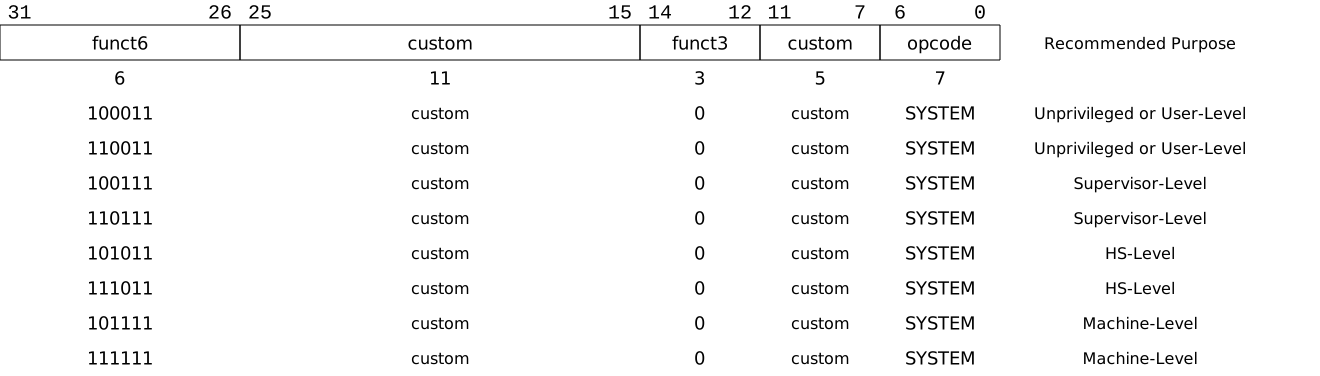
3.4 Reset
Upon reset, a hart’s privilege mode is set to M.
The mstatus fields MIE and MPRV are reset to 0.
If little-endian memory accesses are supported, the mstatus/mstatush field MBE is reset to 0.
The misa register is reset to enable the maximal set of supported
extensions, as described in Section 3.1.1.
For implementations with the Zalrsc standard extension, there is no valid
load reservation.
The pc is set to an implementation-defined reset vector.
The mcause register is set to a value indicating the cause of the reset.
Writable PMP registers’ A and L fields are set to 0, unless
the platform mandates a different reset value for some PMP registers’ A
and L fields.
If the hypervisor extension is implemented, the
hgatp.MODE and vsatp.MODE fields are reset to 0.
If the Smrnmi extension is implemented, the mnstatus.NMIE field is reset to 0.
No WARL field contains an illegal value.
If the Zicfilp extension is implemented, the mseccfg.MLPE field is reset to 0.
All other hart state is UNSPECIFIED.
The MML, MMWP, and RLB fields of the mseccfg register
are set to 0, unless the platform mandates a different reset value.
The mcause values after reset have implementation-specific
interpretation, but the value 0 should be returned on implementations
that do not distinguish different reset conditions. Implementations that
distinguish different reset conditions should only use 0 to indicate the
most complete reset.
The USEED and SSEED fields of the mseccfg CSR
must have defined reset values. The system must not allow them to be in an undefined state
after reset.
Some designs may have multiple causes of reset (e.g., power-on reset, external hard reset, brownout detected, watchdog timer elapse, sleep-mode wake-up), which machine-mode software and debuggers may wish to distinguish.
To avoid ambiguity, mcause reset values may alias mcause values
following synchronous exceptions. There should be no ambiguity in this overlap, since on reset
the pc is typically set to a different value than on other traps.
3.5 Non-Maskable Interrupts
Non-maskable interrupts (NMIs) are only used for hardware error
conditions, and cause an immediate jump to an implementation-defined NMI
vector running in M-mode regardless of the state of a hart’s interrupt
enable bits. The mepc register is written with the virtual address of
the instruction that was interrupted, and mcause is set to a value
indicating the source of the NMI. The NMI can thus overwrite state in an
active machine-mode interrupt handler.
The values written to mcause on an NMI are implementation-defined.
The high Interrupt bit of mcause should be set to indicate
that this was an interrupt. An Exception Code of 0 is reserved to mean unknown
cause and implementations that do not distinguish sources of NMIs via
the mcause register should return 0 in the Exception Code.
Unlike resets, NMIs do not reset processor state, enabling diagnosis, reporting, and possible containment of the hardware error.
3.6 Physical Memory Attributes
The physical memory map for a complete system includes various address ranges, some corresponding to memory regions and some to memory-mapped control registers, portions of which might not be accessible. Some memory regions might not support reads, writes, or execution; some might not support subword or subblock accesses; some might not support atomic operations; and some might not support cache coherence or might have different memory models. Similarly, memory-mapped control registers vary in their supported access widths, support for atomic operations, and whether read and write accesses have associated side effects. In RISC-V systems, these properties and capabilities of each region of the machine’s physical address space are termed physical memory attributes (PMAs). This section describes RISC-V PMA terminology and how RISC-V systems implement and check PMAs.
PMAs are inherent properties of the underlying hardware and rarely change during system operation. Unlike physical memory protection values described in Section 3.7, PMAs do not vary by execution context. The PMAs of some memory regions are fixed at chip design time—for example, for an on-chip ROM. Others are fixed at board design time, depending, for example, on which other chips are connected to off-chip buses. Off-chip buses might also support devices that could be changed on every power cycle (cold pluggable) or dynamically while the system is running (hot pluggable). Some devices might be configurable at run time to support different uses that imply different PMAs—for example, an on-chip scratchpad RAM might be cached privately by one core in one end-application, or accessed as a shared non-cached memory in another end-application.
Most systems will require that at least some PMAs are dynamically checked in hardware later in the execution pipeline after the physical address is known, as some operations will not be supported at all physical memory addresses, and some operations require knowing the current setting of a configurable PMA attribute. While many other architectures specify some PMAs in the virtual memory page tables and use the TLB to inform the pipeline of these properties, this approach injects platform-specific information into a virtualized layer and can cause system errors unless attributes are correctly initialized in each page-table entry for each physical memory region. In addition, the available page sizes might not be optimal for specifying attributes in the physical memory space, leading to address-space fragmentation and inefficient use of expensive TLB entries.
For RISC-V, we separate out specification and checking of PMAs into a separate hardware structure, the PMA checker. In many cases, the attributes are known at system design time for each physical address region, and can be hardwired into the PMA checker. Where the attributes are run-time configurable, platform-specific memory-mapped control registers can be provided to specify these attributes at a granularity appropriate to each region on the platform (e.g., for an on-chip SRAM that can be flexibly divided between cacheable and uncacheable uses). PMAs are checked for any access to physical memory, including accesses that have undergone virtual to physical memory translation. To aid in system debugging, we strongly recommend that, where possible, RISC-V processors precisely trap physical memory accesses that fail PMA checks. Precisely trapped PMA violations manifest as instruction, load, or store access-fault exceptions, distinct from virtual-memory page-fault exceptions. Precise PMA traps might not always be possible, for example, when probing a legacy bus architecture that uses access failures as part of the discovery mechanism. In this case, error responses from peripheral devices will be reported as imprecise bus-error interrupts.
PMAs must also be readable by software to correctly access certain devices or to correctly configure other hardware components that access memory, such as DMA engines. As PMAs are tightly tied to a given physical platform’s organization, many details are inherently platform-specific, as is the means by which software can learn the PMA values for a platform. Some devices, particularly legacy buses, do not support discovery of PMAs and so will give error responses or time out if an unsupported access is attempted. Typically, platform-specific machine-mode code will extract PMAs and ultimately present this information to higher-level less-privileged software using some standard representation.
Where platforms support dynamic reconfiguration of PMAs, an interface will be provided to set the attributes by passing requests to a machine-mode driver that can correctly reconfigure the platform. For example, switching cacheability attributes on some memory regions might involve platform-specific operations, such as cache flushes, that are available only to machine-mode.
3.6.1 Main Memory versus I/O Regions
The most important characterization of a given memory address range is whether it holds regular main memory or I/O devices. Regular main memory is required to have a number of properties, specified below, whereas I/O devices can have a much broader range of attributes. Memory regions that do not fit into regular main memory, for example, device scratchpad RAMs, are categorized as I/O regions.
What previous versions of this specification termed vacant regions are no longer a distinct category; they are now described as I/O regions that are not accessible (i.e. lacking read, write, and execute permissions). Main memory regions that are not accessible are also allowed.
3.6.2 Supported Access Type PMAs
Access types specify which access widths, from 8-bit byte to long multi-word burst, are supported, and also whether misaligned accesses are supported for each access width.
Although software running on a RISC-V hart cannot directly generate bursts to memory, software might have to program DMA engines to access I/O devices and might therefore need to know which access sizes are supported.
Main memory regions always support read and write of all access widths required by the attached devices, and can specify whether instruction fetch is supported.
Some platforms might mandate that all of main memory support instruction fetch. Other platforms might prohibit instruction fetch from some main memory regions.
In some cases, the design of a processor or device accessing main memory might support other widths, but must be able to function with the types supported by the main memory.
I/O regions can specify which combinations of read, write, or execute accesses to which data widths are supported.
For systems with page-based virtual memory, I/O and memory regions can specify which combinations of hardware page-table reads and hardware page-table writes are supported.
Unix-like operating systems generally require that all of cacheable main memory supports page-table walks.
3.6.3 Atomicity PMAs
Atomicity PMAs describes which atomic instructions are supported in this address region. Support for atomic instructions is divided into two categories: LR/SC and AMOs.
Some platforms might mandate that all of cacheable main memory support all atomic operations required by the attached processors.
3.6.3.1 AMO PMA
Within AMOs, there are four levels of support: AMONone, AMOSwap,
AMOLogical, and AMOArithmetic. AMONone indicates that no AMO
operations are supported. AMOSwap indicates that only amoswap
instructions are supported in this address range. AMOLogical indicates
that swap instructions plus all the logical AMOs (amoand, amoor,
amoxor) are supported. AMOArithmetic indicates that all RISC-V AMOs defined by
the A extension are supported.
For each level of support, naturally aligned AMOs of a given width
are supported if the underlying memory region supports reads and writes of that width.
Main memory and I/O regions may only support a subset or none of the processor-supported atomic operations.
Table 22. Classes of AMOs supported by I/O regions.
| AMO Class | Supported Operations |
|---|---|
| AMOArithmetic | above + amoadd, amomin, amomax, amominu, amomaxu |
We recommend providing at least AMOLogical support for I/O regions where possible.
The Zacas extension defines three additional levels of support: AMOCASW, AMOCASD, and AMOCASQ.
AMOCASW indicates that in addition to instructions indicated by AMOArithmetic-level support, the AMOCAS.W instruction is supported. AMOCASD indicates that
in addition to instructions indicated by AMOCASW-level support, the AMOCAS.D
instruction is supported. AMOCASQ indicates that in addition to instructions
indicated by AMOCASD-level support, the AMOCAS.Q instruction is supported.
AMOCASW/D/Q require AMOArithmetic-level support as the AMOCAS.W/D/Q
instructions require ability to perform an arithmetic comparison and a swap operation.
The AMOs specified by the Zabha extension require the same level of support as the corresponding instructions in the Zaamo standard extension or the Zacas extension.
The Ziccamoa extension requires
AMOArithmetic-level support to main memory regions with both the coherence and
cacheability PMAs.
The Ziccamoc extension requires AMOCASQ-level
support to main memory regions with both the coherence and cacheability PMAs.
3.6.3.2 Reservability PMA
For LR/SC, there are three levels of support indicating combinations of the reservability and eventuality properties: RsrvNone, RsrvNonEventual, and RsrvEventual. RsrvNone indicates that no LR/SC operations are supported (the location is non-reservable). RsrvNonEventual indicates that the operations are supported (the location is reservable), but without the eventual success guarantee described in the unprivileged ISA specification. RsrvEventual indicates that the operations are supported and provide the eventual success guarantee.
We recommend providing RsrvEventual support for main memory regions where possible. Most I/O regions will not support LR/SC accesses, as these are most conveniently built on top of a cache-coherence scheme, but some may support RsrvNonEventual or RsrvEventual.
When LR/SC is used for memory locations marked RsrvNonEventual, software should provide alternative fall-back mechanisms used when lack of progress is detected.
The Ziccrse extension requires RsrvEventual
support to main memory regions with both the coherence and cacheability PMAs.
3.6.4 Misaligned Atomicity Granule PMA
The misaligned atomicity granule PMA provides constrained support for misaligned AMOs. This PMA, if present, specifies the size of a misaligned atomicity granule, a naturally aligned power-of-two number of bytes. Specific supported values for this PMA are represented by MAG_NN_, e.g., MAG16 indicates the misaligned atomicity granule is at least 16 bytes.
The misaligned atomicity granule PMA applies only to AMOs; loads and stores
defined in the base ISAs; loads and stores of no more than XLEN bits
defined in the F, D, and Q extensions; the load-acquire and
store-release instructions defined in the Zalasr extension; and compressed
encodings of the foregoing loads and stores.
For an instruction in that set, if all accessed bytes lie within the same
misaligned atomicity granule, the instruction will not raise an exception for
reasons of address alignment, and the instruction will give rise to only one
memory operation for the purposes of RVWMO—i.e., it will execute atomically.
If a misaligned AMO accesses a region that does not specify a misaligned atomicity granule PMA, or if not all accessed bytes lie within the same misaligned atomicity granule, then an exception is raised. For regular loads and stores that access such a region or for which not all accessed bytes lie within the same atomicity granule, then either an exception is raised, or the access proceeds but is not guaranteed to be atomic. Implementations may raise access-fault exceptions instead of address-misaligned exceptions for some misaligned accesses, indicating the instruction should not be emulated by a trap handler.
LR/SC instructions are unaffected by this PMA and so always raise an exception when misaligned. Vector memory accesses are also unaffected, so might execute non-atomically even when contained within a misaligned atomicity granule. Implicit accesses are similarly unaffected by this PMA.
The Zama16b extension requires MAG16 support to main memory regions.
3.6.5 Memory-Ordering PMAs
Regions of the address space are classified as either main memory or I/O for the purposes of ordering by the FENCE instruction and atomic-instruction ordering bits.
Accesses by one hart to main memory regions are observable not only by other harts but also by other devices with the capability to initiate requests in the main memory system (e.g., DMA engines). Coherent main memory regions always have either the RVWMO or RVTSO memory model. Incoherent main memory regions have an implementation-defined memory model.
Accesses by one hart to an I/O region are observable not only by other harts and bus mastering devices but also by the targeted I/O devices, and I/O regions may be accessed with either relaxed or strong ordering. Accesses to an I/O region with relaxed ordering are generally observed by other harts and bus mastering devices in a manner similar to the ordering of accesses to an RVWMO memory region, as discussed in the I/O Ordering section in app:mm-explanatory. By contrast, accesses to an I/O region with strong ordering are generally observed by other harts and bus mastering devices in program order.
Each strongly ordered I/O region specifies a numbered ordering channel, which is a mechanism by which ordering guarantees can be provided between different I/O regions. Channel 0 is used to indicate point-to-point strong ordering only, where only accesses by the hart to the single associated I/O region are strongly ordered.
Channel 1 is used to provide global strong ordering across all I/O
regions. Any accesses by a hart to any I/O region associated with
channel 1 can only be observed to have occurred in program order by all
other harts and I/O devices, including relative to accesses made by that
hart to relaxed I/O regions or strongly ordered I/O regions with
different channel numbers. In other words, any access to a region in
channel 1 is equivalent to executing a fence io,io instruction before
and after the instruction.
Other larger channel numbers provide program ordering to accesses by that hart across any regions with the same channel number
Systems might support dynamic configuration of ordering properties on each memory region.
Strong ordering can be used to improve compatibility with legacy device driver code, or to enable increased performance compared to insertion of explicit ordering instructions when the implementation is known to not reorder accesses.
Local strong ordering (channel 0) is the default form of strong ordering as it is often straightforward to provide if there is only a single in-order communication path between the hart and the I/O device.
Generally, different strongly ordered I/O regions can share the same ordering channel without additional ordering hardware if they share the same interconnect path and the path does not reorder requests.
3.6.6 Coherence and Cacheability PMAs
Coherence is a property defined for a single physical address, and indicates that writes to that address by one agent will eventually be made visible to other coherent agents in the system. Coherence is not to be confused with the memory consistency model of a system, which defines what values a memory read can return given the previous history of reads and writes to the entire memory system. In RISC-V platforms, the use of hardware-incoherent regions is discouraged due to software complexity, performance, and energy impacts.
The cacheability of a memory region should not affect the software view of the region except for differences reflected in other PMAs, such as main memory versus I/O classification, memory ordering, supported accesses and atomic operations, and coherence. For this reason, we treat cacheability as a platform-level setting managed by machine-mode software only.
Where a platform supports configurable cacheability settings for a memory region, a platform-specific machine-mode routine will change the settings and flush caches if necessary, so the system is only incoherent during the transition between cacheability settings. This transitory state should not be visible to lower privilege levels.
Coherence is straightforward to provide for a shared memory region that is not cached by any agent. The PMA for such a region would simply indicate it should not be cached in a private or shared cache.
Coherence is also straightforward for read-only regions, which can be safely cached by multiple agents without requiring a cache-coherence scheme. The PMA for this region would indicate that it can be cached, but that writes are not supported.
Some read-write regions might only be accessed by a single agent, in which case they can be cached privately by that agent without requiring a coherence scheme. The PMA for such regions would indicate they can be cached. The data can also be cached in a shared cache, as other agents should not access the region.
If an agent can cache a read-write region that is accessible by other agents, whether caching or non-caching, a cache-coherence scheme is required to avoid use of stale values. In regions lacking hardware cache coherence (hardware-incoherent regions), cache coherence can be implemented entirely in software, but software coherence schemes are notoriously difficult to implement correctly and often have severe performance impacts due to the need for conservative software-directed cache-flushing. Hardware cache-coherence schemes require more complex hardware and can impact performance due to the cache-coherence probes, but are otherwise invisible to software.
For each hardware cache-coherent region, the PMA would indicate that the region is coherent and which hardware coherence controller to use if the system has multiple coherence controllers. For some systems, the coherence controller might be an outer-level shared cache, which might itself access further outer-level cache-coherence controllers hierarchically.
Most memory regions within a platform will be coherent to software, because they will be fixed as either uncached, read-only, hardware cache-coherent, or only accessed by one agent.
If a PMA indicates non-cacheability, then accesses to that region must be satisfied by the memory itself, not by any caches.
For implementations with a cacheability-control mechanism, the situation may arise that a program uncacheably accesses a memory location that is currently cache-resident. In this situation, the cached copy must be ignored. This constraint is necessary to prevent more-privileged modes’ speculative cache refills from affecting the behavior of less-privileged modes’ uncacheable accesses.
3.6.7 Idempotency PMAs
Idempotency PMAs describe whether reads and writes to an address region are idempotent. Main memory regions are assumed to be idempotent. For I/O regions, idempotency on reads and writes can be specified separately (e.g., reads are idempotent but writes are not). If accesses are non-idempotent, i.e., there is potentially a side effect on any read or write access, then speculative or redundant accesses must be avoided.
For the purposes of defining the idempotency PMAs, changes in observed memory ordering created by redundant accesses are not considered a side effect.
While hardware should always be designed to avoid speculative or redundant accesses to memory regions marked as non-idempotent, it is also necessary to ensure software or compiler optimizations do not generate spurious accesses to non-idempotent memory regions.
Non-idempotent regions might not support misaligned accesses. Misaligned accesses to such regions should raise access-fault exceptions rather than address-misaligned exceptions, indicating that software should not emulate the misaligned access using multiple smaller accesses, which could cause unexpected side effects.
For non-idempotent regions, implicit reads and writes must not be performed early or speculatively, with the following exceptions. When a non-speculative implicit read is performed, an implementation is permitted to additionally read any of the bytes within a naturally aligned power-of-2 region containing the address of the non-speculative implicit read. Furthermore, when a non-speculative instruction fetch is performed, an implementation is permitted to additionally read any of the bytes within the next naturally aligned power-of-2 region of the same size (with the address of the region taken modulo 2XLEN). The results of these additional reads may be used to satisfy subsequent early or speculative implicit reads. The size of these naturally aligned power-of-2 regions is implementation-defined, but, for systems with page-based virtual memory, must not exceed the smallest supported page size.
3.7 Physical Memory Protection
To support secure processing and contain faults, it is desirable to limit the physical addresses accessible by software running on a hart. An optional physical memory protection (PMP) unit provides per-hart machine-mode control registers to allow physical memory access privileges (read, write, execute) to be specified for each physical memory region. The PMP values are checked in parallel with the PMA checks described in Section 3.6.
The granularity of PMP access control settings are platform-specific, but the standard PMP encoding supports regions as small as four bytes. Certain regions’ privileges can be hardwired—for example, some regions might only ever be visible in machine mode but in no lower-privilege layers.
Platforms vary widely in demands for physical memory protection, and some platforms may provide other PMP structures in addition to or instead of the scheme described in this section.
PMP checks are applied to all accesses whose effective privilege mode is
S or U, including instruction fetches and data accesses in S and U mode,
and data accesses in M-mode when the MPRV bit in mstatus is set and
the MPP field in mstatus contains S or U. PMP checks are also applied
to page-table accesses for virtual-address translation, for which the
effective privilege mode is S. Optionally, PMP checks may additionally
apply to M-mode accesses, in which case the PMP registers themselves are
locked, so that even M-mode software cannot change them until the hart
is reset. In effect, PMP can grant permissions to S and U modes, which
by default have none, and can revoke permissions from M-mode, which by
default has full permissions.
PMP violations are always trapped precisely at the processor.
3.7.1 Physical Memory Protection CSRs
PMP entries are described by an 8-bit configuration register and one MXLEN-bit address register. Some PMP settings additionally use the address register associated with the preceding PMP entry. Up to 64 PMP entries are supported. Implementations may implement zero, 16, or 64 PMP entries; the lowest-numbered PMP entries must be implemented first. All PMP CSR fields are WARL and may be read-only zero. PMP CSRs are only accessible to M-mode.
The PMP configuration registers are densely packed into CSRs to minimize
context-switch time. For RV32, sixteen CSRs, pmpcfg0–pmpcfg15, hold
the configurations pmp0cfg–pmp63cfg for the 64 PMP entries, as shown
in RV32 PMP configuration CSR layout.. For RV64, eight
even-numbered CSRs, pmpcfg0, pmpcfg2, …, pmpcfg14, hold the
configurations for the 64 PMP entries, as shown in
RV64 PMP configuration CSR layout.. For RV64, the odd-numbered
configuration registers, pmpcfg1, pmpcfg3, …, pmpcfg15, are
illegal.
RV64 harts use pmpcfg2, rather than pmpcfg1, to hold
configurations for PMP entries 8-15. This design reduces the cost of
supporting multiple MXLEN values, since the configurations for PMP
entries 8-11 appear in pmpcfg2[31:0] for both RV32 and RV64.
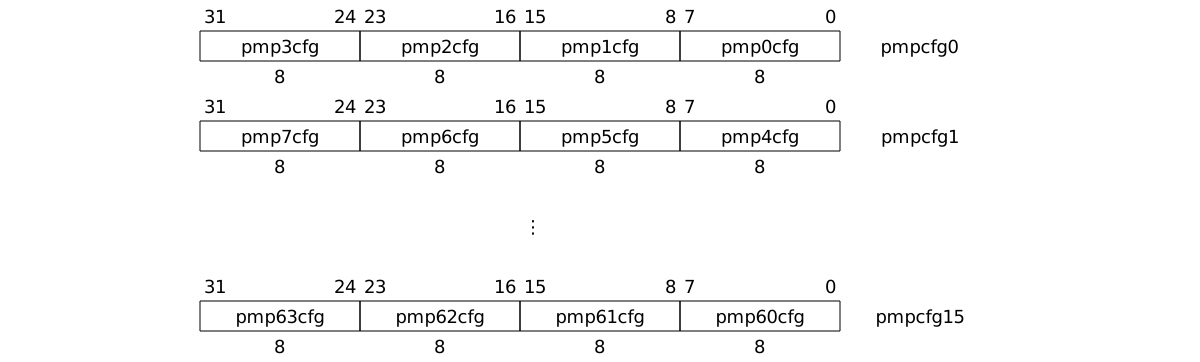
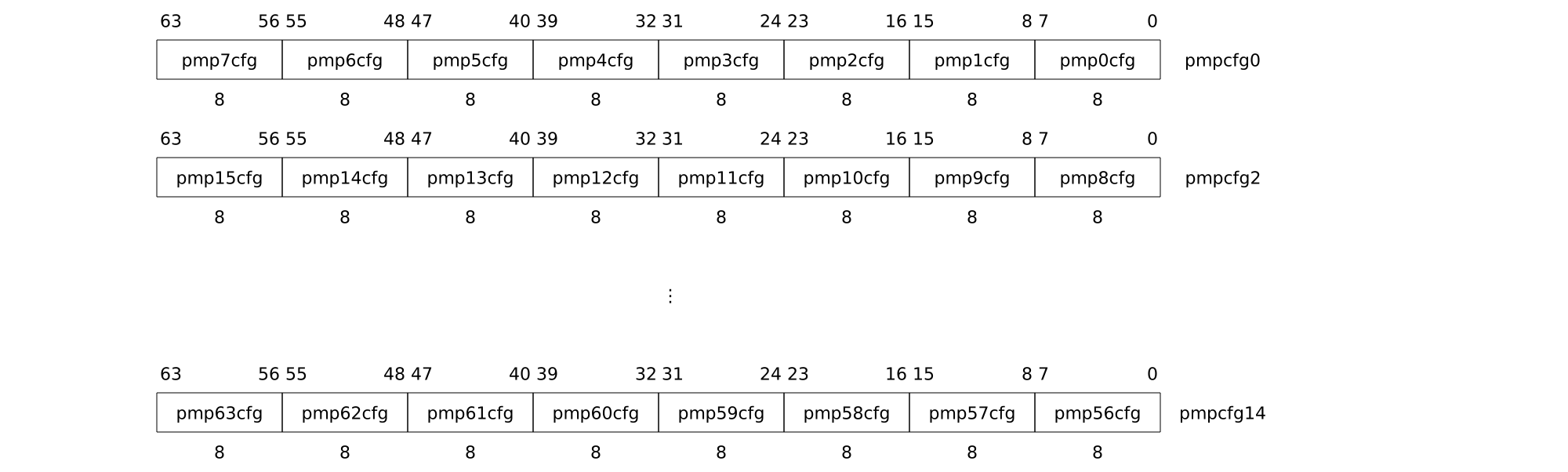
The PMP address registers are CSRs named pmpaddr0-pmpaddr63. Each
PMP address register encodes bits 33-2 of a 34-bit physical address for
RV32, as shown in PMP address register format, RV32.. For RV64,
each PMP address register encodes bits 55-2 of a 56-bit physical
address, as shown in PMP address register format, RV64.. Not all
physical address bits may be implemented, and so the pmpaddr registers
are WARL.
The Sv32 page-based virtual-memory scheme described in Section 4.3 supports 34-bit physical addresses for RV32, so the PMP scheme must support addresses wider than XLEN for RV32. The Sv39 and Sv48 page-based virtual-memory schemes described in Section 4.4 and Section 4.5 support a 56-bit physical address space, so the RV64 PMP address registers impose the same limit.


PMP configuration register format. shows the layout of a PMP configuration register. The R, W, and X bits, when set, indicate that the PMP entry permits read, write, and instruction execution, respectively. When one of these bits is clear, the corresponding access type is denied. The R, W, and X fields form a collective WARL field for which the combinations with R=0 and W=1 are reserved. The remaining two fields, A and L, are described in the following sections.

Attempting to fetch an instruction from a PMP region that does not have execute permissions raises an instruction access-fault exception. Attempting to execute a load, load-reserved, or cache-block management instruction which accesses a physical address within a PMP region without read permissions raises a load access-fault exception. Attempting to execute a store, store-conditional, AMO, or cache-block zero instruction which accesses a physical address within a PMP region without write permissions raises a store access-fault exception.
3.7.1.1 Address Matching
The A field in a PMP entry’s configuration register encodes the address-matching mode of the associated PMP address register. The encoding of this field is shown in Table 23. When A=0, this PMP entry is disabled and matches no addresses. Two other address-matching modes are supported: naturally aligned power-of-2 regions (NAPOT), including the special case of naturally aligned four-byte regions (NA4); and the top boundary of an arbitrary range (TOR). These modes support four-byte granularity.
Table 23. Encoding of A field in PMP configuration registers.
| A | Name | Description |
|---|---|---|
| 3 | NAPOT | Naturally aligned power-of-two region, ≥8 bytes |
NAPOT ranges make use of the low-order bits of the associated address register to encode the size of the range, as shown in Table 24.
Table 24. NAPOT range encoding in PMP address and configuration registers.
pmpaddr | pmpcfg.A | Match type and size |
|---|---|---|
1111…​1111 | NAPOT | 2XLEN+3-byte NAPOT range |
If TOR is selected, the associated address register forms the top of the
address range, and the preceding PMP address register forms the bottom
of the address range. If PMP entry i's A field is set to
TOR, the entry matches any address y such that pmpaddr<sub>i-1</sub>≤y<pmpaddr<sub>i</sub> (irrespective of the value of pmpcfg<sub>i-1</sub>). If PMP entry 0’s A field is set to TOR, zero is used for the lower bound, and so it matches
any address y\<pmpaddr<sub>0</sub>.
If pmpaddr<sub>i-1</sub>≥pmpaddri`` and pmpcfg<sub>i</sub>.A=TOR, then PMP entry i matches no addresses.
It is not possible to represent the address 2XLEN+2 as the top of a range, so, for example, in an RV32 system with 34-bit physical addresses, a TOR PMP cannot be used to give less-privileged modes access to the uppermost word of memory. Either a NAPOT PMP can be used, or that memory can be left inaccessible to less-privileged modes. If the supervisor manages memory at base-page granularity, just 0.00002% of the 16 GiB address space is lost.
Although the PMP mechanism supports regions as small as four bytes, platforms may specify coarser PMP regions. In general, the PMP grain is 2G+2 bytes and must be the same across all PMP regions. When G ≥ 1, the NA4 mode is not selectable. When G ≥ 2 and pmpcfgi.A[1] is set, i.e. the mode is NAPOT, then bits pmpaddri[G-2:0] read as all ones. When G ≥ 1 and pmpcfgi.A[1] is clear, i.e. the mode is OFF or TOR, then bits pmpaddri[G-1:0] read as all zeros. Bits pmpaddri[G-1:0] do not affect the TOR address-matching logic. Although changing pmpcfgi.A[1] affects the value read from pmpaddri, it does not affect the underlying value stored in that register—in particular, pmpaddri[G-1] retains its original value when pmpcfgi.A is changed from NAPOT to TOR/OFF then back to NAPOT.
Software may determine the PMP granularity by writing zero to pmp0cfg, then writing all ones to pmpaddr0, then reading back pmpaddr0. If G is the index of the least-significant bit set, the PMP granularity is 2G+2 bytes.
3.7.1.2 Locking and Privilege Mode
The L bit indicates that the PMP entry is locked, i.e., writes to the
configuration register and associated address registers are ignored.
Locked PMP entries remain locked until the hart is reset. If PMP entry
i is locked, writes to pmpicfg and pmpaddri are ignored. Additionally, if PMP
entry i is locked and pmpicfg.A is set
to TOR, writes to pmpaddri-1 are ignored.
Setting the L bit locks the PMP entry even when the A field is set to OFF.
In addition to locking the PMP entry, the L bit indicates whether the R/W/X permissions are additionally enforced on M-mode accesses. When the L bit is set, these permissions are enforced for all privilege modes. When the L bit is clear, any M-mode access matching the PMP entry will succeed; the R/W/X permissions apply only to S and U modes.
3.7.1.3 Priority and Matching Logic
On some implementations, misaligned loads, stores, and instruction fetches may be decomposed into multiple memory operations, some of which may succeed before an access-fault exception occurs, as described in the RVWMO specification. PMP checking is performed on each memory operation independently. In particular, a portion of a misaligned store that passes the PMP check may become visible, even if another portion fails the PMP check. The same behavior may manifest for stores wider than XLEN bits (e.g., the FSD instruction in RV32D), even when the store address is naturally aligned.
PMP entries are statically prioritized. The lowest-numbered PMP entry
that matches any byte of a memory operation determines whether that operation
succeeds or fails. The matching PMP entry must match all bytes of a memory
operation, or the operation fails, irrespective of the L, R, W, and X bits.
For example, if a PMP entry is configured to match the four-byte range
0xC–0xF, then an 8-byte access to the range 0x8–0xF will fail,
assuming that PMP entry is the highest-priority entry that matches those
addresses.
If a PMP entry matches all bytes of a memory operation, then the L, R, W, and X bits determine whether the operation succeeds or fails. If the L bit is clear and the privilege mode of the access is M, the operation succeeds. Otherwise, if the L bit is set or the privilege mode of the access is S or U, then the operation succeeds only if the R, W, or X bit corresponding to the access type is set.
If no PMP entry matches an M-mode memory operation, the operation succeeds. If no PMP entry matches an S-mode or U-mode memory operation, the operation fails if at least one PMP entry is implemented and succeeds otherwise.
If at least one PMP entry is implemented, but all PMP entries’ A fields are set to OFF, then all S-mode and U-mode memory accesses will fail.
Failed memory operations generate an instruction, load, or store access-fault exception. Note that a single instruction may generate multiple memory operations, which may not be mutually atomic. An access-fault exception is generated if at least one memory operation generated by an instruction fails, though other memory operations generated by that instruction may succeed with visible side effects. Notably, instructions that reference virtual memory are decomposed into multiple memory operations.
3.7.2 Physical Memory Protection and Paging
The Physical Memory Protection mechanism is designed to compose with the page-based virtual memory systems described in Section 4. When paging is enabled, instructions that access virtual memory may result in multiple physical-memory accesses, including implicit references to the page tables. The PMP checks apply to all of these accesses. The effective privilege mode for implicit page-table accesses is S.
Implementations with virtual memory are permitted to perform address
translations speculatively and earlier than required by an explicit
memory access, and are permitted to cache them in address translation
cache structures—including possibly caching the identity mappings from
effective address to physical address used in Bare translation modes and
M-mode. The PMP settings for the resulting physical address may be
checked (and possibly cached) at any point between the address
translation and the explicit memory access. Hence, when the PMP settings
are modified, M-mode software must synchronize the PMP settings with the
virtual memory system and any PMP or address-translation caches. This is
accomplished by executing an SFENCE.VMA instruction with rs1=x0 and
rs2=x0, after the PMP CSRs are written.
See Section 5.5.3 for additional synchronization requirements when the
hypervisor extension is implemented.
If page-based virtual memory is not implemented, memory accesses check the PMP settings synchronously, so no SFENCE.VMA is needed.