5 `H` Extension for Hypervisor Support
This chapter describes the RISC-V hypervisor extension, which virtualizes the supervisor-level architecture to support the efficient hosting of guest operating systems atop a type-1 or type-2 hypervisor. The hypervisor extension changes supervisor mode into hypervisor-extended supervisor mode (HS-mode, or hypervisor mode for short), where a hypervisor or a hosting-capable operating system runs. The hypervisor extension also adds another stage of address translation, from guest physical addresses to supervisor physical addresses, to virtualize the memory and memory-mapped I/O subsystems for a guest operating system. HS-mode acts the same as S-mode, but with additional instructions and CSRs that control the new stage of address translation and support hosting a guest OS in virtual S-mode (VS-mode). Regular S-mode operating systems can execute without modification either in HS-mode or as VS-mode guests.
In HS-mode, an OS or hypervisor interacts with the machine through the same SBI as an OS normally does from S-mode. An HS-mode hypervisor is expected to implement the SBI for its VS-mode guest.
The hypervisor extension depends on an I base integer ISA with 32
x registers (RV32I or RV64I), not RV32E or RV64E, which have only 16 x
registers. CSR mtval must not be read-only zero, and
standard
page-based address translation must be supported, either Sv32 for RV32,
or a minimum of Sv39 for RV64.
The hypervisor extension is enabled by setting bit 7 in the misa CSR,
which corresponds to the letter H. RISC-V harts that implement the
hypervisor extension are encouraged not to hardwire misa[7], so that
the extension may be disabled.
The baseline privileged architecture is designed to simplify the use of classic virtualization techniques, where a guest OS is run at user-level, as the few privileged instructions can be easily detected and trapped. The hypervisor extension improves virtualization performance by reducing the frequency of these traps.
The hypervisor extension has been designed to be efficiently emulable on platforms that do not implement the extension, by running the hypervisor in S-mode and trapping into M-mode for hypervisor CSR accesses and to maintain shadow page tables. The majority of CSR accesses for type-2 hypervisors are valid S-mode accesses so need not be trapped. Hypervisors can support nested virtualization analogously.
5.1 Privilege Modes
The current virtualization mode, denoted V, indicates whether the hart is currently executing in a guest. When V=1, the hart is either in virtual S-mode (VS-mode), or in virtual U-mode (VU-mode) atop a guest OS running in VS-mode. When V=0, the hart is either in M-mode, in HS-mode, or in U-mode atop an OS running in HS-mode. The virtualization mode also indicates whether two-stage address translation is active (V=1) or inactive (V=0). Table 31 lists the possible privilege modes of a RISC-V hart with the hypervisor extension.
Table 31. Privilege modes with the hypervisor extension.
| Mode (V) | Nominal Privilege | Abbreviation | Name | Two-Stage Translation | | 0 | M | M-mode | Machine mode | Off | | 1 | S | VS-mode | Virtual supervisor mode | On |
For privilege modes U and VU, the nominal privilege mode is U, and for privilege modes HS and VS, the nominal privilege mode is S.
HS-mode is more privileged than VS-mode, and VS-mode is more privileged than VU-mode. VS-mode interrupts are globally disabled when executing in U-mode.
This description does not consider the possibility of U-mode or VU-mode interrupts and will be revised if an extension for user-level interrupts is adopted.
5.2 Hypervisor and Virtual Supervisor CSRs
An OS or hypervisor running in HS-mode uses the supervisor CSRs to
interact with the exception, interrupt, and address-translation
subsystems. Additional CSRs are provided to HS-mode, but not to VS-mode,
to manage two-stage address translation and to control the behavior of a
VS-mode guest: hstatus, hedeleg, hideleg, hvip, hip, hie,
hgeip, hgeie, henvcfg, henvcfgh, hcounteren, htimedelta,
htimedeltah, htval, htinst, and hgatp.
Furthermore, several virtual supervisor CSRs (VS CSRs) are replicas of
the normal supervisor CSRs. For example, vsstatus is the VS CSR that
duplicates the usual sstatus CSR.
When V=1, the VS CSRs substitute for the corresponding supervisor CSRs, taking over all functions of the usual supervisor CSRs except as specified otherwise. Instructions that normally read or modify a supervisor CSR shall instead access the corresponding VS CSR. When V=1, an attempt to read or write a VS CSR directly by its own separate CSR address causes a virtual-instruction exception. (Attempts from U-mode cause an illegal-instruction exception as usual.) The VS CSRs can be accessed as themselves only from M-mode or HS-mode.
While V=1, the normal HS-level supervisor CSRs that are replaced by VS CSRs retain their values but do not affect the behavior of the machine unless specifically documented to do so. Conversely, when V=0, the VS CSRs do not ordinarily affect the behavior of the machine other than being readable and writable by CSR instructions.
Some standard supervisor CSRs (senvcfg, scounteren, and scontext,
possibly others) have no matching VS CSR. These supervisor CSRs continue
to have their usual function and accessibility even when V=1, except
with VS-mode and VU-mode substituting for HS-mode and U-mode. Hypervisor
software is expected to manually swap the contents of these registers as
needed.
Matching VS CSRs exist only for the supervisor CSRs that must be duplicated, which are mainly those that get automatically written by traps or that impact instruction execution immediately after trap entry and/or right before SRET, when software alone is unable to swap a CSR at exactly the right moment. Currently, most supervisor CSRs fall into this category, but future ones might not.
In this chapter, we use the term HSXLEN to refer to the effective XLEN when executing in HS-mode, and VSXLEN to refer to the effective XLEN when executing in VS-mode.
5.2.1 Hypervisor Status (hstatus) Register
The hstatus register is an HSXLEN-bit read/write register formatted as
shown in Hypervisor status register (hstatus) when HSXLEN=32 when HSXLEN=32
and Hypervisor status register (hstatus) when HSXLEN=64. when HSXLEN=64. The hstatus
register provides facilities analogous to the mstatus register for
tracking and controlling the exception behavior of a VS-mode guest.

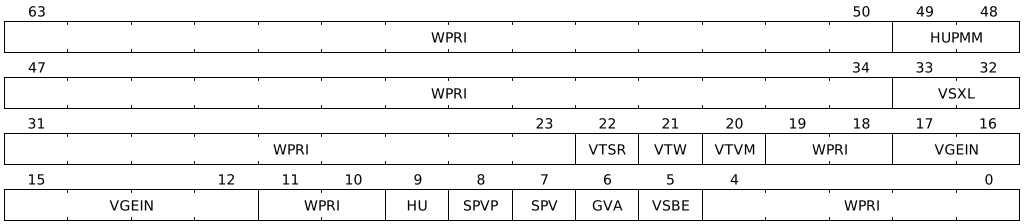
The VSXL field controls the effective XLEN for VS-mode (known as
VSXLEN), which may differ from the XLEN for HS-mode (HSXLEN). When
HSXLEN=32, the VSXL field does not exist, and VSXLEN=32. When HSXLEN=64,
VSXL is a WARL field that is encoded the same as the MXL field of misa,
shown in Table 11. In particular, an
implementation may make VSXL be a read-only field whose value always
ensures that VSXLEN=HSXLEN.
If HSXLEN is changed from 32 to a wider width, and if field VSXL is not restricted to a single value, it gets the value corresponding to the widest supported width not wider than the new HSXLEN.
The hstatus fields VTSR, VTW, and VTVM are defined analogously to the
mstatus fields TSR, TW, and TVM, but affect execution only in VS-mode,
and cause virtual-instruction exceptions instead of illegal-instruction
exceptions.
When VTSR=1, an attempt in VS-mode to execute SRET raises a
virtual-instruction exception.
When VTW=1 (and assuming mstatus.TW=0),
an attempt in VS-mode to execute WFI raises a virtual-instruction
exception if the WFI does not complete within an
implementation-specific, bounded time limit. An implementation may have
WFI always raise a virtual-instruction exception in VS-mode when VTW=1
(and mstatus.TW=0), even if there are pending globally-disabled
interrupts when the instruction is executed.
When VTVM=1, an attempt in
VS-mode to execute SFENCE.VMA or SINVAL.VMA or to access CSR satp
raises a virtual-instruction exception.
The VGEIN (Virtual Guest External Interrupt Number) field selects a guest external interrupt source for VS-level external interrupts. VGEIN is a WLRL field that must be able to hold values between zero and the maximum guest external interrupt number (known as GEILEN), inclusive. When VGEIN=0, no guest external interrupt source is selected for VS-level external interrupts. GEILEN may be zero, in which case VGEIN may be read-only zero. Guest external interrupts are explained in Section 5.2.4, and the use of VGEIN is covered further in Section 5.2.3.
Field HU (Hypervisor in U-mode) controls whether the virtual-machine load/store instructions, HLV, HLVX, and HSV, can be used also in U-mode. When HU=1, these instructions can be executed in U-mode the same as in HS-mode. When HU=0, all hypervisor instructions cause an illegal-instruction exception in U-mode.
The HU bit allows a portion of a hypervisor to be run in U-mode for greater protection against software bugs, while still retaining access to a virtual machine’s memory.
When Ssnpm extension is implemented, the HUPMM field enables or disables
pointer masking (see Section 6.10) for HLV.* and HSV.* instructions in U-mode,
according to the values in Table 34, when their explicit memory
access is performed as though in VU-mode. In HS- and M-modes, pointer masking
for these instructions is enabled or disabled by senvcfg.PMM, when their
explicit memory access is performed as though in VU-mode. Setting henvcfg.PMM
enables or disables pointer masking for HLV.* and HSV.* when their
explicit memory access is performed as though in VS-mode. When the Ssnpm
extension is not implemented, the HUPMM field is read-only zero. The HUPMM
field is read-only zero for RV32.
The hypervisor should copy the value written to senvcfg.PMM by the guest to
the hstatus.HUPMM field prior to invoking HLV.* or HSV.* instructions in
U-mode.
The SPV bit (Supervisor Previous Virtualization mode) is written by the
implementation whenever a trap is taken into HS-mode. Just as the SPP
bit in sstatus is set to the (nominal) privilege mode at the time of
the trap, the SPV bit in hstatus is set to the value of the
virtualization mode V at the time of the trap. When an SRET instruction
is executed when V=0, V is set to SPV.
When V=1 and a trap is taken into HS-mode, bit SPVP (Supervisor Previous
Virtual Privilege) is set to the nominal privilege mode at the time of
the trap, the same as sstatus.SPP. But if V=0 before a trap, SPVP is
left unchanged on trap entry. SPVP controls the effective privilege of
explicit memory accesses made by the virtual-machine load/store
instructions, HLV, HLVX, and HSV.
Without SPVP, if instructions HLV, HLVX, and HSV looked instead to
sstatus.SPP for the effective privilege of their memory accesses,
then, even with HU=1, U-mode could not access virtual machine memory at
VS-level, because to enter U-mode using SRET always leaves SPP=0. Unlike
SPP, field SPVP is untouched by transitions back-and-forth between
HS-mode and U-mode.
Field GVA (Guest Virtual Address) is written by the implementation
whenever a trap is taken into HS-mode. For any trap (breakpoint, address
misaligned, access fault, page fault, or guest-page fault) that writes a
guest virtual address to stval, GVA is set to 1. For any other trap
into HS-mode, GVA is set to 0.
For breakpoint and memory access traps that write a nonzero value to
stval, GVA is redundant with field SPV (the two bits are set the same)
except when the explicit memory access of an HLV, HLVX, or HSV
instruction causes a fault. In that case, SPV=0 but GVA=1.
The VSBE bit is a WARL field that controls the endianness of explicit memory accesses made from VS-mode. If VSBE=0, explicit load and store memory accesses made from VS-mode are little-endian, and if VSBE=1, they are big-endian. VSBE also controls the endianness of all implicit accesses to VS-level memory management data structures, such as page tables. An implementation may make VSBE a read-only field that always specifies the same endianness as HS-mode.
5.2.2 Hypervisor Trap Delegation (hedeleg and hideleg) Registers
Register hedeleg is a 64-bit read/write register, formatted as shown in
Hypervisor exception delegation register (hedeleg)..
Register hideleg is an HSXLEN-bit read/write register, formatted as shown in
Hypervisor interrupt delegation register (hideleg)..
By default, all traps at
any privilege level are handled in M-mode, though M-mode usually uses
the medeleg and mideleg CSRs to delegate some traps to HS-mode. The
hedeleg and hideleg CSRs allow these traps to be further delegated
to a VS-mode guest; their layout is the same as medeleg and mideleg.


A synchronous trap that has been delegated to HS-mode (using medeleg)
is further delegated to VS-mode if V=1 before the trap and the
corresponding hedeleg bit is set.
Each bit of hedeleg shall be
either writable or read-only zero. Many bits of hedeleg are required
specifically to be writable or zero, as enumerated in
Table 32. Bit 0, corresponding to
instruction address-misaligned exceptions, must be writable if
IALIGN=32.
Requiring that certain bits of hedeleg be writable reduces some of the
burden on a hypervisor to handle variations of implementation.
When XLEN=32, hedelegh is a 32-bit read/write register
that aliases bits 63:32 of hedeleg.
Register hedelegh does not exist when XLEN=64.
An interrupt that has been delegated to HS-mode (using mideleg) is
further delegated to VS-mode if the corresponding hideleg bit is set.
Among bits 15:0 of hideleg, bits 10, 6, and 2 (corresponding to the
standard VS-level interrupts) are writable, and bits 12, 9, 5, and 1
(corresponding to the standard S-level interrupts) are read-only zeros.
When a virtual supervisor external interrupt (code 10) is delegated to
VS-mode, it is automatically translated by the machine into a supervisor
external interrupt (code 9) for VS-mode, including the value written to
vscause on an interrupt trap. Likewise, a virtual supervisor timer
interrupt (6) is translated into a supervisor timer interrupt (5) for
VS-mode, and a virtual supervisor software interrupt (2) is translated
into a supervisor software interrupt (1) for VS-mode. Similar
translations may or may not be done for platform interrupt
causes (codes 16 and above).
Table 32. Bits of hedeleg that must be writable or must be read-only zero.
| Bit | Attribute | Corresponding Exception |
|---|---|---|
| 23 | Read-only 0 | Store/AMO guest-page fault |
5.2.3 Hypervisor Interrupt (hvip, hip, and hie) Registers
Register hvip is an HSXLEN-bit read/write register that a hypervisor
can write to indicate virtual interrupts intended for VS-mode. Bits of
hvip that are not writable are read-only zeros.

The standard portion (bits 15:0) of hvip is formatted as shown in
Standard portion (bits 15:0) of hvip.. Bits VSEIP, VSTIP,
and VSSIP of hvip are writable. Setting VSEIP=1 in hvip asserts a
VS-level external interrupt; setting VSTIP asserts a VS-level timer
interrupt; and setting VSSIP asserts a VS-level software interrupt.

Registers hip and hie are HSXLEN-bit read/write registers that
supplement HS-level’s sip and sie respectively. The hip register
indicates pending VS-level and hypervisor-specific interrupts, while
hie contains enable bits for the same interrupts.
For each writable bit in sie, the corresponding bit shall be read-only
zero in both hip and hie. Hence, the nonzero bits in sie and hie
are always mutually exclusive, and likewise for sip and hip.
The active bits of hip and hie cannot be placed in HS-level’s sip
and sie because doing so would make it impossible for software to
emulate the hypervisor extension on platforms that do not implement it
in hardware.
An interrupt i will trap to HS-mode whenever all of the following are
true: (a) either the current operating mode is HS-mode and the SIE bit
in the sstatus register is set, or the current operating mode has less
privilege than HS-mode; (b) bit i is set in both sip and sie, or
in both hip and hie; and (c) bit i is not set in hideleg.
If bit i of sie is read-only zero, the same bit in register hip
may be writable or may be read-only. When bit i in hip is writable,
a pending interrupt i can be cleared by writing 0 to this bit. If
interrupt i can become pending in hip but bit i in hip is
read-only, then either the interrupt can be cleared by clearing bit i
of hvip, or the implementation must provide some other mechanism for
clearing the pending interrupt (which may involve a call to the
execution environment).
A bit in hie shall be writable if the corresponding interrupt can ever
become pending in hip. Bits of hie that are not writable shall be
read-only zero.
The standard portions (bits 15:0) of registers hip and hie are
formatted as shown in Standard portion (bits 15:0) of hip. and Standard portion (bits 15:0) of hie. respectively.


Bits hip.SGEIP and hie.SGEIE are the interrupt-pending and
interrupt-enable bits for guest external interrupts at supervisor level
(HS-level). SGEIP is read-only in hip, and is 1 if and only if the
bitwise logical-AND of CSRs hgeip and hgeie is nonzero in any bit.
(See Section 5.2.4.)
Bits hip.VSEIP and hie.VSEIE are the interrupt-pending and
interrupt-enable bits for VS-level external interrupts. VSEIP is
read-only in hip, and is the logical-OR of these interrupt sources:
- bit VSEIP of
hvip; - the bit of
hgeipselected byhstatus.VGEIN; and - any other platform-specific external interrupt signal directed to VS-level.
Bits hip.VSTIP and hie.VSTIE are the interrupt-pending and interrupt-enable
bits for VS-level timer interrupts. VSTIP is read-only in hip, and is the
logical-OR of hvip.VSTIP and, when the Sstc extension is implemented, the
timer interrupt signal resulting from vstimecmp. The hip.VSTIP bit, in
response to timer interrupts generated by vstimecmp, is set by writing
vstimecmp with a value that is less than or equal to the sum of time and
htimedelta, truncated to 64 bits; it is cleared by writing vstimecmp with a
greater value. The hip.VSTIP bit remains defined while V=0 as well as V=1.
Bits hip.VSSIP and hie.VSSIE are the interrupt-pending and
interrupt-enable bits for VS-level software interrupts. VSSIP in hip
is an alias (writable) of the same bit in hvip.
Multiple simultaneous interrupts destined for HS-mode are handled in the following decreasing priority order: SEI, SSI, STI, SGEI, VSEI, VSSI, VSTI, LCOFI.
5.2.4 Hypervisor Guest External Interrupt Registers (hgeip and hgeie)
The hgeip register is an HSXLEN-bit read-only register, formatted as
shown in Hypervisor guest external interrupt-pending register (hgeip)., that indicates pending guest
external interrupts for this hart.
The hgeie register is an HSXLEN-bit
read/write register, formatted as shown in
Hypervisor guest external interrupt-enable register (hgeie)., that contains enable bits for the
guest external interrupts at this hart. Guest external interrupt number
i corresponds with bit i in both hgeip and hgeie.


Guest external interrupts represent interrupts directed to individual
virtual machines at VS-level. If a RISC-V platform supports placing a
physical device under the direct control of a guest OS with minimal
hypervisor intervention (known as pass-through or direct assignment
between a virtual machine and the physical device), then, in such
circumstance, interrupts from the device are intended for a specific
virtual machine. Each bit of hgeip summarizes all pending interrupts
directed to one virtual hart, as collected and reported by an interrupt
controller. To distinguish specific pending interrupts from multiple
devices, software must query the interrupt controller.
Support for guest external interrupts requires an interrupt controller that can collect virtual-machine-directed interrupts separately from other interrupts.
The number of bits implemented in hgeip and hgeie for guest external
interrupts is UNSPECIFIED and may be zero. This number is known as GEILEN. The
least-significant bits are implemented first, apart from bit 0. Hence,
if GEILEN is nonzero, bits GEILEN:1 shall be writable in hgeie, and
all other bit positions shall be read-only zeros in both hgeip and
hgeie.
The set of guest external interrupts received and handled at one physical hart may differ from those received at other harts. Guest external interrupt number i at one physical hart is typically expected not to be the same as guest external interrupt i at any other hart. For any one physical hart, the maximum number of virtual harts that may directly receive guest external interrupts is limited by GEILEN. The maximum this number can be for any implementation is 31 for RV32 and 63 for RV64, per physical hart.
A hypervisor is always free to emulate devices for any number of virtual harts without being limited by GEILEN. Only direct pass-through (direct assignment) of interrupts is affected by the GEILEN limit, and the limit is on the number of virtual harts receiving such interrupts, not the number of distinct interrupts received. The number of distinct interrupts a single virtual hart may receive is determined by the interrupt controller.
Register hgeie selects the subset of guest external interrupts that
cause a supervisor-level (HS-level) guest external interrupt. The enable
bits in hgeie do not affect the VS-level external interrupt signal
selected from hgeip by hstatus.VGEIN.
5.2.5 Hypervisor Environment Configuration Register (henvcfg)
The henvcfg CSR is a 64-bit read/write register, formatted
as shown in Hypervisor environment configuration register (henvcfg)., that controls
certain characteristics of the execution environment when virtualization
mode V=1.
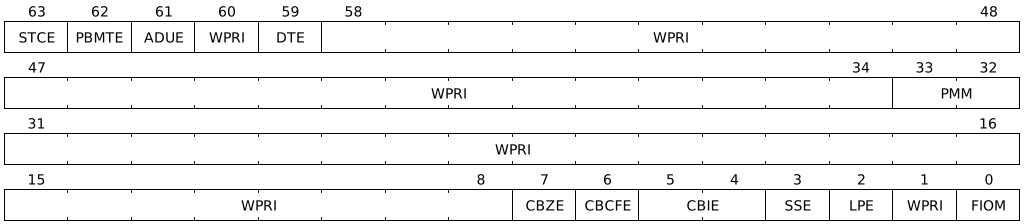
If bit FIOM (Fence of I/O implies Memory) is set to one in henvcfg,
FENCE instructions executed when V=1 are modified so the requirement to
order accesses to device I/O implies also the requirement to order main
memory accesses. Table 33 details the modified
interpretation of FENCE instruction bits PI, PO, SI, and SO when FIOM=1
and V=1.
Similarly, when FIOM=1 and V=1, if an atomic instruction that accesses a region ordered as device I/O has its aq and/or rl bit set, then that instruction is ordered as though it accesses both device I/O and memory.
Table 33. Modified interpretation of FENCE predecessor and successor sets when FIOM=1 and virtualization mode V=1.
| Instruction bit | Meaning when set |
|---|---|
| PO | Predecessor device output and memory writes (PW implied) |
| SO | Successor device output and memory writes (SW implied) |
The PBMTE bit controls whether the Svpbmt extension is available for use in VS-stage address translation. When PBMTE=1, Svpbmt is available for VS-stage address translation. When PBMTE=0, the implementation behaves as though Svpbmt were not implemented for VS-stage address translation. If Svpbmt is not implemented, PBMTE is read-only zero.
If the Svadu extension is implemented, the ADUE bit controls whether hardware updating of PTE A/D bits is enabled for VS-stage address translation. When ADUE=1, hardware updating of PTE A/D bits is enabled during VS-stage address translation, and the implementation behaves as though the Svade extension were not implemented for VS-mode address translation. When ADUE=0, the implementation behaves as though Svade were implemented for VS-stage address translation. If Svadu is not implemented, ADUE is read-only zero.
The Sstc extension adds the STCE (STimecmp Enable) bit to henvcfg CSR. When
the Sstc extension is not implemented, STCE is read-only zero. The STCE bit
enables vstimecmp for VS-mode when set to one. When STCE bit is henvcfg is
zero, an attempt to access stimecmp (really vstimecmp) when V=1 raises a
virtual-instruction exception, and VSTIP in hip reverts to its defined behavior
as if this extension is not implemented.
The Zicboz extension adds the CBZE (Cache Block Zero instruction enable) field
to henvcfg. The CBZE field applies to execution of the cache block zero
instruction (CBO.ZERO) in privilege modes VS and VU, and only when the
instruction is HS-qualified. If the instruction is not HS-qualified, it raises
an illegal-instruction exception. If the instruction is HS-qualified and the
CBZE field is set to 1, the instruction is enabled for execution; otherwise,
if the CBZE field is set to 0, it raises a virtual-instruction exception. When
the Zicboz extension is not implemented, CBZE is read-only zero.
The Zicbom extension adds the CBCFE (Cache Block Clean and Flush instruction
Enable) field to henvcfg. When V=1, if the CBO.CLEAN and CBO.FLUSH
instructions are not HS-qualified, they raise an illegal-instruction exception.
If the instructions are HS-qualified and the CBCFE field is set to 1, the
instructions are enabled for execution; otherwise, if the CBCFE field is set
to 0, they raise a virtual-instruction exception. When the Zicbom extension is
not implemented, CBCFE is read-only zero.
The Zicbom extension adds the CBIE (Cache Block Invalidate instruction Enable)
WARL field to henvcfg. The CBIE field controls execution of the cache block
invalidate instruction (CBO.INVAL) in privilege modes VS and VU. The encoding
0b10 is reserved. When the Zicbom extension is not implemented, CBIE is
read-only zero.
When V=1, if the CBO.INVAL instruction is not HS-qualified, it raises an
illegal-instruction exception. If the instruction is HS-qualified and the
CBIE field is set to 0b01 or 0b11, the instruction is enabled for execution;
otherwise, it raises a virtual-instruction exception.
If CBO.INVAL is enabled in HS-mode to perform a flush operation, then when the
instruction is enabled in VS- or VU-mode it performs a flush operation, even if
CBIE is set to 0b11. Otherwise, when the instruction is enabled for
execution, its behavior depends on the CBIE encoding, as follows:
0b01— The instruction is executed and performs a flush operation, even if configured by VS-mode to perform an invalidate operation.0b11— The instruction is executed and performs an invalidate operation, unless configured by VS-mode to perform a flush operation.
If the Ssnpm extension is implemented, the PMM field enables or disables
pointer masking (see Section 6.10) for VS-mode, according to the values in
Table 34. When the Ssnpm extension is not implemented, the PMM
field is read-only zero. The PMM field is read-only zero for RV32.
Table 34. Legal values of PMM WARL field
| Value | Description |
|---|---|
| 00 | Pointer masking is disabled (PMLEN = 0) |
| 01 | Reserved |
| 10 | Pointer masking is enabled with PMLEN = XLEN - 57 (PMLEN = 7 on RV64) |
| 11 | Pointer masking is enabled with PMLEN = XLEN - 48 (PMLEN = 16 on RV64) |
The Zicfilp extension adds the LPE field in henvcfg. When the LPE field
is set to 1, the Zicfilp extension is enabled in VS-mode. When the LPE field
is 0, the Zicfilp extension is not enabled in VS-mode and the following rules
apply to VS-mode:
- The hart does not update the
ELPstate; it remains asNO_LP_EXPECTED. - The
LPADinstruction operates as a no-op.
The Zicfiss extension adds the SSE field in henvcfg. If the SSE field is
set to 1, the Zicfiss extension is activated in VS-mode. When the SSE field is
0, the Zicfiss extension remains inactive in VS-mode, and the following rules
apply when V=1:
- 32-bit Zicfiss instructions will revert to their behavior as defined by Zimop.
- 16-bit Zicfiss instructions will revert to their behavior as defined by Zcmop.
- The
pte.xwr=0b010encoding in VS-stage page tables becomes reserved. - The
senvcfg.SSEfield is read-only zero. - When
menvcfg.SSEis one,SSAMOSWAP.W/Draises a virtual-instruction exception.
The Ssdbltrp extension adds the double-trap-enable (DTE) field in henvcfg.
When henvcfg.DTE is zero, the implementation behaves as though Ssdbltrp is not
implemented for VS-mode and the vsstatus.SDT bit is read-only zero.
When XLEN=32, henvcfgh is a
32-bit read/write register that aliases bits 63:32
of henvcfg. Register henvcfgh does not exist when
XLEN=64.
5.2.6 Hypervisor Counter-Enable (hcounteren) Register
The counter-enable register hcounteren is a 32-bit register that
controls the availability of the hardware performance monitoring
counters to the guest virtual machine.

When the CY, TM, IR, or HPM_n_ bit in the hcounteren register is
clear, attempts to read the cycle, time, instret, or
hpmcounter n register while V=1 will cause a virtual-instruction
exception if the same bit in mcounteren is 1. When one of these bits
is set, access to the corresponding register is permitted when V=1,
unless prevented for some other reason. In VU-mode, a counter is not
readable unless the applicable bits are set in both hcounteren and
scounteren.
In addition, when the TM bit in the hcounteren register is clear, attempts to
access the vstimecmp register (via stimecmp) while executing in VS-mode will
cause a virtual-instruction exception if the same bit in mcounteren is set.
When this bit and the same bit in mcounteren are both set, access to the
vstimecmp register (if implemented) is permitted in VS-mode.
hcounteren must be implemented. However, any of the bits may be
read-only zero, indicating reads to the corresponding counter will cause
an exception when V=1. Hence, they are effectively WARL fields.
5.2.7 Hypervisor Time Delta (htimedelta) Register
The htimedelta CSR is a 64-bit read/write register
that contains the delta
between the value of the time CSR and the value returned in VS-mode or
VU-mode. That is, reading the time CSR in VS or VU mode returns the
sum of the contents of htimedelta and the actual value of time.
Because overflow is ignored when summing htimedelta and time, large
values of htimedelta may be used to represent negative time offsets.

When XLEN=32, htimedeltah is a 32-bit read/write register
that aliases bits 63:32 of htimedelta.
Register htimedeltah does not exist when XLEN=64.
If the time CSR is implemented, htimedelta (and htimedeltah for XLEN=32)
must be implemented.
5.2.8 Hypervisor Trap Value (htval) Register
The htval register is an HSXLEN-bit read/write register formatted as
shown in Hypervisor trap value register (htval).. When a trap is taken into
HS-mode, htval is written with additional exception-specific
information, alongside stval, to assist software in handling the trap.

When a guest-page-fault trap is taken into HS-mode, htval is written
with either zero or the guest physical address that faulted, shifted
right by 2 bits. For other traps, htval is set to zero, but a future
standard or extension may redefine htval's setting for other traps.
A guest-page fault may arise due to an implicit memory access during
first-stage (VS-stage) address translation, in which case a guest
physical address written to htval is that of the implicit memory
access that faulted—for example, the address of a VS-level page table
entry that could not be read. (The guest physical address corresponding
to the original virtual address is unknown when VS-stage translation
fails to complete.) Additional information is provided in CSR htinst
to disambiguate such situations.
Otherwise, for misaligned loads and stores that cause guest-page faults,
a nonzero guest physical address in htval corresponds to the faulting
portion of the access as indicated by the virtual address in stval.
For instruction guest-page faults on systems with variable-length
instructions, a nonzero htval corresponds to the faulting portion of
the instruction as indicated by the virtual address in stval.
A guest physical address written to htval is shifted right by 2 bits
to accommodate addresses wider than the current XLEN. For RV32, the
hypervisor extension permits guest physical addresses as wide as 34 bits,
and htval reports bits 33:2 of the address. This shift-by-two
encoding of guest physical addresses matches the encoding of physical
addresses in PMP address registers (Section 3.7) and in
page table entries (Section 4.3, Section 4.4, Section 4.5, and Section 4.6).
If the least-significant two bits of a faulting guest physical address
are needed, these bits are ordinarily the same as the least-significant
two bits of the faulting virtual address in stval. For faults due to
implicit memory accesses for VS-stage address translation, the
least-significant two bits are instead zeros. These cases can be
distinguished using the value provided in register htinst.
htval is a WARL register that must be able to hold zero and may be capable
of holding only an arbitrary subset of other 2-bit-shifted guest
physical addresses, if any.
Unless it has reason to assume otherwise (such as a platform standard),
software that writes a value to htval should read back from htval to
confirm the stored value.
5.2.9 Hypervisor Trap Instruction (htinst) Register
The htinst register is an HSXLEN-bit read/write register formatted as
shown in Hypervisor trap instruction (htinst) register.. When a trap is taken into
HS-mode, htinst is written with a value that, if nonzero, provides
information about the instruction that trapped, to assist software in
handling the trap. The values that may be written to htinst on a trap
are documented in Section 5.6.3.

htinst is a WARL register that need only be able to hold the values that
the implementation may automatically write to it on a trap.
5.2.10 Hypervisor Guest Address Translation and Protection (hgatp) Register
The hgatp register is an HSXLEN-bit read/write register, formatted as
shown in Hypervisor guest address translation and protection register hgatp when HSXLEN=32. for HSXLEN=32 and
Hypervisor guest address translation and protection register hgatp when HSXLEN=64 for MODE values Bare, Sv39x4, Sv48x4, and Sv57x4. for HSXLEN=64, which controls
G-stage address translation and protection, the second stage of
two-stage translation for guest virtual addresses (see
Section 5.5). Similar to CSR satp, this
register holds the physical page number (PPN) of the guest-physical root
page table; a virtual machine identifier (VMID), which facilitates
address-translation fences on a per-virtual-machine basis; and the MODE
field, which selects the address-translation scheme for guest physical
addresses. When mstatus.TVM=1, attempts to read or write hgatp while
executing in HS-mode will raise an illegal-instruction exception.


Table 35 shows the encodings of the MODE field when
HSXLEN=32 and HSXLEN=64. When MODE=Bare, guest physical addresses are
equal to supervisor physical addresses, and there is no further memory
protection for a guest virtual machine beyond the physical memory
protection scheme described in Section 3.7. In this
case, software must write zero to the remaining fields in hgatp.
Attempting to select MODE=Bare with a nonzero pattern in the remaining fields
has an UNSPECIFIED effect on the value that the remaining fields assume and an
UNSPECIFIED effect on G-stage address translation and protection behavior.
When HSXLEN=32, the only other valid setting for MODE is Sv32x4, which is a modification of the usual Sv32 paged virtual-memory scheme, extended to support 34-bit guest physical addresses. When HSXLEN=64, modes Sv39x4, Sv48x4, and Sv57x4 are defined as modifications of the Sv39, Sv48, and Sv57 paged virtual-memory schemes. All of these paged virtual-memory schemes are described in Section 5.5.1.
The remaining MODE settings when HSXLEN=64 are reserved for future use
and may define different interpretations of the other fields in hgatp.
Table 35. Encoding of hgatp MODE field.
| HSXLEN=32 | ||
|---|---|---|
| Value | Name | Description |
| 1 | Sv32x4 | Page-based 34-bit virtual addressing (2-bit extension of Sv32). |
| HSXLEN=64 | ||
| Value | Name | Description |
| 11-15 | — | Page-based 41-bit virtual addressing (2-bit extension of Page-based 50-bit virtual addressing (2-bit extension of Page-based 59-bit virtual addressing (2-bit extension of Reserved |
Implementations are not required to support all defined MODE settings when HSXLEN=64.
A write to hgatp with an unsupported MODE value is not ignored as it
is for satp. Instead, the fields of hgatp are WARL in the normal way,
when so indicated.
As explained in Section 5.5.1, for the
paged virtual-memory schemes (Sv32x4, Sv39x4, Sv48x4, and Sv57x4), the
root page table is 16 KiB and must be aligned to a 16-KiB boundary. In
these modes, the lowest two bits of the physical page number (PPN) in
hgatp always read as zeros. An implementation that supports only the
defined paged virtual-memory schemes and/or Bare may make PPN[1:0]
read-only zero.
The number of VMID bits is UNSPECIFIED and may be zero. The number of implemented
VMID bits, termed VMIDLEN, may be determined by writing one to every
bit position in the VMID field, then reading back the value in hgatp
to see which bit positions in the VMID field hold a one. The
least-significant bits of VMID are implemented first: that is, if
VMIDLEN > 0, VMID[VMIDLEN-1:0] is writable. The maximal
value of VMIDLEN, termed VMIDMAX, is 7 for Sv32x4 or 14 for Sv39x4,
Sv48x4, and Sv57x4.
The hgatp register is considered active for the purposes of the
address-translation algorithm unless the effective privilege mode is U
and hstatus.HU=0.
This definition simplifies the implementation of speculative execution of HLV, HLVX, and HSV instructions.
Note that writing hgatp does not imply any ordering constraints
between page-table updates and subsequent G-stage address translations.
If the new virtual machine’s guest physical page tables have been
modified, or if a VMID is reused, it may be necessary to execute an
HFENCE.GVMA instruction (see Section 5.3.2) before or
after writing hgatp.
5.2.11 Virtual Supervisor Status (vsstatus) Register
The vsstatus register is a VSXLEN-bit read/write register that is
VS-mode’s version of supervisor register sstatus, formatted as shown
in Virtual supervisor status (vsstatus) register when VSXLEN=32. when VSXLEN=32 and
Virtual supervisor status (vsstatus) register when VSXLEN=64. when VSXLEN=64. When V=1,
vsstatus substitutes for the usual sstatus, so instructions that
normally read or modify sstatus actually access vsstatus instead.

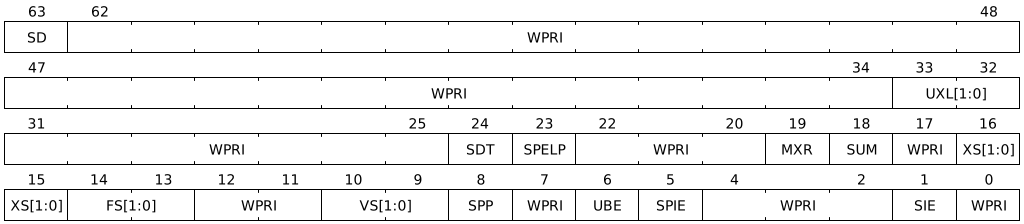
The UXL field controls the effective XLEN for VU-mode, which may differ
from the XLEN for VS-mode (VSXLEN). When VSXLEN=32, the UXL field does
not exist, and VU-mode XLEN=32. When VSXLEN=64, UXL is a WARL field that is
encoded the same as the MXL field of misa, shown in Table 11. In particular, an implementation may make UXL be a read-only copy of field VSXL of hstatus, forcing VU-mode XLEN=VSXLEN.
If VSXLEN is changed from 32 to a wider width, and if field UXL is not restricted to a single value, it gets the value corresponding to the widest supported width not wider than the new VSXLEN.
When V=1, both vsstatus.FS and the HS-level sstatus.FS are in
effect. Attempts to execute a floating-point instruction when either
field is 0 (Off) raise an illegal-instruction exception. Modifying the
floating-point state when V=1 causes both fields to be set to 3 (Dirty).
For a hypervisor to benefit from the extension context status, it must
have its own copy in the HS-level sstatus, maintained independently of
a guest OS running in VS-mode. While a version of the extension context
status obviously must exist in vsstatus for VS-mode, a hypervisor
cannot rely on this version being maintained correctly, given that
VS-level software can change vsstatus.FS arbitrarily. If the HS-level
sstatus.FS were not independently active and maintained by the
hardware in parallel with vsstatus.FS while V=1, hypervisors would
always be forced to conservatively swap all floating-point state when
context-switching between virtual machines.
Similarly, when V=1, both vsstatus.VS and the HS-level sstatus.VS
are in effect. Attempts to execute a vector instruction when either
field is 0 (Off) raise an illegal-instruction exception. Modifying the
vector state when V=1 causes both fields to be set to 3 (Dirty).
Read-only fields SD and XS summarize the extension context status as it
is visible to VS-mode only. For example, the value of the HS-level
sstatus.FS does not affect vsstatus.SD.
An implementation may make field UBE be a read-only copy of
hstatus.VSBE.
When V=0, vsstatus does not directly affect the behavior of the
machine, unless a virtual-machine load/store (HLV, HLVX, or HSV) or the
MPRV feature in the mstatus register is used to execute a load or
store as though V=1.
The Zicfilp extension adds the SPELP field that holds the previous ELP, and
is updated as specified in Section 6.9.1.2. The SPELP field is
encoded as follows:
- 0 -
NO_LP_EXPECTED- no landing pad instruction expected. - 1 -
LP_EXPECTED- a landing pad instruction is expected.
The Ssdbltrp adds an S-mode-disable-trap (SDT) field extension to address
double trap (See Section 4.1.1.5) in VS-mode.
5.2.12 Virtual Supervisor Interrupt (vsip and vsie) Registers
The vsip and vsie registers are VSXLEN-bit read/write registers that
are VS-mode’s versions of supervisor CSRs sip and sie, formatted as
shown in Virtual supervisor interrupt-pending register (vsip). and Virtual supervisor interrupt-enable register (vsie).
respectively. When V=1, vsip and vsie substitute for the usual sip
and sie, so instructions that normally read or modify sip/sie
actually access vsip/vsie instead. However, interrupts directed to
HS-level continue to be indicated in the HS-level sip register, not in
vsip, when V=1.

The standard portions (bits 15:0) of registers vsip and vsie are
formatted as shown in Standard portion (bits 15:0) of vsip.
and Standard portion (bits 15:0) of vsie. respectively.


Extension Shlcofideleg supports delegating LCOFI interrupts to VS-mode.
If the Shlcofideleg extension is implemented, hideleg bit 13 is
writable; otherwise, it is read-only zero.
When bit 13 of hideleg is zero, vsip.LCOFIP and vsie.LCOFIE
are read-only zeros.
Else, vsip.LCOFIP and vsie.LCOFIE are aliases of sip.LCOFIP
and sie.LCOFIE.
When bit 10 of hideleg is zero, vsip.SEIP and vsie.SEIE are
read-only zeros. Else, vsip.SEIP and vsie.SEIE are aliases of
hip.VSEIP and hie.VSEIE.
When bit 6 of hideleg is zero, vsip.STIP and vsie.STIE are
read-only zeros. Else, vsip.STIP and vsie.STIE are aliases of
hip.VSTIP and hie.VSTIE.
When bit 2 of hideleg is zero, vsip.SSIP and vsie.SSIE are
read-only zeros. Else, vsip.SSIP and vsie.SSIE are aliases of
hip.VSSIP and hie.VSSIE.
5.2.13 Virtual Supervisor Trap Vector Base Address (vstvec) Register
The vstvec register is a VSXLEN-bit read/write register that is
VS-mode’s version of supervisor register stvec, formatted as shown in
Virtual supervisor trap vector base address register vstvec.. When V=1, vstvec substitutes for
the usual stvec, so instructions that normally read or modify stvec
actually access vstvec instead. When V=0, vstvec does not directly
affect the behavior of the machine.

5.2.14 Virtual Supervisor Scratch (vsscratch) Register
The vsscratch register is a VSXLEN-bit read/write register that is
VS-mode’s version of supervisor register sscratch, formatted as shown
in Virtual supervisor scratch register vsscratch.. When V=1, vsscratch
substitutes for the usual sscratch, so instructions that normally read
or modify sscratch actually access vsscratch instead. The contents
of vsscratch never directly affect the behavior of the machine.

5.2.15 Virtual Supervisor Exception Program Counter (vsepc) Register
The vsepc register is a VSXLEN-bit read/write register that is
VS-mode’s version of supervisor register sepc, formatted as shown in
Virtual supervisor exception program counter (vsepc).. When V=1, vsepc substitutes for the
usual sepc, so instructions that normally read or modify sepc
actually access vsepc instead. When V=0, vsepc does not directly
affect the behavior of the machine.
vsepc is a WARL register that must be able to hold the same set of values
that sepc can hold.

5.2.16 Virtual Supervisor Cause (vscause) Register
The vscause register is a VSXLEN-bit read/write register that is
VS-mode’s version of supervisor register scause, formatted as shown in
Virtual supervisor cause register (vscause).. When V=1, vscause substitutes
for the usual scause, so instructions that normally read or modify
scause actually access vscause instead. When V=0, vscause does not
directly affect the behavior of the machine.
vscause is a WLRL register that must be able to hold the same set of
values that scause can hold.

5.2.17 Virtual Supervisor Trap Value (vstval) Register
The vstval register is a VSXLEN-bit read/write register that is
VS-mode’s version of supervisor register stval, formatted as shown in
Virtual supervisor trap value register (vstval).. When V=1, vstval substitutes for
the usual stval, so instructions that normally read or modify stval
actually access vstval instead. When V=0, vstval does not directly
affect the behavior of the machine.
vstval is a WARL register that must be able to hold the same set of values
that stval can hold.

5.2.18 Virtual Supervisor Address Translation and Protection (vsatp) Register
The vsatp register is a VSXLEN-bit read/write register that is
VS-mode’s version of supervisor register satp, formatted as shown in
Virtual supervisor address translation and protection vsatp register when VSXLEN=32. for VSXLEN=32 and Virtual supervisor address translation and protection vsatp register when VSXLEN=64. for VSXLEN=64. When V=1,
vsatp substitutes for the usual satp, so instructions that normally
read or modify satp actually access vsatp instead. vsatp controls
VS-stage address translation, the first stage of two-stage translation
for guest virtual addresses (see
Section 5.5).


The vsatp register is considered active for the purposes of the
address-translation algorithm unless the effective privilege mode is U
and hstatus.HU=0. However, even when vsatp is active, VS-stage
page-table entries’ A bits must not be set as a result of speculative
execution, unless the effective privilege mode is VS or VU.
In particular, virtual-machine load/store (HLV, HLVX, or HSV) instructions that are mispredicted must not cause VS-stage A bits to be set.
When V=0, a write to vsatp with an unsupported MODE value is either
ignored as it is for satp, or the fields of vsatp are treated as WARL in
the normal way. However, when V=1, a write to satp with an unsupported
MODE value is ignored and no write to vsatp is effected.
When V=0, vsatp does not directly affect the behavior of the machine,
unless a virtual-machine load/store (HLV, HLVX, or HSV) or the MPRV
feature in the mstatus register is used to execute a load or store as
though V=1.
5.2.19 Virtual Supervisor Timer (vstimecmp) Register
The vstimecmp CSR is a 64-bit register and has 64-bit precision on all RV32
and RV64 systems. In RV32 only, accesses to the vstimecmp CSR access the low
32 bits, while accesses to the vstimecmph CSR access the high 32 bits of
vstimecmp.
A virtual supervisor timer interrupt becomes pending, as reflected in the
VSTIP bit in the hip register, whenever (time + htimedelta), truncated
to 64 bits, contains a value greater than or equal to vstimecmp, treating
the values as unsigned integers.
If the result of this comparison changes, it is guaranteed to be reflected in
VSTIP eventually, but not necessarily immediately.
The interrupt remains posted until vstimecmp becomes greater than (time + htimedelta),
typically as a result of writing vstimecmp.
The interrupt will be taken based on the standard interrupt enable and
delegation rules while V=1.
In systems in which a supervisor execution environment (SEE) implemented by an HS-mode hypervisor provides timer facilities via an SBI function call, this SBI call will continue to support requests to schedule a timer interrupt. The SEE will simply make use of vstimecmp, changing its value as appropriate. This ensures compatibility with existing guest VS-mode software that uses this SEE facility, while new VS-mode software takes advantage of vstimecmp directly.)
5.3 Hypervisor Instructions
The hypervisor extension adds virtual-machine load and store instructions and two privileged fence instructions.
5.3.1 Hypervisor Virtual-Machine Load and Store Instructions

The hypervisor virtual-machine load and store instructions are valid
only in M-mode or HS-mode, or in U-mode when hstatus.HU=1.
Each
instruction performs an explicit memory access with an effective privilege mode
of VS or VU. The effective privilege mode of the explicit memory access is VU
when hstatus.SPVP=0, and VS when hstatus.SPVP=1.
As usual for VS-mode and
VU-mode, two-stage address translation is applied, and
the HS-level sstatus.SUM is ignored.
HS-level sstatus.MXR makes
execute-only pages readable by explicit loads for both stages of address translation
(VS-stage and G-stage), whereas
vsstatus.MXR affects only the first
translation stage (VS-stage).
For every RV32I or RV64I load instruction, LB, LBU, LH, LHU, LW, LWU, and LD, there is a corresponding virtual-machine load instruction: HLV.B, HLV.BU, HLV.H, HLV.HU, HLV.W, HLV.WU, and HLV.D. For every RV32I or RV64I store instruction, SB, SH, SW, and SD, there is a corresponding virtual-machine store instruction: HSV.B, HSV.H, HSV.W, and HSV.D. Instructions HLV.WU, HLV.D, and HSV.D are not valid for RV32, of course.
Instructions HLVX.HU and HLVX.WU are the same as HLV.HU and HLV.WU, except that execute permission takes the place of read permission during address translation. That is, the memory being read must be executable in both stages of address translation, but read permission is not required. For the supervisor physical address that results from address translation, the supervisor physical memory attributes must grant both execute and read permissions. (The supervisor physical memory attributes are the machine’s physical memory attributes as modified by physical memory protection, Section 3.7, for supervisor level.)
HLVX cannot override machine-level physical memory protection (PMP), so attempting to read memory that PMP designates as execute-only still results in an access-fault exception.
Although HLVX instructions’ explicit memory accesses require execute permissions, they still raise the same exceptions as other load instructions, rather than raising fetch exceptions instead.
HLVX.WU is valid for RV32, even though LWU and HLV.WU are not. (For RV32, HLVX.WU can be considered a variant of HLV.W, as sign extension is irrelevant for 32-bit values.)
The memory accesses performed by the HLVX.* instructions are not subject to
pointer masking (see Section 6.10).
HLVX.* instructions, designed for emulating implicit access to fetch
instructions from guest memory, perform memory accesses that are exempt from
pointer masking to facilitate this emulation. For the same reason, pointer
masking does not apply when MXR is set.
Attempts to execute a virtual-machine load/store instruction (HLV, HLVX,
or HSV) when V=1 cause a virtual-instruction exception.
Attempts to execute one of these same instructions from U-mode when hstatus.HU=0 cause an
illegal-instruction exception.
5.3.2 Hypervisor Memory-Management Fence Instructions

The hypervisor memory-management fence instructions, HFENCE.VVMA and
HFENCE.GVMA, perform a function similar to SFENCE.VMA
(Section 4.2.1), except applying to the
VS-level memory-management data structures controlled by CSR vsatp
(HFENCE.VVMA) or the guest-physical memory-management data structures
controlled by CSR hgatp (HFENCE.GVMA). Instruction SFENCE.VMA applies
only to the memory-management data structures controlled by the current
satp (either the HS-level satp when V=0 or vsatp when V=1).
HFENCE.VVMA is valid only in M-mode or HS-mode. Its effect is much the same as temporarily entering VS-mode and executing SFENCE.VMA. Executing an HFENCE.VVMA guarantees that any previous stores already visible to the current hart are ordered before all implicit reads by that hart done for VS-stage address translation for instructions that
- are subsequent to the HFENCE.VVMA, and
- execute when
hgatp.VMID has the same setting as it did when HFENCE.VVMA executed.
Implicit reads need not be ordered when hgatp.VMID is different than
at the time HFENCE.VVMA executed. If operand rs1≠x0, it specifies a single guest virtual address, and if operand rs2≠x0, it specifies a single guest address-space identifier (ASID).
An HFENCE.VVMA instruction applies only to a single virtual machine,
identified by the setting of hgatp.VMID when HFENCE.VVMA executes.
When rs2≠x0, bits XLEN-1:ASIDMAX of the value held
in rs2 are reserved for future standard use. Until their use is
defined by a standard extension, they should be zeroed by software and
ignored by current implementations. Furthermore, if
ASIDLEN < ASIDMAX, the implementation shall ignore bits
ASIDMAX-1:ASIDLEN of the value held in rs2.
Simpler implementations of HFENCE.VVMA can ignore the guest virtual
address in rs1 and the guest ASID value in rs2, as well as
hgatp.VMID, and always perform a global fence for the VS-level memory
management of all virtual machines, or even a global fence for all
memory-management data structures.
Neither mstatus.TVM nor hstatus.VTVM causes HFENCE.VVMA to trap.
HFENCE.GVMA is valid only in HS-mode when mstatus.TVM=0, or in M-mode
(irrespective of mstatus.TVM). Executing an HFENCE.GVMA instruction
guarantees that any previous stores already visible to the current hart
are ordered before all implicit reads by that hart done for G-stage
address translation for instructions that follow the HFENCE.GVMA. If
operand rs1≠x0, it specifies a single guest
physical address, shifted right by 2 bits, and if operand
rs2≠x0, it specifies a single virtual machine
identifier (VMID).
Conceptually, an implementation might contain two address-translation caches: one that maps guest virtual addresses to guest physical addresses, and another that maps guest physical addresses to supervisor physical addresses. HFENCE.GVMA need not flush the former cache, but it must flush entries from the latter cache that match the HFENCE.GVMA’s address and VMID arguments.
More commonly, implementations contain address-translation caches that map guest virtual addresses directly to supervisor physical addresses, removing a level of indirection. For such implementations, any entry whose guest virtual address maps to a guest physical address that matches the HFENCE.GVMA’s address and VMID arguments must be flushed. Selectively flushing entries in this fashion requires tagging them with the guest physical address, which is costly, and so a common technique is to flush all entries that match the HFENCE.GVMA’s VMID argument, regardless of the address argument.
Like for a guest physical address written to htval on a trap, a guest
physical address specified in rs1 is shifted right by 2 bits to
accommodate addresses wider than the current XLEN.
When rs2≠x0, bits XLEN-1:VMIDMAX of the value held
in rs2 are reserved for future standard use. Until their use is
defined by a standard extension, they should be zeroed by software and
ignored by current implementations. Furthermore, if
VMIDLEN < VMIDMAX, the implementation shall ignore bits
VMIDMAX-1:VMIDLEN of the value held in rs2.
Simpler implementations of HFENCE.GVMA can ignore the guest physical address in rs1 and the VMID value in rs2 and always perform a global fence for the guest-physical memory management of all virtual machines, or even a global fence for all memory-management data structures.
If hgatp.MODE is changed for a given VMID, an HFENCE.GVMA with
rs1=x0 (and rs2 set to either x0 or the VMID) must be executed
to order subsequent guest translations with the MODE change—even if the
old MODE or new MODE is Bare.
Attempts to execute HFENCE.VVMA or HFENCE.GVMA when V=1 cause a
virtual-instruction exception, while attempts to do the same in U-mode cause an
illegal-instruction exception. Attempting to execute HFENCE.GVMA in HS-mode
when mstatus.TVM=1 also causes an illegal-instruction exception.
5.4 Machine-Level CSRs
The hypervisor extension augments or modifies machine CSRs mstatus,
mstatush, mideleg, mip, and mie, and adds CSRs mtval2 and
mtinst.
5.4.1 Machine Status (mstatus and mstatush) Registers
The hypervisor extension adds two fields, MPV and GVA, to the
machine-level mstatus or mstatush CSR, and modifies the behavior of
several existing mstatus fields.
Machine status (mstatus) register for RV64 when the hypervisor extension is implemented. shows the modified
mstatus register when the hypervisor extension is implemented and
MXLEN=64. When MXLEN=32, the hypervisor extension adds MPV and GVA not
to mstatus but to mstatush.
Additional machine status (mstatush) register for RV32 when the hypervisor extension is implemented. The format of mstatus is unchanged for RV32. shows the
mstatush register when the hypervisor extension is implemented and
MXLEN=32.
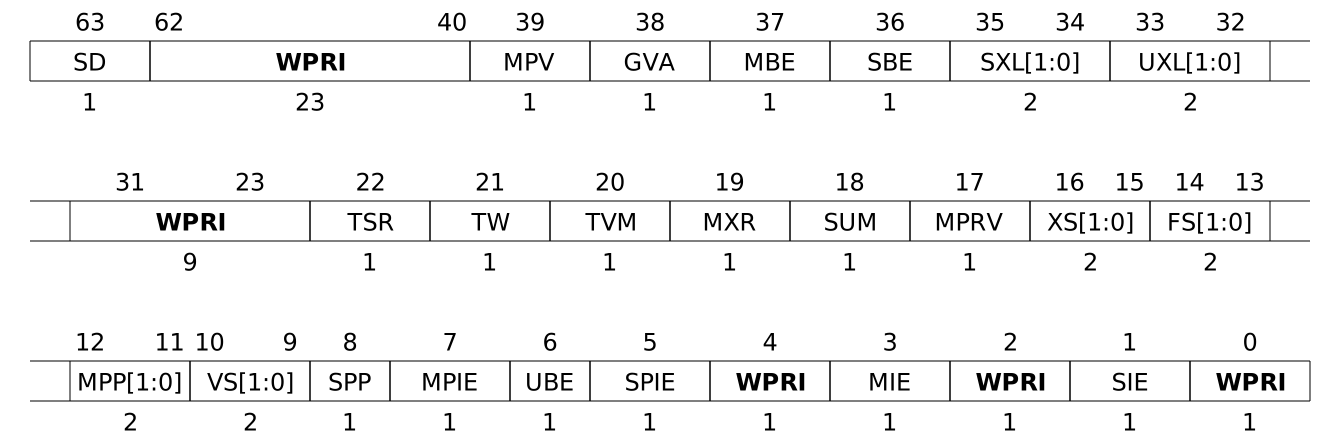

The MPV bit (Machine Previous Virtualization Mode) is written by the implementation whenever a trap is taken into M-mode. Just as the MPP field is set to the (nominal) privilege mode at the time of the trap, the MPV bit is set to the value of the virtualization mode V at the time of the trap. When an MRET instruction is executed, the virtualization mode V is set to MPV, unless MPP=3, in which case V remains 0.
Field GVA (Guest Virtual Address) is written by the implementation
whenever a trap is taken into M-mode. For any trap (breakpoint, address
misaligned, access fault, page fault, or guest-page fault) that writes a
guest virtual address to mtval, GVA is set to 1. For any other trap
into M-mode, GVA is set to 0.
The TSR and TVM fields of mstatus affect execution only in HS-mode,
not in VS-mode. The TW field affects execution in all modes except
M-mode.
Setting TVM=1 prevents HS-mode from accessing hgatp or executing
HFENCE.GVMA or HINVAL.GVMA, but has no effect on accesses to vsatp or
instructions HFENCE.VVMA or HINVAL.VVMA.
TVM exists in mstatus to allow machine-level software to modify the
address translations managed by a supervisor-level OS, usually for the
purpose of inserting another stage of address translation below that
controlled by the OS. The instruction traps enabled by TVM=1 permit
machine level to co-opt both satp and hgatp and substitute shadow
page tables that merge the OS’s chosen page translations with M-level’s
lower-stage translations, all without the OS being aware. M-level
software needs this ability not only to emulate the hypervisor extension
if not already supported, but also to emulate any future RISC-V
extensions that may modify or add address translation stages, perhaps,
for example, to improve support for nested hypervisors, i.e., running
hypervisors atop other hypervisors.
However, setting TVM=1 does not cause traps for accesses to vsatp or
instructions HFENCE.VVMA or HINVAL.VVMA, or for any actions taken in
VS-mode, because M-level software is not expected to need to involve
itself in VS-stage address translation. For virtual machines, it should
be sufficient, and in all likelihood faster as well, to leave VS-stage
address translation alone and merge all other translation stages into
G-stage shadow page tables controlled by hgatp. This assumption does
place some constraints on possible future RISC-V extensions that current
machines will be able to emulate efficiently.
The hypervisor extension changes the behavior of the Modify Privilege
field, MPRV, of mstatus. When MPRV=0, translation and protection
behave as normal. When MPRV=1, explicit memory accesses are translated
and protected, and endianness is applied, as though the current
virtualization mode were set to MPV and the current nominal privilege
mode were set to MPP. Table 36 enumerates the cases.
Table 36. Effect of MPRV on the translation and protection of explicit memory accesses.
| MPRV | MPV | MPP | Effect |
|---|---|---|---|
| 0 | - | - | Normal access; current privilege mode applies. |
| 1 | 0 | 0 | U-level access with HS-level translation and protection only. |
| 1 | 0 | 1 | HS-level access with HS-level translation and protection only. |
| 1 | - | 3 | M-level access with no translation. |
| 1 | 1 | 0 | VU-level access with two-stage translation and protection. The HS-level MXR bit makes any executable page readable. vsstatus.MXR makes readable those pages marked executable at the VS translation stage, but only if readable at the guest-physical translation stage. |
| 1 | 1 | 1 | VS-level access with two-stage translation and protection. The HS-level MXR bit makes any executable page readable. vsstatus.MXR makes readable those pages marked executable at the VS translation stage, but only if readable at the guest-physical translation stage. vsstatus.SUM applies instead of the HS-level SUM bit. |
MPRV does not affect the virtual-machine load/store instructions, HLV,
HLVX, and HSV. The explicit loads and stores of these instructions
always act as though V=1 and the nominal privilege mode were
hstatus.SPVP, overriding MPRV.
The mstatus register is a superset of the HS-level sstatus register
but is not a superset of vsstatus.
5.4.2 Machine Interrupt Delegation (mideleg) Register
When the hypervisor extension is implemented, bits 10, 6, and 2 of
mideleg (corresponding to the standard VS-level interrupts) are each
read-only one. Furthermore, if any guest external interrupts are
implemented (GEILEN is nonzero), bit 12 of mideleg (corresponding to
supervisor-level guest external interrupts) is also read-only one.
VS-level interrupts and guest external interrupts are always delegated
past M-mode to HS-mode.
For bits of mideleg that are zero, the corresponding bits in
hideleg, hip, and hie are read-only zeros.
5.4.3 Machine Interrupt (mip and mie) Registers
The hypervisor extension gives registers mip and mie additional
active bits for the hypervisor-added interrupts. Standard portion (bits 15:0) of mip. and Standard portion (bits 15:0) of mie. show the
standard portions (bits 15:0) of registers mip and mie when the
hypervisor extension is implemented.


Bits SGEIP, VSEIP, VSTIP, and VSSIP in mip are aliases for the same
bits in hypervisor CSR hip, while SGEIE, VSEIE, VSTIE, and VSSIE in
mie are aliases for the same bits in hie.
5.4.4 Machine Second Trap Value (mtval2) Register
The mtval2 register is an MXLEN-bit read/write register formatted as
shown in Machine second trap value register (mtval2).. When a trap is taken into
M-mode, mtval2 is written with additional exception-specific
information, alongside mtval, to assist software in handling the trap.

When a guest-page-fault trap is taken into M-mode, mtval2 is written
with either zero or the guest physical address that faulted, shifted
right by 2 bits. For other traps, mtval2 is set to zero, but a future
standard or extension may redefine mtval2's setting for other traps.
If a guest-page fault is due to an implicit memory access during
first-stage (VS-stage) address translation, a guest physical address
written to mtval2 is that of the implicit memory access that faulted.
Additional information is provided in CSR mtinst to disambiguate such
situations.
Otherwise, for misaligned loads and stores that cause guest-page faults,
a nonzero guest physical address in mtval2 corresponds to the faulting
portion of the access as indicated by the virtual address in mtval.
For instruction guest-page faults on systems with variable-length
instructions, a nonzero mtval2 corresponds to the faulting portion of
the instruction as indicated by the virtual address in mtval.
mtval2 is a WARL register that must be able to hold zero and may be
capable of holding only an arbitrary subset of other 2-bit-shifted guest
physical addresses, if any.
The Ssdbltrap extension (See Section 8.10) requires the implementation of
the mtval2 CSR.
5.4.5 Machine Trap Instruction (mtinst) Register
The mtinst register is an MXLEN-bit read/write register formatted as
shown in Machine trap instruction (mtinst) register.. When a trap is taken into
M-mode, mtinst is written with a value that, if nonzero, provides
information about the instruction that trapped, to assist software in
handling the trap. The values that may be written to mtinst on a trap
are documented in Section 5.6.3.

mtinst is a WARL register that need only be able to hold the values that
the implementation may automatically write to it on a trap.
5.5 Two-Stage Address Translation
Whenever the current virtualization mode V is 1, two-stage address
translation and protection is in effect. For any virtual memory access,
the original virtual address is converted in the first stage by VS-level
address translation, as controlled by the vsatp register, into a
guest physical address. The guest physical address is then converted
in the second stage by guest physical address translation, as controlled
by the hgatp register, into a supervisor physical address. The two
stages are known also as VS-stage and G-stage translation. Although
there is no option to disable two-stage address translation when V=1,
either stage of translation can be effectively disabled by zeroing the
corresponding vsatp or hgatp register.
The vsstatus field MXR, which makes execute-only pages readable by explicit loads, only
overrides VS-stage page protection. Setting MXR at VS-level does not
override guest-physical page protections.
Setting MXR at HS-level,
however, overrides both VS-stage and G-stage execute-only permissions.
When V=1, memory accesses that would normally bypass address translation are subject to G-stage address translation alone. This includes memory accesses made in support of VS-stage address translation, such as reads and writes of VS-level page tables.
Machine-level physical memory protection applies to supervisor physical addresses and is in effect regardless of virtualization mode.
5.5.1 Guest Physical Address Translation
The mapping of guest physical addresses to supervisor physical addresses
is controlled by CSR hgatp (Section 5.2.10).
When the address translation scheme selected by the MODE field of
hgatp is Bare, guest physical addresses are equal to supervisor
physical addresses without modification, and no memory protection
applies in the trivial translation of guest physical addresses to
supervisor physical addresses.
When hgatp.MODE specifies a translation scheme of Sv32x4, Sv39x4,
Sv48x4, or Sv57x4, G-stage address translation is a variation on the
usual page-based virtual address translation scheme of Sv32, Sv39, Sv48,
or Sv57, respectively. In each case, the size of the incoming address is
widened by 2 bits (to 34, 41, 50, or 59 bits). To accommodate the
two extra bits, the root page table (only) is expanded by a factor of 4
to be 16 KiB instead of the usual 4 KiB. Matching its larger size, the
root page table also must be aligned to a 16 KiB boundary instead of the
usual 4 KiB page boundary. Except as noted, all other aspects of Sv32,
Sv39, Sv48, or Sv57 are adopted unchanged for G-stage translation.
Non-root page tables and all page table entries (PTEs) have the same
formats as documented in Section 4.3, Section 4.4, Section 4.5, and Section 4.6.
For Sv32x4, an incoming guest physical address is partitioned into a virtual page number (VPN) and page offset as shown in Sv32x4 virtual address (guest physical address).. This partitioning is identical to that for an Sv32 virtual address as depicted in Sv32 virtual address., except with two more bits at the high end in VPN[1]. (Note that the fields of a partitioned guest physical address also correspond one-for-one with the structure that Sv32 assigns to a physical address, depicted in Sv32 virtual address..)

For Sv39x4, an incoming guest physical address is partitioned as shown in Sv39x4 virtual address (guest physical address).. This partitioning is identical to that for an Sv39 virtual address as depicted in Sv39 virtual address., except with 2 more bits at the high end in VPN[2]. Address bits 63:41 must all be zeros, or else a guest-page-fault exception occurs.

For Sv48x4, an incoming guest physical address is partitioned as shown in Sv48x4 virtual address (guest physical address).. This partitioning is identical to that for an Sv48 virtual address as depicted in Sv48 virtual address., except with 2 more bits at the high end in VPN[3]. Address bits 63:50 must all be zeros, or else a guest-page-fault exception occurs.

For Sv57x4, an incoming guest physical address is partitioned as shown in Sv57x4 virtual address (guest physical address).. This partitioning is identical to that for an Sv57 virtual address as depicted in Sv57 virtual address., except with 2 more bits at the high end in VPN[4]. Address bits 63:59 must all be zeros, or else a guest-page-fault exception occurs.

The page-based G-stage address translation scheme for RV32, Sv32x4, is defined to support a 34-bit guest physical address so that an RV32 hypervisor need not be limited in its ability to virtualize real 32-bit RISC-V machines, even those with 33-bit or 34-bit physical addresses. This may include the possibility of a machine virtualizing itself, if it happens to use 33-bit or 34-bit physical addresses. Multiplying the size and alignment of the root page table by a factor of four is the cheapest way to extend Sv32 to cover a 34-bit address. The possible wastage of 12 KiB for an unnecessarily large root page table is expected to be of negligible consequence for most (maybe all) real uses.
A consistent ability to virtualize machines having as much as four times the physical address space as virtual address space is believed to be of some utility also for RV64. For a machine implementing 39-bit virtual addresses (Sv39), for example, this allows the hypervisor extension to support up to a 41-bit guest physical address space without either necessitating hardware support for 48-bit virtual addresses (Sv48) or falling back to emulating the larger address space using shadow page tables.
The conversion of an Sv32x4, Sv39x4, Sv48x4, or Sv57x4 guest physical address is accomplished with the same algorithm used for Sv32, Sv39, Sv48, or Sv57, as presented in Section 4.3.2, except that:
hgatpsubstitutes for the usualsatp;- for the translation to begin, the effective privilege mode must be VS-mode or VU-mode;
- when checking the U bit, the current privilege mode is always taken to be U-mode; and
- guest-page-fault exceptions are raised instead of regular page-fault exceptions.
For G-stage address translation, all memory accesses (including those made to access data structures for VS-stage address translation) are considered to be user-level accesses, as though executed in U-mode. Access type permissions—readable, writable, or executable—are checked during G-stage translation the same as for VS-stage translation. For a memory access made to support VS-stage address translation (such as to read/write a VS-level page table), permissions and the need to set A and/or D bits at the G-stage level are checked as though for an implicit load or store, not for the original access type. However, any exception is always reported for the original access type (instruction, load, or store/AMO).
The G bit in all G-stage PTEs is currently not used. Until its use is defined by a standard extension, it should be cleared by software for forward compatibility, and must be ignored by hardware.
G-stage address translation uses the identical format for PTEs as regular address translation, even including the U bit, due to the possibility of sharing some (or all) page tables between G-stage translation and regular HS-level address translation. Regardless of whether this usage will ever become common, we chose not to preclude it.
5.5.2 Guest-Page Faults
Guest-page-fault traps may be delegated from M-mode to HS-mode under the
control of CSR medeleg, but cannot be delegated to other privilege
modes. On a guest-page fault, CSR mtval or stval is written with the
faulting guest virtual address as usual, and mtval2 or htval is
written either with zero or with the faulting guest physical address,
shifted right by 2 bits. CSR mtinst or htinst may also be written
with information about the faulting instruction or other reason for the
access, as explained in Section 5.6.3.
When an instruction fetch or a misaligned memory access straddles a page
boundary, two different address translations are involved. When a
guest-page fault occurs in such a circumstance, the faulting virtual
address written to mtval/stval is the same as would be required for
a regular page fault. Thus, the faulting virtual address may be a
page-boundary address that is higher than the instruction’s original
virtual address, if the byte at that page boundary is among the accessed
bytes.
When a guest-page fault is not due to an implicit memory access for
VS-stage address translation, a nonzero guest physical address written
to mtval2/htval shall correspond to the exact virtual address
written to mtval/stval.
5.5.3 Memory-Management Fences
The behavior of the SFENCE.VMA instruction is affected by the current virtualization mode V. When V=0, the virtual-address argument is an HS-level virtual address, and the ASID argument is an HS-level ASID. The instruction orders stores only to HS-level address-translation structures with subsequent HS-level address translations.
When V=1, the virtual-address argument to SFENCE.VMA is a guest virtual
address within the current virtual machine, and the ASID argument is a
VS-level ASID within the current virtual machine. The current virtual
machine is identified by the VMID field of CSR hgatp, and the
effective ASID can be considered to be the combination of this VMID with
the VS-level ASID. The SFENCE.VMA instruction orders stores only to the
VS-level address-translation structures with subsequent VS-stage address
translations for the same virtual machine, i.e., only when hgatp.VMID
is the same as when the SFENCE.VMA executed.
Hypervisor instructions HFENCE.VVMA and HFENCE.GVMA provide additional memory-management fences to complement SFENCE.VMA. These instructions are described in Section 5.3.2.
Section 3.7.2 discusses the intersection between
physical memory protection (PMP) and page-based address translation. It
is noted there that, when PMP settings are modified in a manner that
affects either the physical memory that holds page tables or the
physical memory to which page tables point, M-mode software must
synchronize the PMP settings with the virtual memory system. For
HS-level address translation, this is accomplished by executing in
M-mode an SFENCE.VMA instruction with rs1=x0 and rs2=x0, after
the PMP CSRs are written. Synchronization with G-stage and VS-stage data
structures is also needed. Executing an HFENCE.GVMA instruction with
rs1=x0 and rs2=x0 suffices to flush all G-stage or VS-stage
address-translation cache entries that have cached PMP settings
corresponding to the final translated supervisor physical address. An
HFENCE.VVMA instruction is not required.
Similarly, if the setting of the PBMTE or ADUE bits in menvcfg are changed, an
HFENCE.GVMA instruction with rs1=x0 and rs2=x0 suffices to synchronize
with respect to the altered interpretation of G-stage and VS-stage PTEs' PBMT
and A/D bit fields, respectively.
By contrast, if the PBMTE or ADUE bits in henvcfg are changed, executing an
HFENCE.VVMA with rs1=x0 and rs2=x0 suffices to synchronize with
respect to the altered interpretation of VS-stage PTEs' PBMT and A/D bit fields
for the currently active VMID.
No mechanism is provided to atomically change vsatp and hgatp
together. Hence, to prevent speculative execution causing one guest’s
VS-stage translations to be cached under another guest’s VMID, world-switch
code should zero vsatp, then swap hgatp, then finally write the new
vsatp value. Similarly, if henvcfg.PBMTE/ADUE need be world-switched, they
should be switched after zeroing vsatp but before writing the new vsatp
value, obviating the need to execute an HFENCE.VVMA instruction.
5.5.4 Interaction with Pointer Masking
Guest physical addresses (GPAs) are 2-bit wider than the corresponding virtual
address translation modes, resulting in additional address translation schemes
Sv32x4, Sv39x4, Sv48x4, and Sv57x4 for translating guest physical addresses to
supervisor physical addresses. When running with virtualization in VS/VU mode
with vsatp.MODE=Bare, this means that those 2 bits may be subject to
pointer masking, depending on hgatp.MODE and senvcfg.PMM or henvcfg.PMM (for
VU/VS mode). If vsatp.MODE≠Bare, this issue does not apply.
An implementation could mask those two bits on the TLB access path, but this can have a significant timing impact. Alternatively, an implementation may choose to waste TLB capacity by having up to 4 duplicate entries for each page. In this case, the pointer masking operation can be applied on the TLB refill path, where it is unlikely to affect timing. To support this approach, some TLB entries need to be flushed when PMLEN changes in a way that may affect these duplicate entries.
To support implementations where (XLEN-PMLEN) can be less than the GPA width
supported by hgatp.MODE, hypervisors should execute an HFENCE.GVMA with
rs1=x0 if the henvcfg.PMM is changed from or to a value where (XLEN-PMLEN)
is less than GPA width supported by the hgatp translation mode of that guest.
Specifically, these cases are:
PMLEN=7andhgatp.MODE=sv57x4PMLEN=16andhgatp.MODE=sv57x4PMLEN=16andhgatp.MODE=sv48x4
Implementation of an address-specific HFENCE.GVMA should either ignore the
address argument, or should ignore the top masked GPA bits of entries when
comparing for an address match.
5.6 Traps
5.6.1 Trap Cause Codes
The hypervisor extension augments the trap cause encoding. Table 37 lists the possible M-mode and HS-mode trap cause codes when the hypervisor extension is implemented. Codes are added for VS-level interrupts (interrupts 2, 6, 10), for supervisor-level guest external interrupts (interrupt 12), for virtual-instruction exceptions (exception 22), and for guest-page faults (exceptions 20, 21, 23). Furthermore, environment calls from VS-mode are assigned cause 10, whereas those from HS-mode or S-mode use cause 9 as usual.
Table 37. Machine and supervisor cause register (mcause and scause) values when the hypervisor extension is implemented.
| Interrupt | Exception Code | Description |
|---|---|---|
| 1 | 3 | Machine software interrupt |
| 1 | 7 | Machine timer interrupt |
| 1 | 11 | Machine external interrupt |
| 1 | ≥16 | Designated for platform use |
| ≥64 | Reserved |
HS-mode and VS-mode ECALLs use different cause values so they can be delegated separately.
When V=1, a virtual-instruction exception (code 22) is normally raised
instead of an illegal-instruction exception if the attempted instruction
is HS-qualified but is prevented from executing when V=1 either due to
insufficient privilege or because the instruction is expressly disabled
by a supervisor or hypervisor CSR such as scounteren or hcounteren.
An instruction is HS-qualified if it would be valid to execute in
HS-mode (for some values of the instruction’s register operands),
assuming fields TSR and TVM of CSR mstatus are both zero.
A special rule applies for CSR instructions that access 32-bit high-half
CSRs such as cycleh and htimedeltah. When V=1 and
XLEN=32, an invalid attempt to access a high-half CSR
raises a virtual-instruction
exception instead of an illegal-instruction exception if the same CSR
instruction for the corresponding low-half CSR (e.g.cycle or
htimedelta) is HS-qualified.
When XLEN>32, an attempt to access a high-half CSR always raises an illegal-instruction exception.
Specifically, a virtual-instruction exception is raised for the following cases:
- in VS-mode, attempts to access a non-high-half counter CSR when the
corresponding bit in
hcounterenis 0 and the same bit inmcounterenis 1; - in VS-mode, if XLEN=32, attempts to access a high-half counter CSR
when the corresponding bit in
hcounterenis 0 and the same bit inmcounterenis 1; - in VU-mode, attempts to access a non-high-half counter CSR when the
corresponding bit in either
hcounterenorscounterenis 0 and the same bit inmcounterenis 1; - in VU-mode, if XLEN=32, attempts to access a high-half counter CSR
when the corresponding bit in either
hcounterenorscounterenis 0 and the same bit inmcounterenis 1; - in VS-mode or VU-mode, attempts to execute a hypervisor instruction (HLV, HLVX, HSV, or HFENCE);
- in VS-mode or VU-mode, attempts to access an implemented non-high-half
hypervisor CSR or VS CSR when the same access (read/write) would be
allowed in HS-mode, assuming
mstatus.TVM=0; - in VS-mode or VU-mode, if XLEN=32, attempts to access an implemented
high-half hypervisor CSR or high-half VS CSR when the same access
(read/write) to the CSR’s low-half partner would be allowed in HS-mode,
assuming
mstatus.TVM=0; - in VU-mode, attempts to execute WFI when
mstatus.TW=0, or to execute a supervisor instruction (SRET or SFENCE); - in VU-mode, attempts to access an implemented non-high-half supervisor
CSR when the same access (read/write) would be allowed in HS-mode,
assuming
mstatus.TVM=0; - in VU-mode, if XLEN=32, attempts to access an implemented high-half
supervisor CSR when the same access to the CSR’s low-half partner would
be allowed in HS-mode, assuming
mstatus.TVM=0; - in VS-mode, attempts to execute WFI when
hstatus.VTW=1 andmstatus.TW=0, unless the instruction completes within an implementation-specific, bounded time; - in VS-mode, attempts to execute SRET when
hstatus.VTSR=1; and - in VS-mode, attempts to execute an SFENCE.VMA or SINVAL.VMA
instruction or to access
satp, whenhstatus.VTVM=1.
Other extensions to the RISC-V Privileged Architecture may add to the set of circumstances that cause a virtual-instruction exception when V=1.
On a virtual-instruction trap, mtval or stval is written the same as
for an illegal-instruction trap.
It is not unusual that hypervisors must emulate the instructions that raise virtual-instruction exceptions, to support nested hypervisors or for other reasons. Machine level is expected ordinarily to delegate virtual-instruction traps directly to HS-level, whereas illegal-instruction traps are likely to be processed first in M-mode before being conditionally delegated (by software) to HS-level. Consequently, virtual-instruction traps are expected typically to be handled faster than illegal-instruction traps.
When not emulating the trapping instruction, a hypervisor should convert a virtual-instruction trap into an illegal-instruction exception for the guest virtual machine.
Because TSR and TVM in mstatus are intended to impact only S-mode
(HS-mode), they are ignored for determining exceptions in VS-mode.
Fields FS and VS in registers sstatus and vsstatus deviate from the usual
HS-qualified rule.
If an instruction is prevented from executing because FS or VS is zero in
either sstatus or vsstatus, the exception raised is always an
illegal-instruction exception, never a virtual-instruction exception.
Early implementations of the H extension treated FS and VS in sstatus and
vsstatus specially this way, and the behavior has been codified to maintain
compatibility for software.
Table 38. Synchronous exception priority when the hypervisor extension is implemented.
| Priority | Exc.Code | Description |
|---|---|---|
| Highest | 3 | Instruction address breakpoint |
| 12, 20, 1 | First encountered page fault, guest-page fault, or access fault | |
| 1 | Instruction access fault | |
| 3 | Load/store/AMO address breakpoint | |
| 4,6 | Load/store/AMO address misaligned | |
| 13, 15, 21, 23, 5, 7 | First encountered page fault, guest-page fault, or access fault | |
| 5, 7 | Load/store/AMO access fault | |
| Lowest | 4, 6 | Load/store/AMO address misaligned |
If an instruction may raise multiple synchronous exceptions, the
decreasing priority order of Table 38
indicates which exception is taken and reported in mcause or scause.
5.6.2 Trap Entry
When a trap occurs in HS-mode or U-mode, it goes to M-mode, unless
delegated by medeleg or mideleg, in which case it goes to HS-mode.
When a trap occurs in VS-mode or VU-mode, it goes to M-mode, unless
delegated by medeleg or mideleg, in which case it goes to HS-mode,
unless further delegated by hedeleg or hideleg, in which case it
goes to VS-mode.
When a trap is taken into M-mode, virtualization mode V gets set to 0,
and fields MPV and MPP in mstatus (or mstatush) are set according to
Table 39. A trap into M-mode also writes fields GVA,
MPIE, and MIE in mstatus/mstatush and writes CSRs mepc, mcause,
mtval, mtval2, and mtinst.
Table 39. Value of mstatus/mstatush fields MPV and MPP after a trap into M-mode. Upon trap return, MPV is ignored when MPP=3.
| Previous Mode | MPV | MPP |
|---|---|---|
| M-mode | 0 | 3 |
| VS-mode | 1 | 1 |
When a trap is taken into HS-mode, virtualization mode V is set to 0,
and hstatus.SPV and sstatus.SPP are set according to
Table 40. If V was 1 before the trap, field SPVP in
hstatus is set the same as sstatus.SPP; otherwise, SPVP is left
unchanged. A trap into HS-mode also writes field GVA in hstatus,
fields SPIE and SIE in sstatus, and CSRs sepc, scause, stval,
htval, and htinst.
Table 40. Value of hstatus field SPV and sstatus field SPP after a trap into HS-mode.
| Previous Mode | SPV | SPP |
|---|---|---|
| 0 | 1 | |
| VS-mode | 1 | 1 |
When a trap is taken into VS-mode, vsstatus.SPP is set according to
Table 41. Register hstatus and the HS-level
sstatus are not modified, and the virtualization mode V remains 1. A
trap into VS-mode also writes fields SPIE and SIE in vsstatus and
writes CSRs vsepc, vscause, and vstval.
Table 41. Value of vsstatus field SPP after a trap into VS-mode.
| Previous Mode | SPP |
|---|---|
| VS-mode | 1 |
5.6.3 Transformed Instruction or Pseudoinstruction for mtinst or htinst
On any trap into M-mode or HS-mode, one of these values is written
automatically into the appropriate trap instruction CSR, mtinst or
htinst:
- zero;
- a transformation of the trapping instruction;
- a custom value (allowed only if the trapping instruction is non-standard); or
- a special pseudoinstruction.
Except when a pseudoinstruction value is required (described later), the
value written to mtinst or htinst may always be zero, indicating
that the hardware is providing no information in the register for this
particular trap.
The value written to the trap instruction CSR serves two purposes. The first is to improve the speed of instruction emulation in a trap handler, partly by allowing the handler to skip loading the trapping instruction from memory, and partly by obviating some of the work of decoding and executing the instruction. The second purpose is to supply, via pseudoinstructions, additional information about guest-page-fault exceptions caused by implicit memory accesses done for VS-stage address translation.
A transformation of the trapping instruction is written instead of simply a copy of the original instruction in order to minimize the burden for hardware yet still provide to a trap handler the information needed to emulate the instruction. An implementation may at any time reduce its effort by substituting zero in place of the transformed instruction.
On an interrupt, the value written to the trap instruction register is always zero. On a synchronous exception, if a nonzero value is written, one of the following shall be true about the value:
-
Bit 0 is
1, and replacing bit 1 with1makes the value into a valid encoding of a standard instruction. In this case, the instruction that trapped is the same kind as indicated by the register value, and the register value is the transformation of the trapping instruction, as defined later. For example, if bits 1:0 are binary11and the register value is the encoding of a standard LW (load word) instruction, then the trapping instruction is LW, and the register value is the transformation of the trapping LW instruction. -
Bit 0 is
1, and replacing bit 1 with1makes the value into an instruction encoding that is explicitly designated for a custom instruction (not an unused reserved encoding). This is a custom value. The instruction that trapped is a non-standard instruction. The interpretation of a custom value is not otherwise specified by this standard. -
The value is one of the special pseudoinstructions defined later, all of which have bits 1:0 equal to
00.
These three cases exclude a large number of other possible values, such
as all those having bits 1:0 equal to binary 10. A future standard or
extension may define additional cases, thus allowing values that are
currently excluded. Software may safely treat an unrecognized value in a
trap instruction register the same as zero.
To be forward-compatible with future revisions of this standard,
software that interprets a nonzero value from mtinst or htinst must
fully verify that the value conforms to one of the cases listed above.
For instance, for RV64, discovering that bits 6:0 of mtinst are
0000011 and bits 14:12 are 010 is not sufficient to establish that
the first case applies and the trapping instruction is a standard LW
instruction; rather, software must also confirm that bits 63:32 of
mtinst are all zeros. A future standard might define new values for
64-bit mtinst that are nonzero in bits 63:32 yet may coincidentally
have in bits 31:0 the same bit patterns as standard RV64 instructions.
Unlike for standard instructions, there is no requirement that the instruction encoding of a custom value be of the same ``kind'' as the instruction that trapped (or even have any correlation with the trapping instruction).
Table 42 shows the values that may be automatically written to the trap instruction register for each standard exception cause. For exceptions that prevent the fetching of an instruction, only zero or a pseudoinstruction value may be written. A custom value may be automatically written only if the instruction that traps is non-standard. A future standard or extension may permit other values to be written, chosen from the set of allowed values established earlier.
Table 42. Values that may be automatically written to the trap instruction (mtinst or htinst) register on an exception trap.
| Exception | Zero | Instruction | Custom Value | Pseudoinstruction Value |
|---|---|---|---|---|
| Instruction address misaligned | Yes | No | Yes | No |
| Virtual instruction | Yes | Yes | No | |
| Store/AMO access fault | Yes | Yes | Yes | No |
| Environment call | Yes | No | Yes | No |
| Store/AMO page fault | Yes | Yes | Yes | No |
| Store/AMO guest-page fault | Yes | Yes | Yes | Yes |
As enumerated in the table, a synchronous exception may write to the trap instruction register a standard transformation of the trapping instruction only for exceptions that arise from explicit memory accesses (from loads, stores, and AMO instructions). Accordingly, standard transformations are currently defined only for these memory-access instructions. If a synchronous trap occurs for a standard instruction for which no transformation has been defined, the trap instruction register shall be written with zero (or, under certain circumstances, with a special pseudoinstruction value).
For a standard load instruction that is not a compressed instruction and is one of LB, LBU, LH, LHU, LW, LWU, LD, FLW, FLD, FLQ, or FLH, the transformed instruction has the format shown in Transformed load instruction (LB, LBU, LH, LHU, LW, LWU, LD, FLW, FLD, FLQ, or FLH). Fields funct3, rd, and opcode are the same as the trapping load instruction..

For a standard store instruction that is not a compressed instruction and is one of SB, SH, SW, SD, FSW, FSD, FSQ, or FSH, the transformed instruction has the format shown in Transformed store instruction (SB, SH, SW, SD, FSW, FSD, FSQ, or FSH). Fields rs2, funct3, and opcode are the same as the trapping store instruction..

For a standard atomic instruction (load-reserved, store-conditional, or AMO instruction), the transformed instruction has the format shown in Transformed atomic instruction (load-reserved, store-conditional, or AMO instruction). All fields are the same as the trapping instruction except bits 19:15, Addr. Offset..

For a standard virtual-machine load/store instruction (HLV, HLVX, or HSV), the transformed instruction has the format shown in Transformed virtual-machine load/store instruction (HLV, HLVX, HSV). All fields are the same as the trapping instruction except bits 19:15, Addr. Offset.

In all the transformed instructions above, the Addr. Offset field that
replaces the instruction’s rs1 field in bits 19:15 is the positive
difference between the faulting virtual address (written to mtval or
stval) and the original virtual address. This difference can be
nonzero only for a misaligned memory access. Note also that, for basic
loads and stores, the transformations replace the instruction’s
immediate offset fields with zero.
For a standard compressed instruction (16-bit size), the transformed instruction is found as follows:
- Expand the compressed instruction to its 32-bit equivalent.
- Transform the 32-bit equivalent instruction.
- Replace bit 1 with a
0.
Bits 1:0 of a transformed standard instruction will be binary 01 if
the trapping instruction is compressed and 11 if not.
In decoding the contents of mtinst or htinst, once software has
determined that the register contains the encoding of a standard basic
load (LB, LBU, LH, LHU, LW, LWU, LD, FLW, FLD, FLQ, or FLH) or basic
store (SB, SH, SW, SD, FSW, FSD, FSQ, or FSH), it is not necessary to
confirm also that the immediate offset fields (31:25, and 24:20 or 11:7)
are zeros. The knowledge that the register’s value is the encoding of a
basic load/store is sufficient to prove that the trapping instruction is
of the same kind.
A future version of this standard may add information to the fields that are currently zeros. However, for backwards compatibility, any such information will be for performance purposes only and can safely be ignored.
For guest-page faults, the trap instruction register is written with a
special pseudoinstruction value if: (a) the fault is caused by an
implicit memory access for VS-stage address translation, and (b) a
nonzero value (the faulting guest physical address) is written to
mtval2 or htval. If both conditions are met, the value written to
mtinst or htinst must be taken from
Table 43; zero is not allowed.
Table 43. Special pseudoinstruction values for guest-page faults. The RV32 values are used when VSXLEN=32, and the RV64 values when VSXLEN=64.
| Value | Meaning |
|---|---|
0x00002020 | 32-bit write for VS-stage address translation (RV32) |
0x00003020 | 64-bit write for VS-stage address translation (RV64) |
The defined pseudoinstruction values are designed to correspond closely with the encodings of basic loads and stores, as illustrated by Table 44.
Table 44. Standard instructions corresponding to the special pseudoinstructions of Table 43.
| Encoding | Instruction |
|---|---|
0x00002023 | sw x0,0(x0) |
0x00003023 | sd x0,0(x0) |
A write pseudoinstruction (0x00002020 or 0x00003020) is used for
the case that the machine is attempting automatically to update bits A
and/or D in VS-level page tables. All other implicit memory accesses for
VS-stage address translation will be reads. If a machine never
automatically updates bits A or D in VS-level page tables (leaving this
to software), the write case will never arise. The fact that such a
page table update must actually be atomic, not just a simple write, is
ignored for the pseudoinstruction.
If the conditions that necessitate a pseudoinstruction value can ever
occur for M-mode, then mtinst cannot be entirely read-only zero; and
likewise for HS-mode and htinst. However, in that case, the trap
instruction registers may minimally support only values 0 and
0x00002000 or 0x00003000, and possibly 0x00002020 or 0x00003020,
requiring as few as one or two flip-flops in hardware, per register.
There is no harm here in ignoring the atomicity requirement for page table updates, because a hypervisor is not expected in these circumstances to emulate an implicit memory access that fails. Rather, the hypervisor is given enough information about the faulting access to be able to make the memory accessible (e.g. by restoring a missing page of virtual memory) before resuming execution by retrying the faulting instruction.
5.6.4 Trap Return
The MRET instruction is used to return from a trap taken into M-mode.
MRET first determines what the new privilege mode will be according to
the values of MPP and MPV in mstatus or mstatush, as encoded in
Table 39. MRET then in mstatus/mstatush sets
MPV=0, MPP=0, MIE=MPIE, and MPIE=1. Lastly, MRET sets the privilege mode
as previously determined, and sets pc=mepc.
The SRET instruction is used to return from a trap taken into HS-mode or VS-mode. Its behavior depends on the current virtualization mode.
When executed in M-mode or HS-mode (i.e., V=0), SRET first determines
what the new privilege mode will be according to the values in
hstatus.SPV and sstatus.SPP, as encoded in
Table 40. SRET then sets hstatus.SPV=0, and in
sstatus sets SPP=0, SIE=SPIE, and SPIE=1. Lastly, SRET sets the
privilege mode as previously determined, and sets pc=sepc.
When executed in VS-mode (i.e., V=1), SRET sets the privilege mode
according to Table 41, in vsstatus sets SPP=0,
SIE=SPIE, and SPIE=1, and lastly sets pc=vsepc.
If the Ssdbltrp extension is implemented, when SRET is executed in HS-mode,
if the new privilege mode is VU, the SRET instruction sets vsstatus.SDT
to 0. When executed in VS-mode, vsstatus.SDT is set to 0.