6 Memory-mapped register interface
The IOMMU provides a memory-mapped programming interface. The memory-mapped registers of each IOMMU are located within a naturally aligned 4-KiB region (a page) of physical address space.
The IOMMU behavior for register accesses where the address is not aligned to
the size of the access, or if the access spans multiple registers, or if the
size of the access is not 4 bytes or 8 bytes, is UNSPECIFIED. A 4 byte access
to an IOMMU register must be single-copy atomic. Whether an 8 byte access to an
IOMMU register is single-copy atomic is UNSPECIFIED, and such an access may
appear, internally to the IOMMU, as if two separate 4 byte accesses — first to
the high half and second to the low half — were performed.
The 8-byte IOMMU registers are defined in such a way that software can perform two individual 4-byte accesses, or hardware can perform two independent 4-byte transactions resulting from an 8-byte access, to the high and low halves of the register, in that order, as long as the register semantics, with regard to side-effects, are respected between the two software accesses, or two hardware transactions, respectively.
The IOMMU registers have little-endian byte order, even for systems where all harts are big-endian-only.
Big-endian-configured harts that make use of an IOMMU are expected to implement
the REV8 byte-reversal instruction defined by the Zbb extension. If REV8 is
not implemented, then endianness conversion may be implemented using a sequence
of instructions.
If a register is optional, as determined by the corresponding capabilities
register bit being 0, then a read from the memory-mapped register offset of
the register returns 0 and writes to that offset are ignored.
Registers and register fields designated for future standard use must be read-only zero. For forward compatibility, registers and register fields designated for custom use should be implemented as read-only zero if the implementation does not define a custom use for them.
6.1 Register layout
Table 15. IOMMU Memory-mapped register layout
| Offset | Name | Size | Description | Is Optional? |
|---|---|---|---|---|
| 0 | capabilities | 8 | Capabilities of the IOMMU | No |
| 8 | fctl | 4 | Features control | No |
| 12 | custom | 4 | Designated For custom use | |
| 16 | ddtp | 8 | Device directory table pointer | No |
| 24 | cqb | 8 | Command-queue base | No |
| 32 | cqh | 4 | Command-queue head | No |
| 36 | cqt | 4 | Command-queue tail | No |
| 40 | fqb | 8 | Fault-queue base | No |
| 48 | fqh | 4 | Fault-queue head | No |
| 52 | fqt | 4 | Fault-queue tail | No |
| 56 | pqb | 8 | Page-request-queue base | if capabilities.ATS==0 |
| 64 | pqh | 4 | Page-request-queue head | if capabilities.ATS==0 |
| 68 | pqt | 4 | Page-request-queue tail | if capabilities.ATS==0 |
| 72 | cqcsr | 4 | Command-queue CSR | No |
| 76 | fqcsr | 4 | Fault-queue CSR | No |
| 80 | pqcsr | 4 | Page-request-queue CSR | if capabilities.ATS==0 |
| 84 | ipsr | 4 | Interrupt pending status register | No |
| 88 | iocountovf | 4 | HPM counter overflows | if capabilities.HPM==0 |
| 92 | iocountinh | 4 | HPM counter inhibits | if capabilities.HPM==0 |
| 96 | iohpmcycles | 8 | HPM cycles counter | if capabilities.HPM==0 |
| 104 | iohpmctr1-31 | 248 | HPM event counters | if capabilities.HPM==0 |
| 352 | iohpmevt1-31 | 248 | HPM event selector | if capabilities.HPM==0 |
| 600 | tr_req_iova | 8 | Translation-request IOVA | if capabilities.DBG==0 |
| 608 | tr_req_ctl | 8 | Translation-request control | if capabilities.DBG==0 |
| 616 | tr_response | 8 | Translation-request response | if capabilities.DBG==0 |
| 624 | iommu_qosid | 4 | IOMMU QoS ID | if capabilities.QOSID==0 |
| 628 | Reserved | 60 | Reserved for future use (WPRI) | |
| 688 | custom | 72 | Designated for custom use (WARL) | |
| 760 | icvec | 8 | Interrupt cause to vector register | No |
| 768 | msi_cfg_tbl | 256 | MSI Configuration Table | if capabilities.IGS==WSI |
| 1024 | Reserved | 3072 | Reserved for standard use |
6.2 Reset behavior
The reset value is 0 for the following registers fields.
cqcsr-cqen,cqie,cqon, andbusyfqcsr-fqen,fqie,fqon, andbusypqcsr-pqen,pqie,pqon, andbusytr_req_ctl.Go/Busyddtp.busy
The reset value is 0 for the following registers.
ipsr
Reset value for ddtp.iommu_mode field must be either Off or Bare.
After a reset the caches (Section 3.8) must have no valid entries.
The reset value for the iommu_mode is recommended to be Off.
The reset value is UNSPECIFIED for all other registers and/or fields.
6.3 IOMMU capabilities (capabilities)
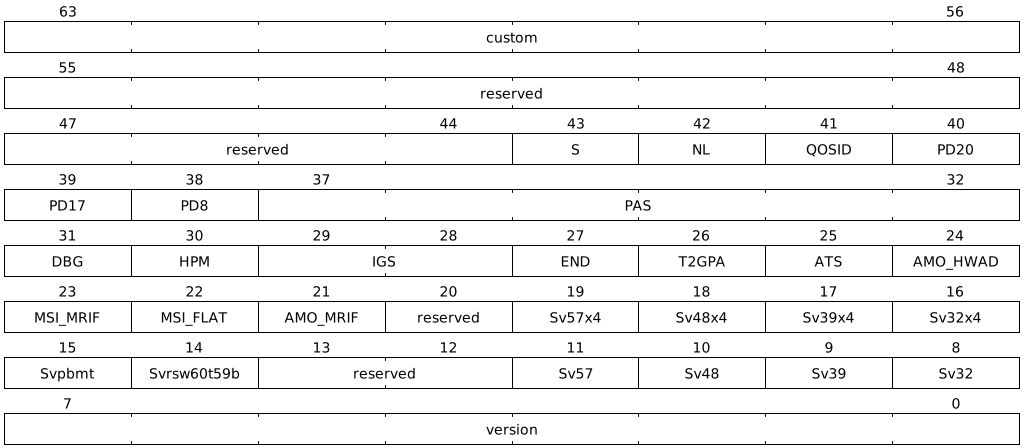
The capabilities register is a read-only register reporting features supported
by the IOMMU. Each field if not clear indicates the presence of that feature in
the IOMMU. At reset, the register shall contain the IOMMU supported features.
| Bits | Field | Attribute | Description |
|---|---|---|---|
| 7:0 | version | RO | The version field holds the version of the specification implemented by the IOMMU. The low nibble is used to hold the minor version of the specification and the upper nibble is used to hold the major version of the specification. For example, an implementation that supports version 1.0 of the specification reports 0x10. |
| 8 | Sv32 | RO | Page-based 32-bit virtual addressing is supported. |
| 9 | Sv39 | RO | Page-based 39-bit virtual addressing is supported. |
| 10 | Sv48 | RO | When Sv48 is set, Sv39 must be set. |
| 11 | Sv57 | RO | When Sv57 is set, Sv48 must be set. |
| 13:12 | reserved | RO | Reserved for standard use. |
| 14 | Svrsw60t59b | RO | PTE Reserved-for-Software Bits 60-59. |
| 15 | Svpbmt | RO | Page-based memory types. |
| 16 | Sv32x4 | RO | Page-based 34-bit virtual addressing for second-stage address translation is supported. |
| 17 | Sv39x4 | RO | Page-based 41-bit virtual addressing for second-stage address translation is supported. |
| 18 | Sv48x4 | RO | Page-based 50-bit virtual addressing for second-stage address translation is supported. |
| 19 | Sv57x4 | RO | Page-based 59-bit virtual addressing for second-stage address translation is supported. |
| 20 | reserved | RO | Reserved for standard use. |
| 21 | AMO_MRIF | RO | Atomic updates to MRIF is supported. |
| 22 | MSI_FLAT | RO | MSI address translation using Pass-through mode MSI PTE is supported. |
| 23 | MSI_MRIF | RO | MSI address translation using MRIF mode MSI PTE is supported. |
| 24 | AMO_HWAD | RO | Atomic updates to PTE accessed (A) and dirty (D) bit is supported. |
| 25 | ATS | RO | PCIe Address Translation Services (ATS) and page-request interface (PRI) [5] is supported. |
| 26 | T2GPA | RO | Returning guest-physical-address in ATS translation completions is supported. |
| 27 | END | RO | When 0, IOMMU supports one endianness (either little or big). When 1, IOMMU supports both endianness. The endianness is defined in the fctl register. |
| 29:28 | IGS | RO | IOMMU interrupt generation support. | Value | Name | Description | | --- | --- | --- | | 0 | MSI | IOMMU supports only message- signaled-interrupt generation. | | 1 | WSI | IOMMU supports only wire- signaled-interrupt generation. | | 2 | BOTH | IOMMU supports both MSI and WSI generation. The interrupt generation method must be defined in the fctl register. | | 3 | 0 | Reserved for standard use | |
| 30 | HPM | RO | IOMMU implements a hardware performance monitor. |
| 31 | DBG | RO | IOMMU supports the translation-request interface |
| 37:32 | PAS | RO | Physical Address Size supported by the IOMMU. |
| 38 | PD8 | RO | One level PDT with 8-bit process_id supported. |
| 39 | PD17 | RO | Two level PDT with 17-bit process_id supported. |
| 40 | PD20 | RO | Three level PDT with 20-bit process_id supported. |
| 41 | QOSID | RO | Associating QoS IDs with requests is supported. |
| 42 | NL | RO | Non-leaf PTE invalidation extension is supported. |
| 43 | S | RO | Address range invalidation extension is supported. |
| 55:44 | reserved | RO | Reserved for standard use. |
| 63:56 | custom | RO | Designated for custom use. |
When HPM is 1, the iohpmcycles and the iohpmctr1 registers must be present
and be at least 32-bits wide.
At least one method, MSI or WSI, of generating interrupts from the IOMMU
must be supported.
IOMMU implementations must support the Svnapot standard extension for NAPOT Translation Contiguity.
The physical address space addressable by the IOMMU ranges from 0 to .
Hypervisor may provide an SW emulated IOMMU to allow the guest to manage the first-stage page tables for fine grained control on memory accessed by guest controlled devices.
A hypervisor that provides such an emulated IOMMU to the guest may retain
control of the second-stage address translation and clear the SvNx4 fields of
the emulated capabilities register.
A hypervisor that provides such an emulated IOMMU to the guest may retain
control of the MSI page tables used to direct MSIs to guest interrupt files in
an IMSIC or to a memory-resident-interrupt-file and clear the MSI_FLAT and
MSI_MRIF fields of the emulated capabilities register.
The AMO_HWAD/AMO_MRIF bits do not indicate support for device-initiated atomic memory
operations. Support for device-initiated atomic memory operations must be
discovered through other means.
The IOMMU is designed to provide a highly modular and extensible set of capabilities allowing implementations to include only the exact set of capabilities required for an application. In addition, implementations may add their own custom extensions to the IOMMU.
The IOMMU must support all the virtual memory extensions that are supported by any of the harts in the system.
RISC-V platform specifications may mandate a set of IOMMU capabilities that must be provided by an implementation to be compliant to those specifications.
6.4 Features-control register (fctl)
This register must be readable in any implementation. An implementation may allow one or more fields in the register to be writable to support enabling or disabling the feature controlled by that field.
If software enables or disables a feature when the IOMMU is not OFF
(i.e. when ddtp.iommu_mode != Off) then the IOMMU behavior is UNSPECIFIED.
If software enables or disables a feature when the IOMMU in-memory queues
are enabled (i.e. cqcsr.cqon/cqen == 1, fqcsr.fqon/fqen == 1, or
pqcsr.pqon/pqen == 1) then the IOMMU behavior is UNSPECIFIED.

| Bits | Field | Attribute | Description |
|---|---|---|---|
| 0 | BE | WARL | When 0, IOMMU accesses to memory resident data structures, as specified in Table 9, accesses made by the IOMMU during command processing or for MSI generation, and accesses to in-memory queues are performed as little-endian accesses and when 1 as big-endian accesses. |
| 1 | WSI | WARL | When 1, IOMMU interrupts are signaled as wire-signaled-interrupts else they are signaled as message-signaled-interrupts. |
| 2 | GXL | WARL | Controls the address-translation schemes that may be used for guest physical addresses as defined in Table 2 and Table 3. |
| 15:3 | reserved | WPRI | Reserved for standard use. |
| 31:16 | custom | WPRI | Designated for custom use. |
6.5 Device-directory-table pointer (ddtp)
| Bits | Field | Attribute | Description |
|---|---|---|---|
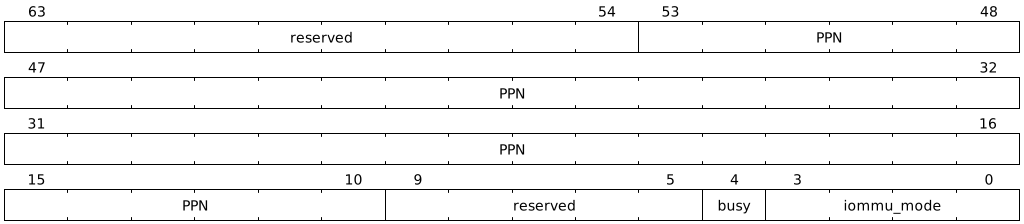
| 3:0 | iommu_mode | WARL | The IOMMU may be configured to be in the following modes: | Value | Name | Description | | --- | --- | --- | | 0 | Off | No inbound memory transactions are allowed by the IOMMU. | | 1 | Bare | No translation or protection. All inbound memory accesses are passed through. | | 2 | 1LVL | One-level device-directory-table | | 3 | 2LVL | Two-level device-directory-table | | 4 | 3LVL | Three-level device-directory-table | | 5-13 | reserved | Reserved for standard use. | | 14-15 | custom | Designated for custom use. | |
| 4 | busy | RO | A write to ddtp.iommu_mode may require the IOMMU to perform many operations that may not occur synchronously to the write. When a write is observed by the ddtp.iommu_mode, the busy bit is set to 1. When the busy bit is 1, behavior of additional writes to the ddtp is UNSPECIFIED. Some implementations may ignore the second write and others may perform the actions determined by the second write. Software must verify that the busy If the busy bit reads 0 then the IOMMU has completed the operations associated with the An IOMMU that can complete these operations synchronously may hard-wire this bit to 0. |
| 9:5 | reserved | WPRI | Reserved for standard use |
| 53:10 | PPN | WARL | Holds the PPN of the root page of the device-directory-table. |
| 63:54 | reserved | WPRI | Reserved for standard use |
The device-context is 64-bytes in size if capabilities.MSI_FLAT is 1 else it is
32-bytes.
When the iommu_mode is Bare or Off, the PPN field is don’t-care. When
in Bare mode only Untranslated requests are allowed. Translated requests,
Translation request, and PCIe message transactions are unsupported.
All IOMMUs must support Off and Bare mode. An IOMMU is allowed to support a
subset of directory-table levels and device-context widths. At a minimum one
of the modes must be supported.
When the iommu_mode field value is changed to Off the IOMMU guarantees that
in-flight transactions, observed at the time of the write to this field, from devices
connected to the IOMMU will either be processed with the configurations
applicable to the old value of the iommu_mode field or be aborted
(Section 8.3). It also ensures that all transactions and previous
requests from devices that have already been processed by the IOMMU are committed
to a global ordering point such that they can be observed by all RISC-V harts,
devices, and IOMMUs in the platform. Software must not change the PPN field
value when transitioning the iommu_mode to Off.
The IOMMU behavior of writing iommu_mode to 1LVL, 2LVL, or 3LVL, when
the previous value of the iommu_mode is not Off or Bare is UNSPECIFIED.
To change DDT levels, the IOMMU must first be transitioned to Bare or Off
state. The behavior resulting from changing the iommu_mode to Bare when the
previous value of the iommu_mode was not Off is UNSPECIFIED.
When an IOMMU is transitioned to Bare or Off state, the IOMMU may retain
information cached from in-memory data structures such as page tables, DDT,
PDT, etc. Software must use suitable invalidation commands to invalidate cached
entries.
In RV32, only the low order 32-bits of the register (22-bit PPN and
4-bit iommu_mode) need to be written.
6.6 Command-queue base (cqb)
This 64-bit register (RW) holds the PPN of the root page of the command-queue and number of entries in the queue. Each command is 16 bytes.
The IOMMU behavior on writing cqb when cqcsr.busy or cqon bits are 1 is
UNSPECIFIED. The software recommended sequence to change cqb is to first
disable the command-queue by clearing cqen and wait for both cqcsr.busy and
cqon to be 0 before changing the cqb. The status of bits 31:cqb.LOG2SZ in
cqt following a write to cqb is 0 and the bits cqb.LOG2SZ-1:0 in cqt
assume a valid but otherwise UNSPECIFIED value.

| Bits | Field | Attribute | Description |
|---|---|---|---|
| 4:0 | LOG2SZ-1 | WARL | The LOG2SZ-1 field holds the number of entries in command-queue as a log to base 2 minus 1. A value of 0 indicates a queue of 2 entries. Each IOMMU command is 16-bytes. If the command-queue has 256 or fewer entries then the base address of the queue is always aligned to 4-KiB. If the command-queue has more than 256 entries then the command-queue base address must be naturally aligned to 2<sup>LOG2SZ</sup> x 16. |
| 9:5 | reserved | WPRI | Reserved for standard use |
| 53:10 | PPN | WARL | Holds the PPN of the root page of the in-memory command-queue used by software to queue commands to the IOMMU. If the base address as determined by PPN is not aligned as required, all entries in the queue appear to an IOMMU as UNSPECIFIED and any address an IOMMU may compute and use for accessing an entry in the queue is also UNSPECIFIED. |
| 63:54 | reserved | WPRI | Reserved for standard use |
In RV32, only the low order 32-bits of the register (22-bit PPN and
5-bit LOG2SZ-1) need to be written.
6.7 Command-queue head (cqh)
This 32-bit register (RO) holds the index into the command-queue where the IOMMU will fetch the next command.

| Bits | Field | Attribute | Description |
|---|---|---|---|
| 31:0 | index | RO | Holds the index into the command-queue from where the next command will be fetched by the IOMMU. |
6.8 Command-queue tail (cqt)
This 32-bit register (RW) holds the index into the command-queue where the software queues the next command for the IOMMU.
| Bits | Field | Attribute | Description |
|---|---|---|---|
| 31:0 | index | WARL | Holds the index into the command-queue where software queues the next command for IOMMU. Only LOG2SZ-1:0 bits are writable. |
6.9 Fault queue base (fqb)
This 64-bit register (RW) holds the PPN of the root page of the fault-queue and number of entries in the queue. Each fault record is 32 bytes.
The IOMMU behavior on writing fqb when fqcsr.busy or fqon bits are 1 is
UNSPECIFIED. The software recommended sequence to change fqb is to first
disable the fault-queue by clearing fqen and wait for both fqcsr.busy and
fqon to be 0 before changing the fqb. The status of bits 31:fqb.LOG2SZ
in fqh following a write to fqb is 0 and the bits fqb.LOG2SZ-1:0 in fqh
assume a valid but otherwise UNSPECIFIED value.

| Bits | Field | Attribute | Description |
|---|---|---|---|
| 4:0 | LOG2SZ-1 | WARL | The LOG2SZ-1 field holds the number of entries in the fault-queue as a log-to-base-2 minus 1. A value of 0 indicates a queue of 2 entries. Each fault record is 32-bytes. If the fault-queue has 128 or fewer entries then the base address of the queue is always aligned to 4-KiB. If the fault-queue has more than 128 entries then the fault-queue base address must be naturally aligned to 2<sup>LOG2SZ</sup> x 32. |
| 9:5 | reserved | WPRI | Reserved for standard use |
| 53:10 | PPN | WARL | Holds the PPN of the root page of the in-memory fault-queue used by IOMMU to queue fault record. If the base address as determined by PPN is not aligned as required, all entries in the queue appear to an IOMMU as UNSPECIFIED and any address an IOMMU may compute and use for accessing an entry in the queue is also UNSPECIFIED. |
| 63:54 | reserved | WPRI | Reserved for standard use |
In RV32, only the low order 32-bits of the register (22-bit PPN and
5-bit LOG2SZ-1) need to be written.
6.10 Fault queue head (fqh)
This 32-bit register (RW) holds the index into the fault-queue where the software will fetch the next fault record.
| Bits | Field | Attribute | Description |
|---|---|---|---|
| 31:0 | index | WARL | Holds the index into the fault-queue from which software reads the next fault record. Only LOG2SZ-1:0 bits are writable. |
6.11 Fault queue tail (fqt)
This 32-bit register (RO) holds the index into the fault-queue where the IOMMU queues the next fault record.
| Bits | Field | Attribute | Description |
|---|---|---|---|
| 31:0 | index | RO | Holds the index into the fault-queue where IOMMU writes the next fault record. |
6.12 Page-request-queue base (pqb)
This 64-bit register (WARL) holds the PPN of the root page of the page-request-queue and number of entries in the queue. Each "Page Request" message is 16 bytes.
The IOMMU behavior on writing pqb when pqcsr.busy or pqon bits are 1 is
UNSPECIFIED. The software recommended sequence to change pqb is to first
disable the page-request-queue by clearing pqen and wait for both pqcsr.busy
and pqon to be 0 before changing the pqb. The status of bits 31:pqb.LOG2SZ
in pqh following a write to pqb is 0 and the bits pqb.LOG2SZ-1:0 in pqh
assume a valid but otherwise UNSPECIFIED value.

| Bits | Field | Attribute | Description |
|---|---|---|---|
| 4:0 | LOG2SZ-1 | WARL | The LOG2SZ-1 field holds the number of entries in the page-request-queue as a log-to-base-2 minus 1. A value of 0 indicates a queue of 2 entries. Each page-request is 16-bytes. If the page-request-queue has 256 or fewer entries then the base address of the queue is always aligned to 4-KiB. If the page-request-queue has more than 256 entries then the page-request-queue base address must be naturally aligned to 2<sup>LOG2SZ</sup> x 16. |
| 9:5 | reserved | WPRI | Reserved for standard use |
| 53:10 | PPN | WARL | Holds the PPN of the root page of the in-memory page-request-queue used by IOMMU to queue "Page Request" messages. If the base address as determined by PPN is not aligned as required, all entries in the queue appear to an IOMMU as UNSPECIFIED and any address an IOMMU may compute and use for accessing an entry in the queue is also UNSPECIFIED. |
| 63:54 | reserved | WPRI | Reserved for standard use |
In RV32, only the low order 32-bits of the register (22-bit PPN and
5-bit LOG2SZ-1) need to be written.
6.13 Page-request-queue head (pqh)
This 32-bit register (RW) holds the index into the page-request-queue where software will fetch the next page-request.
| Bits | Field | Attribute | Description |
|---|---|---|---|
| 31:0 | index | WARL | Holds the index into the page-request-queue from which software reads the next "Page Request" message. Only LOG2SZ-1:0 bits are writable. |
6.14 Page-request-queue tail (pqt)
This 32-bit register (RO) holds the index into the page-request-queue where the IOMMU writes the next page-request.
| Bits | Field | Attribute | Description |
|---|---|---|---|
| 31:0 | index | RO | Holds the index into the page-request-queue where IOMMU writes the next "Page Request" message. |
6.15 Command-queue CSR (cqcsr)
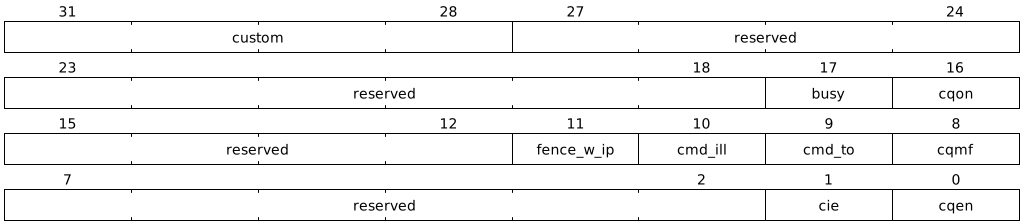
This 32-bit register (RW) is used to control the operations and report the status of the command-queue.
| Bits | Field | Attribute | Description |
|---|---|---|---|
| 0 | cqen | RW | The command-queue-enable bit enables the command- Changing cqen from 0 to 1 sets the cqh register and the cqcsr bits cmd_ill,cmd_to, cqmf, fence_w_ip to 0. The command-queue may take some time to be active following setting the cqen to 1. During this delay the busy bit is 1. When the command queue is active, the cqon bit When cqen is changed from 1 to 0, the command queue may stay active (with busy asserted) until the commands already fetched from the command-queue are being processed and/or there are outstanding implicit loads from the command-queue. When the command-queue turns off the cqon bit reads 0. When the cqon bit reads 0, the IOMMU guarantees that no implicit memory accesses to the command queue are in-flight and the command-queue will not generate new implicit loads to the queue memory. |
| 1 | cie | RW | Command-queue-interrupt-enable bit enables generation of interrupts from command-queue when set to 1. |
| 7:2 | reserved | WPRI | Reserved for standard use |
| 8 | cqmf | RW1C | If command-queue access to fetch a command or a memory access made by a command leads to a memory fault, then the command-queue-memory-fault bit is set to 1, and the command-queue stalls until this bit is cleared. To re-enable command processing, software should clear this bit by writing 1. |
| 9 | cmd_to | RW1C | If the execution of a command leads to a timeout (e.g. a command to invalidate device ATC may timeout waiting for a completion), then the command-queue sets the cmd_to bit and stops processing from the command-queue. To re-enable command processing, software should clear this bit by writing 1. |
| 10 | cmd_ill | RW1C | If an illegal or unsupported command is fetched and decoded by the command-queue then the command-queue sets the cmd_ill bit and stops processing from the command-queue. To re-enable command processing software should clear this bit by writing 1. |
| 11 | fence_w_ip | RW1C | An IOMMU that supports wire-signaled-interrupts sets the fence_w_ip bit to indicate completion of an IOFENCE.C command. To re-enable interrupts on IOFENCE.C completion, software should clear this bit by writing 1. This bit is reserved if the IOMMU does not support wire-signaled-interrupts or wire-signaled-interrupts are not enabled (i.e., fctl.WSI == 0). |
| 15:12 | reserved | WPRI | Reserved for standard use |
| 16 | cqon | RO | The command-queue is active if cqon is 1. |
| 17 | busy | RO | A write to cqcsr may require the IOMMU to perform many operations that may not occur synchronously to the write. When a write is observed by the When the busy bit is 1, behavior of additional writes to the cqcsr is UNSPECIFIED. Some implementations may ignore the second write and others may perform the actions determined by the Software must verify that the busy bit is 0 before An IOMMU that can complete these operations synchronously may hard-wire this bit to 0. |
| 27:18 | reserved | WPRI | Reserved for standard use. |
| 31:28 | custom | WPRI | Designated for custom use. |
When cmd_ill or cqmf is 1 in cqcsr, the cqh references the command in the
CQ that caused the error. Previous commands may have completed, timed out, or
their execution aborted by the IOMMU.
If software makes the CQ operational again after a cmd_ill or cqmf error,
then software should resubmit the commands submitted since the last IOFENCE.C
that successfully completed.
The cmd_to bit is set when a IOFENCE.C command detects that one or more
previous commands that are specified to have timeouts have timed out but all
other commands previous to the IOFENCE.C have completed. When cmd_to is 1,
cqh references the IOFENCE.C command that detected the timeout.
Command-queue being empty does not imply that all commands fetched from the
command-queue have been completed. When the command-queue is requested to be
disabled, an implementation may either complete the already fetched commands
or abort execution of those commands. Software must use an IOFENCE.C command
to wait for all previous commands to be committed, if so desired, before
turning off the command-queue.
6.16 Fault queue CSR (fqcsr)
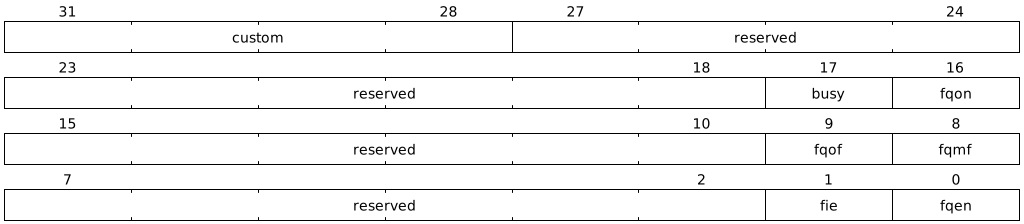
This 32-bit register (RW) is used to control the operations and report the status of the fault-queue.
| Bits | Field | Attribute | Description |
|---|---|---|---|
| 0 | fqen | RW | The fault-queue enable bit enables the fault-queue Changing fqen from 0 to 1 sets the fqt register and the fqcsr bits fqof and fqmf to 0. The fault-queue may take some time to be active following setting the fqen to 1. During this delay the busy bit is 1. When the fault queue is active, When fqen is changed from 1 to 0, the fault-queue may stay active (with busy asserted) until in-flight fault-recording is completed. When the fault-queue is off the fqon bit reads 0. When fqon reads 0, the IOMMU guarantees that there are no in-flight implicit writes to the fault-queue in progress and that no new fault records will be written to the fault-queue. |
| 1 | fie | RW | Fault queue interrupt enable bit enables generation of interrupts from fault-queue when set to 1. |
| 7:2 | reserved | WPRI | Reserved for standard use |
| 8 | fqmf | RW1C | The fqmf bit is set to 1 if the IOMMU encounters an access fault when storing a fault record to the fault queue. The fault-record that was attempted to be written is discarded and no more fault records are generated until software clears the fqmf bit by writing 1 to the bit. |
| 9 | fqof | RW1C | The fault-queue-overflow bit is set to 1 if the IOMMU needs to queue a fault record but the The fault-record is discarded and no more fault records are generated until software clears fqof by writing 1 to the bit. |
| 15:10 | reserved | WPRI | Reserved for standard use |
| 16 | fqon | RO | The fault-queue is active if fqon reads 1. |
| 17 | busy | RO | Write to fqcsr may require the IOMMU to perform many operations that may not occur synchronously to the write. When a write is observed by the fqcsr, the busy bit is set to 1. When the busy bit is 1, behavior of additional writes to the fqcsr are UNSPECIFIED. Some implementations may ignore the second write and others may perform the Software should ensure that the busy bit is 0 An IOMMU that can complete controls synchronously may hard-wire this bit to 0. |
| 27:18 | reserved | WPRI | Reserved for standard use. |
| 31:28 | custom | WPRI | Designated for custom use. |
6.17 Page-request-queue CSR (pqcsr)
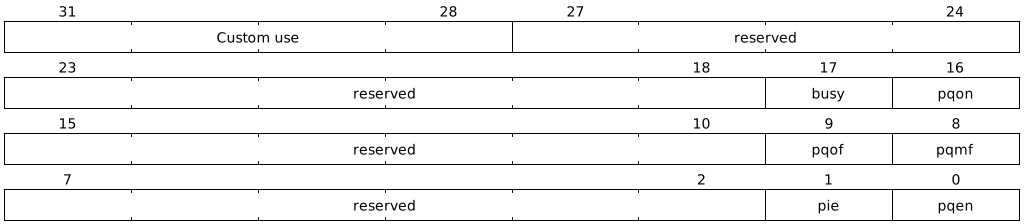
This 32-bit register (RW) is used to control the operations and report the status of the page-request-queue.
| Bits | Field | Attribute | Description |
|---|---|---|---|
| 0 | pqen | RW | The page-request-enable bit enables the Changing pqen from 0 to 1, sets the pqt register and the pqcsr bits pqmf and pqof to 0. The page-request-queue may take some time to be active following setting the pqen to 1. During this delay the busy bit is 1. When the page-request-queue is active, the pqon bit When pqen is changed from 1 to 0, the page-request-queue may stay active (with busy asserted) until in-flight page-request writes are completed. When the page-request-queue turns off, When pqon reads 0, the IOMMU guarantees that there are no older in-flight implicit writes to the queue memory and no further implicit writes The IOMMU may respond to “Page Request” messages received when page-request-queue is off or in the process of being turned off, as specified in Section 3.7. |
| 1 | pie | RW | The page-request-queue-interrupt-enable bit when set to 1, enables generation of interrupts from page-request-queue. |
| 7:2 | reserved | WPRI | Reserved for standard use |
| 8 | pqmf | RW1C | The pqmf bit is set to 1 if the IOMMU encounters an access fault when storing a The "Page Request" message that caused the pqmf or pqof error and all subsequent "Page Request" messages are discarded until software clears the The IOMMU may respond to “Page Request” messages that caused the pqof or pqmf bit to be set and all subsequent “Page Request” messages received while these bits are 1 as specified in Section 3.7. |
| 9 | pqof | RW1C | The page-request-queue-overflow bit is set to 1 if the page-request queue overflows i.e. IOMMU needs to queue a "Page Request" message but the page-request queue is full The "Page Request" message that caused the pqmf or pqof error and all subsequent "Page Request" messages are discarded until software clears the The IOMMU may respond to “Page Request” messages that caused the pqof or pqmf bit to be set and all subsequent “Page Request” messages received while these bits are 1 as specified in Section 3.7. |
| 15:10 | reserved | WPRI | Reserved for standard use |
| 16 | pqon | RO | |
| 17 | busy | RO | A write to pqcsr may require the IOMMU to perform many operations that may not occur synchronously to the write. When a write is observed by the pqcsr, the busy bit is set When the busy bit is 1, behavior of additional writes to the pqcsr are UNSPECIFIED. Some implementations may ignore the second write and others may perform the actions determined by the second write. Software should ensure that the An IOMMU that can complete controls synchronously may hard-wire this bit to 0 |
| 27:18 | reserved | WPRI | Reserved for standard use |
| 31:28 | custom | WPRI | Designated for custom use. |
6.18 Interrupt pending status register (ipsr)
This 32-bit register (RW1C) reports the pending interrupts which require software service. Each interrupt-pending bit in the register corresponds to a interrupt source in the IOMMU. The interrupt-pending bit in the register once set to 1 stays 1 till software clears that interrupt-pending bit by writing 1 to clear it.
When fctl.WSI is 1, the interrupt-pending bit drives the wire selected by
the corresponding icvec field to signal an interrupt.
When fctl.WSI is 0, the IOMMU signals interrupts using messages. MSI have edge
semantics and an interrupt message is generated when an interrupt-pending bit
transitions from 0 to 1. The address and data for the message are obtained from
the msi_cfg_tbl entry selected by the icvec field corresponding to the
interrupt-pending bit.

Table 16. Interrupt pending status register fields
| Bits | Field | Attribute | Description |
|---|---|---|---|
| 0 | cip | RW1C | The command-queue-interrupt-pending bit is set to 1 if cqcsr.cie is 1 and any of the following are true: - cqcsr.fence_w_ip is 1. - cqcsr.cmd_ill is 1. - cqcsr.cmd_to is 1. - cqcsr.cqmf is 1. |
| 1 | fip | RW1C | The fault-queue-interrupt-pending bit is set to 1 if fqcsr.fie is 1 and any of the following are true: - fqcsr.fqof is 1. - fqcsr.fqmf is 1. - A new record is produced in the FQ. |
| 2 | pmip | RW1C | The performance-monitoring-interrupt-pending bit is set to 1 when the OF bit in iohpmcycles or in any of the iohpmevt1-31 registers transitions from 0 to 1 due to a counter overflow. |
| 3 | pip | RW1C | The page-request-queue-interrupt-pending is set to 1 if pqcsr.pie is 1 and any of the following are true: - pqcsr.pqof is 1. - pqcsr.pqmf is 1. - A new message is produced in the PQ. |
| 7:4 | reserved | WPRI | Reserved for standard use. |
| 15:8 | custom | WPRI | Designated for custom use. |
| 31:16 | reserved | WPRI | Reserved for standard use |
If a bit in ipsr is 1 then a write of 1 to the bit transitions the bit from 1→0.
If the conditions to set that bit are still present (See Table 16) or if
they occur after the bit is cleared then that bit transitions again from 0→1.
6.19 Performance-monitoring counter overflow status (iocountovf)
The performance-monitoring counter overflow status is a 32-bit read-only
register that contains shadow copies of the OF bits in the iohpmevt1-31
registers - where iocountovf bit X corresponds to iohpmevtX and bit 0
corresponds to the OF bit of iohpmcycles.
This register enables overflow interrupt handler software to quickly and easily determine which counter(s) have overflowed.

| Bits | Field | Attribute | Description |
|---|---|---|---|
| 0 | CY | RO | Shadow of iohpmcycles.OF |
| 31:1 | HPM | RO | Shadow of iohpmevt[1-31].OF |
6.20 Performance-monitoring counter inhibits (iocountinh)
The performance-monitoring counter inhibits is a 32-bit WARL register
that contains bits to inhibit the corresponding counters from counting. Bit X
when set inhibits counting in iohpmctrX and bit 0 inhibits counting in
iohpmcycles.
| Bits | Field | Attribute | Description |
|---|---|---|---|
| 0 | CY | RW | When set, iohpmcycles counter is inhibited from counting. |
| 31:1 | HPM | WARL | When bit X is set, then counting of events in iohpmctrX is inhibited. |
When the iohpmcycles counter is not needed, it is desirable to conditionally
inhibit it to reduce energy consumption. Providing a single register to
inhibit all counters allows a) one or more counters to be atomically programmed
with events to count b) one or more counters to be sampled atomically.
To initialize an event counter or the cycles counter to a desired value, it should be first inhibited if it is enabled to count. This measure ensures that it does not count during the update process. The inhibition should be removed after the register has been programmed with the desired value.
6.21 Performance-monitoring cycles counter (iohpmcycles)
This 64-bit register is a free running clock cycle counter.
There is no associated iohpmevt0.

| Bits | Field | Attribute | Description |
|---|---|---|---|
| 62:0 | counter | WARL | Cycles counter value. |
| 63 | OF | RW | Overflow |
The OF bit is set when the iohpmcycles counter overflows, and remains set
until cleared by software. Since iohpmcycles value is an unsigned value,
overflow is defined as unsigned overflow. Note that there is no loss of
information after an overflow since the counter wraps around and keeps counting
while the sticky OF bit remains set.
If the iohpmcycles counter overflows when the OF bit is zero, then a HPM
Counter Overflow interrupt is generated by setting ipsr.pmip bit to 1. If
the OF bit is already one, then no interrupt request is generated. Consequently
the OF bit also functions as a count overflow interrupt disable for the
iohpmcycles.
6.22 Performance-monitoring event counters (iohpmctr1-31)
These registers are 64-bit WARL counter registers.

| Bits | Field | Attribute | Description |
|---|---|---|---|
| 63:0 | counter | WARL | Event counter value. |
6.23 Performance-monitoring event selectors (iohpmevt1-31)
These performance-monitoring event registers are 64-bit RW registers. When a
transaction processed by the IOMMU causes an event that is programmed to count
in a counter then the counter is incremented. In addition to matching events,
the event selector may be programmed with additional filters based on
device_id, process_id, GSCID, and PSCID such that the counter is
incremented conditionally based on the transaction matching these additional
filters. When such device_id based filtering is used, the match may be
configured to be a precise match or a partial match. A partial match allows
transactions with a range of IDs to be counted by the counter.
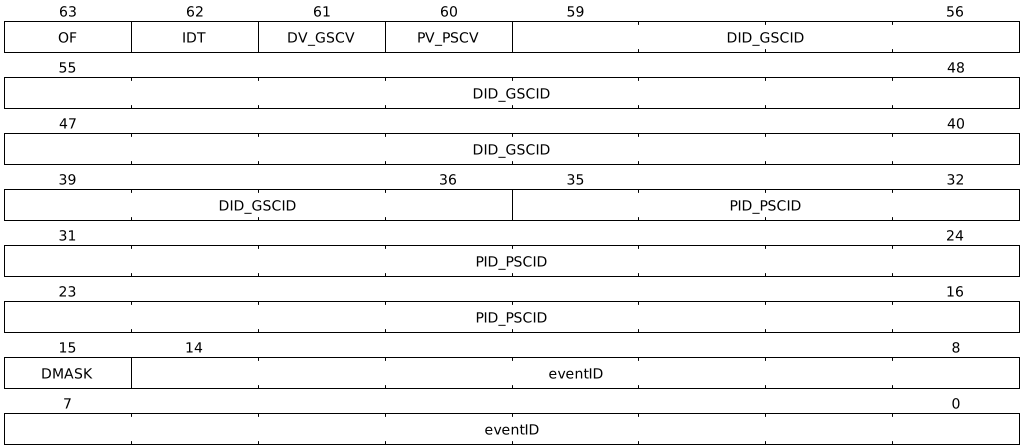
| Bits | Field | Attribute | Description |
|---|---|---|---|
| 14:0 | eventID | WARL | Indicates the event to count. A value of 0 Encodings 1 to 16383 are reserved for standard Encodings 16384 to 32767 are for designated for When eventID is changed, including to 0, the counter retains its value. |
| 15 | DMASK | RW | When set to 1, partial matching of the DID_GSCID is performed for the transaction. The lower bits of the DID_GSCID all the way to the first low order 0 bit (including the 0 bit position itself) are masked. |
| 35:16 | PID_PSCID | RW | process_id if IDT is 0, PSCID if IDT is 1 |
| 59:36 | DID_GSCID | RW | device_id if IDT is 0, GSCID if IDT is 1. |
| 60 | PV_PSCV | RW | If set, only transactions with matching process_id or PSCID (based on the Filter ID Type) are counted. |
| 61 | DV_GSCV | RW | If set, only transactions with matching device_id or GSCID (based on the Filter ID Type) are counted. |
| 62 | IDT | RW | Filter ID Type: This field indicates the type of ID to filter on. When 0, the DID_GSCID field holds a device_id and the PID_PSCID field holds a process_id. When 1, the DID_GSCID field holds a GSCID and PID_PSCID field holds a PSCID. |
| 63 | OF | RW | Overflow status or Interrupt disable |
The table below summarizes the filtering option for events that support filtering by IDs.
Table 17. filtering options
IDT | DV_GSCV | PV_PSCV | Operation |
|---|---|---|---|
| 0/1 | 0 | 0 | Counter increments. No ID based filtering. |
| 0 | 0 | 1 | If the transaction has a valid process_id, counter increments if process_id matches PID_PSCID. |
| 0 | 1 | 0 | Counter increments if device_id matches DID_GSCID. |
| 0 | 1 | 1 | If the transaction has a valid process_id, counter increments if device_id matches DID_GSCID and process_id matches PID_PSCID. |
| 1 | 0 | 1 | If the transaction has a valid PSCID, counter increments if the PSCID of that process matches PID_PSCID. |
| 1 | 1 | 0 | Counter increments if GSCID is valid and matches DID_GSCID. |
| 1 | 1 | 1 | Counter increments if GSCID is valid and matches DID_GSCID and if PSCID is valid and matches PID_PSCID. |
When filtering by device_id or GSCID is selected and the event supports
ID based filtering, the DMASK field can be used to configure a partial match.
When DMASK is set to 1, partial matching of the DID_GSCID is performed for
the transaction. The lower bits of the DID_GSCID all the way to the first
low order 0 bit (including the 0 bit position itself) are masked.
The following example illustrates the use of DMASK and filtering by device_id.
Table 18. DMASK with IDT set to device_id based filtering
DMASK | DID_GSCID | Comment |
|---|---|---|
| 0 | yyyyyyyy yyyyyyyy yyyyyyyy | One specific seg🚌dev:func |
| 1 | yyyyyyyy yyyyyyyy yyyyy011 | seg:bus:dev - any func |
| 1 | yyyyyyyy yyyyyyyy 01111111 | seg:bus - any dev:func |
| 1 | yyyyyyyy 01111111 11111111 | seg - any bus:dev:func |
The following table lists the standard events that can be counted:
Table 19. Standard Events list
| eventID | Event counted | IDT settings supported |
|---|---|---|
| 0 | Do not count | |
| 1 | Untranslated requests | 0 |
| 2 | Translated requests | 0 |
| 3 | ATS Translation requests | 0 |
| 4 | TLB miss | 0/1 |
| 5 | Device Directory Walks | 0 |
| 6 | Process Directory Walks | 0 |
| 7 | First-stage Page Table Walks | 0/1 |
| 8 | Second-stage Page Table Walks | 0/1 |
| 9 - 16383 | reserved for future standard | - |
When the programmed IDT setting is not supported for an event then the
associated counter does not increment.
The OF bit is set when the corresponding iohpmctr1-31 counter overflows,
and remains set until cleared by software. Since iohpmctr1-31 values are
unsigned values, overflow is defined as unsigned overflow. Note that there is no
loss of information after an overflow since the counter wraps around and keeps
counting while the sticky OF bit remains set.
If a iohpmctr1-31 counter overflows when the associated OF bit is zero, then
a HPM Counter Overflow interrupt is generated by setting ipsr.pmip bit to 1. If
the OF bit is already one, then no interrupt request is generated. Consequently
the OF bit also functions as a count overflow interrupt disable for the
associated iohpmctr1-31.
There are not separate overflow status and overflow interrupt enable bits. In
practice, enabling overflow interrupt generation (by clearing the OF bit) is
done in conjunction with initializing the counter to a starting value. Once a
counter has overflowed, it and the OF bit must be reinitialized before
another overflow interrupt can be generated.
In RV32, memory-mapped writes to iohpmevt1-31 modify only one 32-bit part of
the register. The following sequence may be used to update the register without
counting events spuriously due to the intermediate value of the register:
- Write the low order 32-bits to set
eventIDto 0. - Write the high order 32-bits with the new desired values.
- Write the low order 32-bits the new desired values, including that of the
eventIDfield.
Alternatively, the counter may first be inhibited such that no events count during the update and the inhibit removed after the register has been programmed with the desired value.
If capabilities.HPM is 1 then a minimum of one programmable event counter
besides the cycles counter is required to comply with this specification. One
counter may be used in a time multiplexed manner to sample events but such
analysis may take longer to complete. The IOMMU, unlike the CPU MMU, services
multiple streams of IO and the HPM may be used by a performance analyst to
analyze one or more of those streams concurrently. Typically, a performance
analyst may require four programmable counters to count events for an IO
stream. To support concurrent analysis of at least two streams of IO it is
recommended to support seven programmable counters.
6.24 Translation-request IOVA (tr_req_iova)
The tr_req_iova is a 64-bit register used to implement a
translation-request interface for debug. This register is present when
capabilities.DBG == 1.

| Bits | Field | Attribute | Description |
|---|---|---|---|
| 11:0 | reserved | WPRI | Reserved for standard use |
| 63:12 | vpn | WARL | The IOVA virtual page number |
6.25 Translation-request control (tr_req_ctl)
The tr_req_ctl is a 64-bit WARL register used to implement a
translation-request interface for debug. This register is present when
capabilities.DBG == 1.
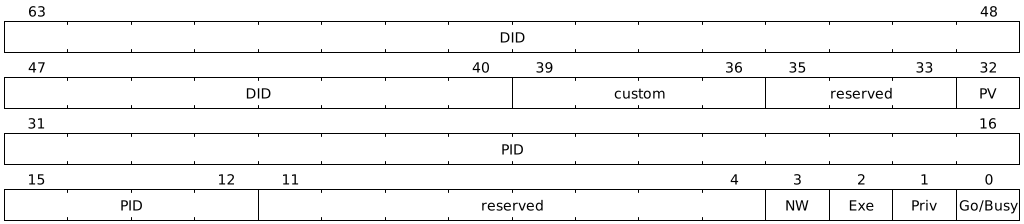
| Bits | Field | Attribute | Description |
|---|---|---|---|
| 0 | Go/Busy | RW1S | This bit is set to indicate a valid request has been setup in the tr_req_iova/tr_req_ctl registers The IOMMU indicates completion of the requested translation by clearing this bit to 0. On completion, the results of the translation are in the tr_response register. |
| 1 | Priv | WARL | If set to 1, Privileged Mode access is requested; otherwise, Privileged Mode access is not requested. When PV is 0, this field is ignored and no Privileged Mode access is requested. |
| 2 | Exe | WARL | If set to 1, execute permission is requested else execute permission is not requested. If Exe is set to 1, then NW must be also be set to 1; otherwise the behavior is UNSPECIFIED. |
| 3 | NW | WARL | If set to 1, read permission is requested. If set to 0, both read and write permissions are requested. |
| 11:4 | reserved | WPRI | Reserved for standard use |
| 31:12 | PID | WARL | If PV is 1, this field provides the process_id input for this translation request. If PV is 0 then this field is not used. |
| 32 | PV | WARL | If set to 1, the PID field of the register is valid and provides the process_id for this translation request. If set to 0 then the PID field is not used and a process_id is not valid for this translation request. |
| 35:33 | reserved | WPRI | Reserved for standard use. |
| 39:36 | custom | WPRI | Designated for custom use. |
| 63:40 | DID | WARL | This field provides the device_id for this translation request. |
In RV32, the high half of the register should be written first, followed by the
low half, which includes the Go/Busy bit, to initiate a translation.
6.26 Translation-response (tr_response)
The tr_response is a 64-bit RO register used to hold the results
of a translation requested using the translation-request interface.
This register is present when capabilities.DBG == 1.
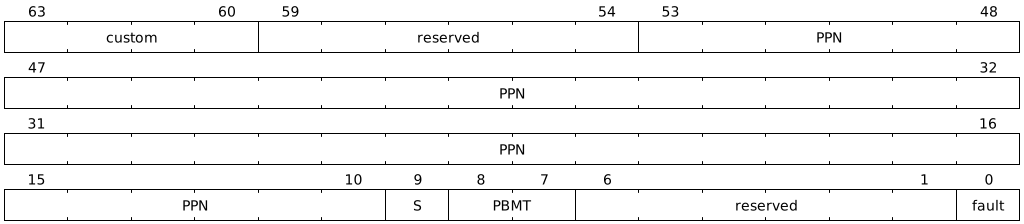
| Bits | Field | Attribute | Description |
|---|---|---|---|
| 0 | fault | RO | If the process to translate the IOVA detects a fault then the fault field is set to 1. The detected fault may be reported through the fault-queue. |
| 6:1 | reserved | RO | Reserved for standard use |
| 8:7 | PBMT | RO | Memory type determined for the translation using the PBMT fields in the first-stage and/or the second-stage page tables used for the translation. This value of this field is UNSPECIFIED if the fault field is 1. |
| 9 | S | RO | Translation range size field, when set to 1 indicates that the translation applies to a range that is larger than 4 KiB and the size of the translation range is encoded in the PPN field. The value of this field is UNSPECIFIED if the fault field is 1. |
| 53:10 | PPN | RO | If the fault bit is 0, then this field provides the PPN determined as a result of If the fault bit is 1, then the value of If the S bit is 0, then the size of the If the S bit is 1, then the translation resulted in a superpage, and the size of the superpage is encoded in the PPN itself. If scanning from bit position 0 to bit position 43, the first bit with a value of 0 at position X, then the superpage size is If X is not 0, then all bits at position 0 through X-1 are each encoded with a value of 1. Table 20. Example of encoding of super page size in PPN | S | Size | | --- | --- | --- | | yyyy…​.yyyy yyyy yyyy | 0 | 4 KiB | | yyyy…​.yyyy yyyy 0111 | 1 | 64 KiB | | yyyy…​.yyy0 1111 1111 | 1 | 2 MiB | | yyyy…​.yy01 1111 1111 | 1 | 4 MiB | |
| 59:54 | reserved | RO | Reserved for standard use. |
| 63:60 | custom | RO | Designated for custom use. |
An IOMMU implementation is not required to report a superpage translation
or support reporting all possible superpage sizes. An implementation is
allowed to report a 4 KiB translation corresponding to the requested
vpn or report a translation size that is smaller than the superpage
size configured in the page tables.
6.27 IOMMU QoS ID (iommu_qosid)
The iommu_qosid register fields are defined as follows:

| Bits | Field | Attribute | Description |
|---|---|---|---|
| 11:0 | RCID | WARL | RCID for IOMMU-initiated requests. |
| 15:12 | reserved | WPRI | Reserved for standard use. |
| 27:16 | MCID | WARL | MCID for IOMMU-initiated requests. |
| 31:28 | reserved | WPRI | Reserved for standard use. |
IOMMU-initiated requests for accessing the following data structures use the
value programmed in the RCID and MCID fields of the iommu_qosid register.
- Device directory table (
DDT) - Fault queue (
FQ) - Command queue (
CQ) - Page-request queue (
PQ) - IOMMU-initiated MSI (Message-signaled interrupts)
When ddtp.iommu_mode == Bare, all device-originated requests are
associated with the QoS IDs configured in the iommu_qosid register.
6.28 Interrupt-cause-to-vector register (icvec)
Interrupt-cause-to-vector register maps a cause to a vector. All causes can be mapped to the same vector or a cause can be given a unique vector.
The vector is used:
- By an IOMMU that generates interrupts as MSIs, to index into MSI
configuration table (
msi_cfg_tbl) to determine the MSI to generate. An IOMMU is capable of generating interrupts as a MSI ifcapabilities.IGS==MSIor ifcapabilities.IGS==BOTH. Whencapabilities.IGS==BOTHthe IOMMU may be configured to generate interrupts as MSI by settingfctl.WSIto 0. - By an IOMMU that generates WSI, to determine the wire
to signal the interrupt. An IOMMU is capable of generating wire-signaled-
interrupts if
capabilities.IGS==WSIor ifcapabilities.IGS==BOTH. Whencapabilities.IGS==BOTHthe IOMMU may be configured to generate wire-signaled- interrupts by settingfctl.WSIto 1.
If an implementation only supports a single vector then all bits of this register may be hardwired to 0 (WARL). Likewise if only two vectors are supported then only bit 0 for each cause could be writable.
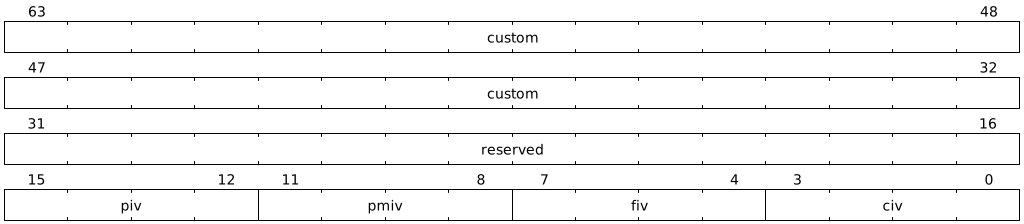
| Bits | Field | Attribute | Description |
|---|---|---|---|
| 3:0 | civ | WARL | The command-queue-interrupt-vector (civ) is the vector number assigned to the command-queue-interrupt. |
| 7:4 | fiv | WARL | The fault-queue-interrupt-vector (fiv) is the vector number assigned to the fault-queue-interrupt. |
| 11:8 | pmiv | WARL | The performance-monitoring-interrupt-vector (pmiv) is the vector number assigned to the performance-monitoring-interrupt. |
| 15:12 | piv | WARL | The page-request-queue-interrupt-vector (piv) is the vector number assigned to the page-request-queue-interrupt. |
| 31:16 | reserved | WPRI | Reserved for standard use. |
| 63:32 | custom | WPRI | Designated for custom use. |
6.29 MSI configuration table (msi_cfg_tbl)
An IOMMU that supports generating IOMMU-originated interrupts
(i.e., capabilities.IGS == MSI or capabilities.IGS == BOTH) as MSIs
implements a MSI configuration table that is indexed by the vector from icvec
to determine a MSI table entry. Each MSI table entry for interrupt vector x
has three registers msi_addr_x, msi_data_x, and msi_vec_ctl_x. These
registers are hardwired to 0 if capabilities.IGS == WSI.
If an access fault is detected on a MSI write using msi_addr_x, then the IOMMU
reports a "IOMMU MSI write access fault" (cause 273) fault, with TTYP set to 0
and iotval set to the value of msi_addr_x.
Table 21. MSI configuration table structure
| bit 63 | bit 0 | Byte Offset |
|---|---|---|
| Entry 0: Message address | +000h | |
| Entry 0: Vector Control | Entry 0: Message Data | +008h |
| Entry 1: Message address | +010h | |
| Entry 1: Vector Control | Entry 1: Message Data | +018h |
| … | +020h | |

| Bits | Field | Attribute | Description |
|---|---|---|---|
| 1:0 | 0 | RO | Fixed to 0 |
| 55:2 | ADDR | WARL | Holds the 4-byte aligned MSI address. |
| 63:56 | reserved | WPRI | Reserved for standard use. |

| Bits | Field | Attribute | Description |
|---|---|---|---|
| 31:0 | data | WARL | Holds the MSI data |

| Bits | Field | Attribute | Description |
|---|---|---|---|
| 0 | M | RW | When the mask bit M is 1, the corresponding interrupt vector is masked and the IOMMU is prohibited from sending the associated message. Pending messages for that vector are later generated if the corresponding mask bit is cleared to 0. |
| 31:1 | reserved | WPRI | Reserved for standard use. |